Supported by the European Interregional Innovation Investments (I3) Instrument, H2BLUE aims to establish an integrated value chain, from hydrogen supply to its use in maritime operations and the valorization of by-products. Over the next 36 months, engineering, feasibility, and demonstration activities will be carried out in connection with Gran Canaria, La Palma, and the Azores.
Planned activities include pilot hydrogen refueling facilities in ports, the integration of fuel cells of up to 20 kW into aquaculture support vessels, and the use of oxygen generated through electrolysis in land-based aquaculture facilities. The project aims to contribute to a reduction of up to 80% in CO2 emissions associated with fossil fuels in the maritime and port applications addressed.
H2BLUE will promote SME participation through direct financial support to third parties.
One of H2BLUE’s key features is the implementation of a Financial Support to Third Parties (FSTP) mechanism, designed to facilitate the participation of small and medium-sized enterprises (SMEs) in the development and adoption of innovative solutions related to green hydrogen and the decarbonization of the blue economy.
Through this mechanism, the project will launch open and competitive calls enabling companies outside the consortium to access funding to develop, adapt and validate technological solutions related to the hydrogen value chain, its application in maritime and port operations, and its integration into activities such as aquaculture and fisheries.
The mechanism provides for two funding calls aimed at fostering business innovation, interregional cooperation and the transfer of clean technologies to the market. Grants may reach up to €60,000 per beneficiary, subject to the specific conditions of each call, which will be launched during 2027.
Through this initiative, H2BLUE seeks to broaden the impact of its demonstration activities, facilitate the participation of new companies in the green hydrogen ecosystem and generate business opportunities for the blue economy sector, particularly in the Canary Islands and the Azores.
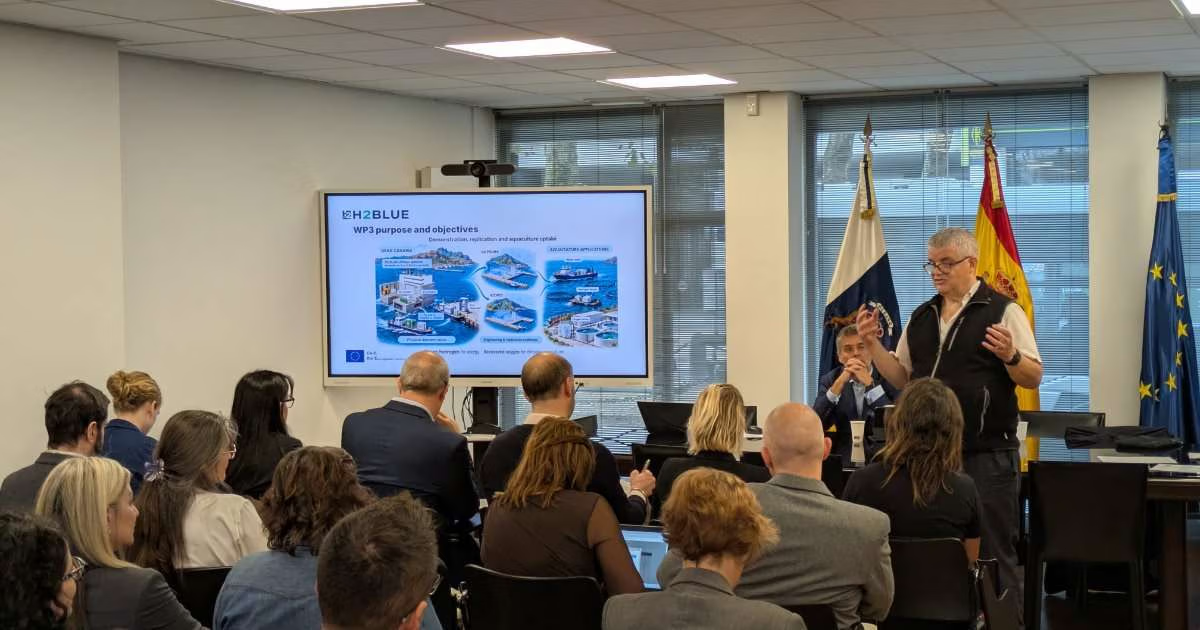
H2BLUE also held a workshop in Brussels aimed at connecting technological capabilities, business needs and future funding opportunities. The event was organized around four parallel thematic working groups, followed by a joint reporting session.
The working groups addressed renewable energy, hydrogen and decarbonization; data, artificial intelligence and the digitalization of maritime operations; ocean observation, biodiversity and responsible research and innovation; and blue food, aquaculture and multiple uses of marine space. PLOCAN staff facilitated the discussions, supported by rapporteurs from organizations participating in the H2BLUE consortium.
The workshop format was designed to enable participating organizations to present their capabilities and needs, examine European funding calls and explore project ideas, potential coordinators, partners and testing infrastructures. Each working group aimed to prioritize two or three funding calls and outline at least one potential consortium-based collaboration, with identified next steps. These objectives formed part of the workshop design and should not be interpreted as already confirmed outcomes.
The funding opportunities examined included Horizon Europe 2026–2027 calls related to marine renewable energy, maritime transport decarbonization, green ports, ocean observation and aquaculture, as well as the I3 Instrument and the Sustainable Blue Economy Partnership. The workshop also provided an opportunity to consider future partnerships in the context of the next European Union Multiannual Financial Framework for 2028–2034.
The conclusions of the working groups are expected to contribute to H2BLUE’s mapping of stakeholders and innovation ecosystems, dialogue with authorities responsible for regional smart specialization strategies, and blue economy stakeholder engagement activities. In this way, the Brussels launch combines the start of technological demonstration activities with the development of a collaborative network to extend their reach.
Following the event, the project teams will move forward with technical studies and the identification of opportunities for companies, research centers and other regional stakeholders to participate in the development and validation of clean solutions for the maritime sector.
The H2BLUE project, Integration of Green Hydrogen for the Decarbonization of the Aquaculture and Fisheries Value Chain, is coordinated by the Oceanic Platform of the Canary Islands (PLOCAN) and will run from September 1, 2026, to August 31, 2029. It has a total budget of €7,020,892.22, of which €5,514,624.56 comes from the European Union through the European Regional Development Fund (ERDF), under the Interregional Innovation Investments (I3) program, call I3-2025-INV2a, managed by the European Innovation Council and SMEs Executive Agency (EISMEA).