With support from federal agencies and private foundations alike, we advance understanding of marine “dead zones,” climate change impacts, subduction zone earthquakes, tsunamis, harmful algal blooms, wave energy potential and interactions between ocean conditions and commercial fishing stocks. In short, the college is helping people make informed choices about natural resources.
Below is a sampling of the year’s awards:
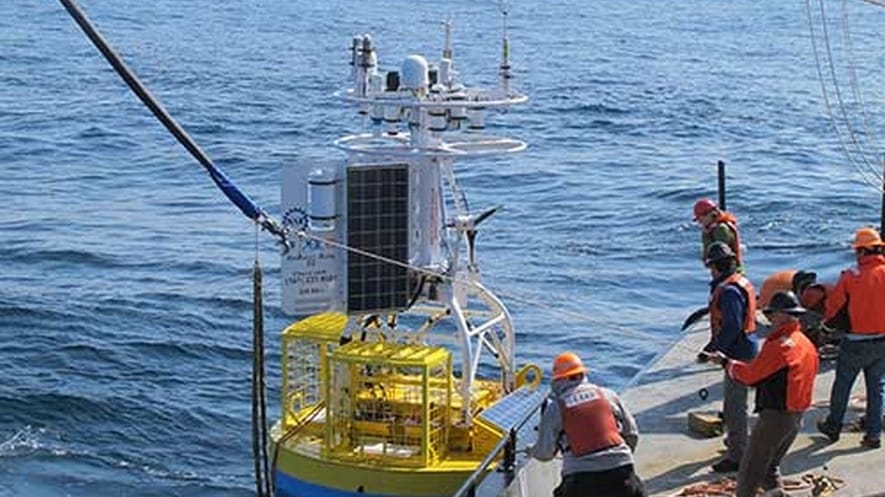
The installment of a sophisticated research buoy and two undersea gliders completes a critical step in enabling real-time monitoring and assessment of the ocean — by scientists and citizens alike.
Lead PI: Edward Dever
Funding Agency: National Science foundation
Amount: $4.1 million
Since 2007, OCCRI has served as the region’s flagship clearinghouse for climate information. The institute reported on a number of timely issues in FY15, including regional drought and wildfire risk, as well as the mass of unusually warm water off the West Coast known as “The Blob.”
Lead PI: Philip Mote
Funding Agency: U.S. Geological Survey, National Science Foundation and various others
Amount: $2.8 million
Researchers received a $1 million grant from the W.M. Keck Foundation to fund a pair of undersea gliders that will use acoustical sensors and predictive algorithms to respond to environmental cues and identify biological hot spots. Lead PI: Jack Barth, Kelly Benoit-Bird and Geoff Hollinger
Funding Agency: W.M. Keck Foundation
Amount: $1 million
The college also continues to be an integral part of the university’s research success. In FY15, Oregon State earned a record level of research funding, bringing in $308.9 million. This achievement represents an 8.38 percent increase over the previous year. In addition, total private sector funding from sponsored contracts, research cooperatives, royalties and other sources has risen 60 percent over the last five years — from $25 million in 2010 to more than $40 million in 2015.