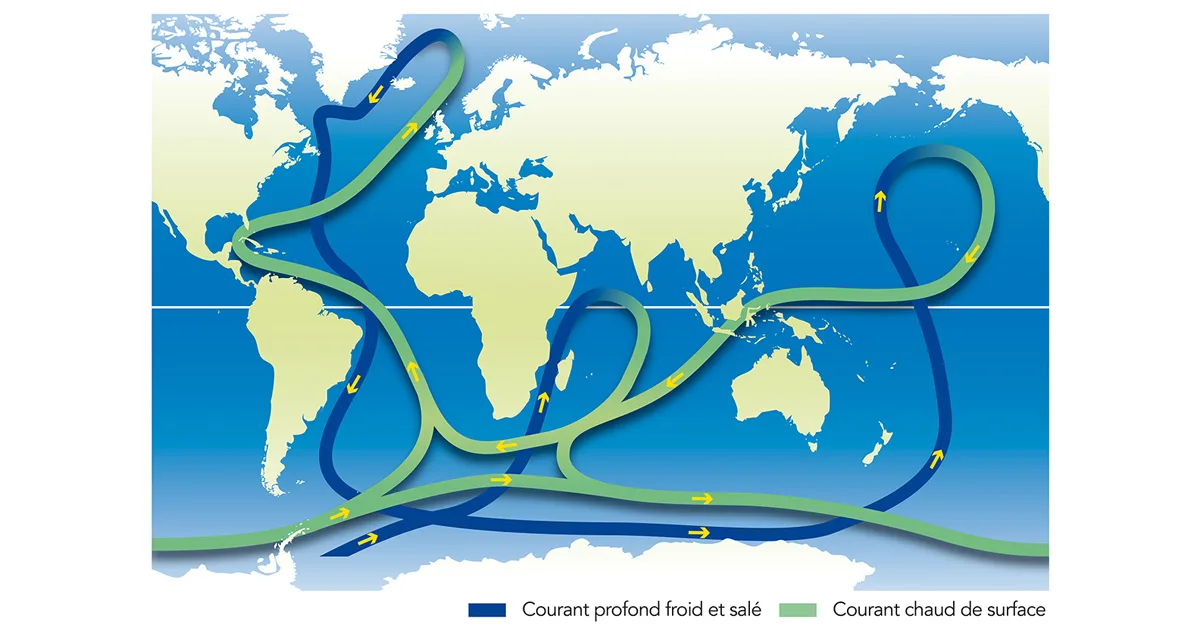
At pre-industrial atmospheric CO2 concentrations, 280 ppm, even if the AMOC collapses under freshwater forcing, it fully recovers once the forcing ends. However, at CO2 levels of 350ppm or higher—well below today’s level of around 430ppm—once the AMOC collapses, it stays in the “off” state.
“Higher CO2 concentrations fundamentally alter the AMOC’s stability, pushing the system into a bistable regime where the AMOC could weaken over hundreds of years before shifting to, and remaining in, a collapsed state. Once shut down, we see it does not recover in the long run,” said lead author Da Nian of PIK.
In all scenarios analyzed in the paper, a shift of the AMOC into an off state would see additional warming of 0.17°C to 0.27°C.
“This change in temperatures is driven by a large release of carbon from the Southern Ocean, due to enhanced mixing that brings carbon-rich deep waters to the surface,” explains co-author Matteo Willeit of PIK.
Regional temperature changes would be even more pronounced than the global mean temperature change. In one scenario, at CO2 concentrations of 450 ppm—last experienced by the Earth several million years ago, when polar ice was significantly reduced—Antarctic temperatures rise by 6°C while Arctic temperatures drop by 7°C due to AMOC collapse.
“The ocean has been our greatest ally, absorbing a quarter of human-made CO2 emissions. Our study shows how an AMOC collapse could flip the Southern Ocean from a carbon sink into a carbon source, releasing vast amounts of CO2 and fueling further global warming. The more CO2 in our atmosphere at the stage of shutdown, the higher the likelihood of additional warming. Put simply, rising emissions today increase the risk of a stronger climate response down the line,” said PIK Director and co-author Johan Rockström.