The results, reported in the journal Nature Geoscience, could have implications for future winter conditions in the UK and across Europe.
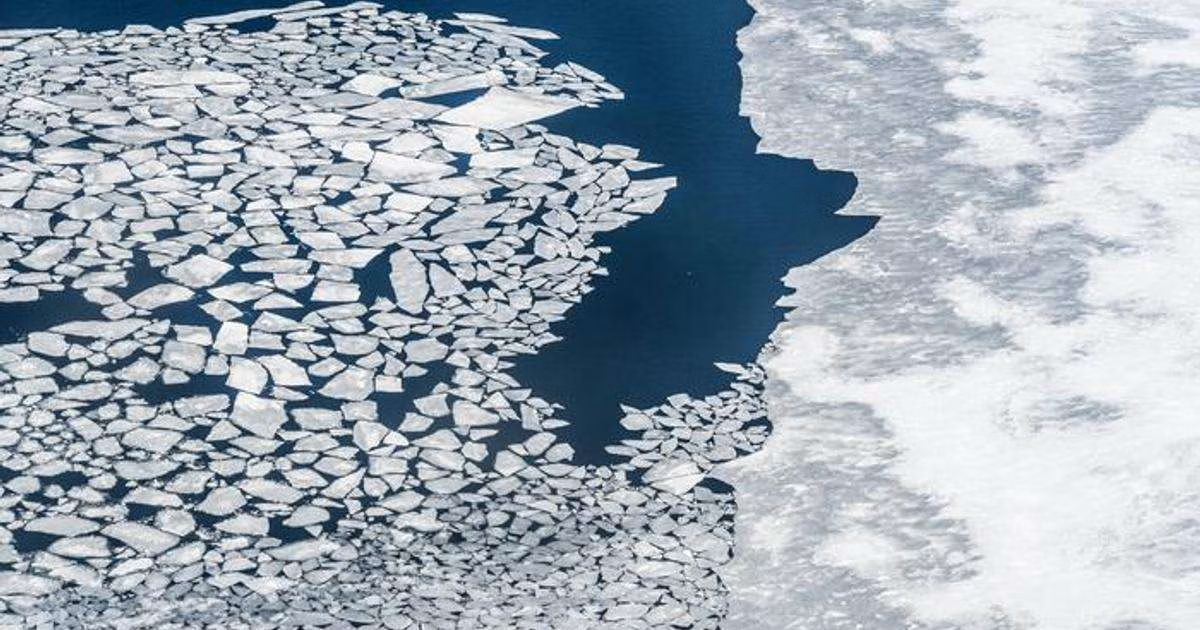
The retreat of Arctic sea ice in the summer months has been widely reported. However, the loss of winter sea ice has received far less attention, despite the fact that climate models disagree with each other most during the winter months.
Winter ice cover plays an outsize role in weather patterns beyond the Arctic, as it regulates the release of heat and moisture to the atmosphere. Its loss has been linked to colder winters and heavier snowfall in the UK, the rest of northern Europe, and North America. In March 2025, the Arctic recorded its lowest maximum sea ice extent since modern measurements began. That record was tied again this year.
Now, researchers from the University of Cambridge and the Centro de Investigación en Matematicas in Mexico (CIMAT) have compiled the largest-ever database of a key biomarker produced by algae living in sea ice to improve winter sea ice projections. The samples were taken from ocean sediment cores dating from the mid-Holocene period, when subtle shifts in the Earth’s orbit contributed to warmer conditions and reduced sea ice cover in the Arctic, offering clues into how the region might respond to future warming.
By measuring levels of the biomarker, called IP25, alongside complementary biomarkers from organisms that live in open water, the researchers were able to estimate the extent of sea ice cover thousands of years ago.
These ancient measurements were then compared to simulations from 27 climate models of the same period. Using a type of statistical analysis called Bayesian weighting, the researchers gave different weights to models based on how well they reproduced the ancient sea ice conditions. Because the same physical processes govern sea ice across different climates, these model weights could then be applied to simulations of the recent past and future.
Taken together, the models over-predicted how much winter sea ice there should be. “When we apply the model weights to historical simulations, we completely eliminated the positive bias,” said lead author Crystal Fu, from Cambridge’s Scott Polar Research Institute. “The future projections similarly end up being lower than previous estimates, by about a million square kilometers.”
Using past climate data, known as palaeoclimate data, to make predictions about the future is challenging. “The scientific community has amassed lots of palaeoclimate records over recent decades, but it’s remained a challenge to directly link these records to future projections, since there is uncertainty at both ends,” said Fu.
The approach used by Fu and her colleagues helped reduce the range of uncertainty in their projections by as much as 85 percent. “By using evidence from the past, we can now produce more reliable maps of where Arctic winter sea ice is likely to disappear,” said co-author Marco Aquino-López, of CIMAT. “These give us a much clearer picture of what the Arctic might look like in the coming decades, and how much uncertainty remains.”
Although the Arctic warmed for different reasons in the mid-Holocene than today, Fu says that regardless of the cause, sea ice will respond in the same way. “It doesn’t matter if the warming is natural variation or caused by human activity: if it warms, sea ice is going to melt,” she said.
The researchers say they found hints in their study that knock-on effects could be larger than expected. Applying their revised climate model weights to precipitation projections suggests that snowfall over southeast Greenland and rainfall in the Mediterranean may also be underestimated, which could have implications for the stability of the Greenland ice sheet and future flood risk in southern Europe.
The research was supported in part by the US National Science Foundation and the Cambridge Trust. Crystal Fu is a Member of Girton College, Cambridge.