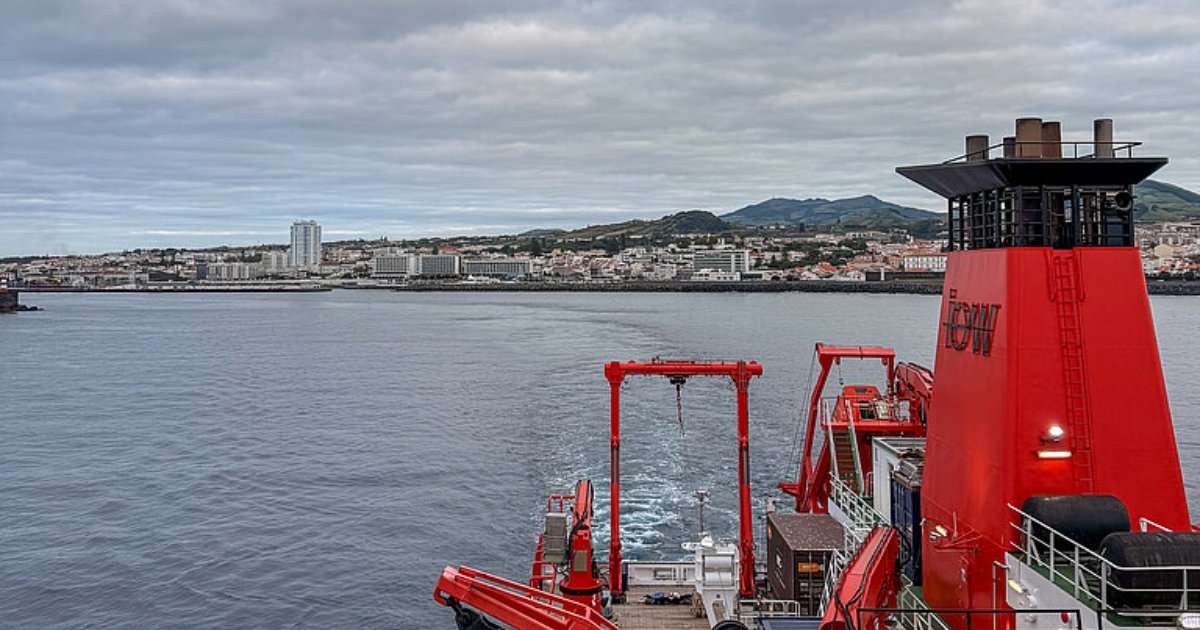
Driven by the need to ‘eat without being eaten,’ many animals in the ocean make a daily vertical migration: as darkness falls, they rise from the depths to near-surface layers and descend again in daylight. But what happens below around 1,000 meters, where perpetual darkness reigns? Do the animals still migrate here, and is there perhaps even a ‘ladder’ of vertical migrations reaching ever deeper? And if so, what drives them? The MSM147 expedition, aboard the research vessel Maria S. Merian, will be investigating these questions while at sea in the Atlantic between the Azores and Cape Verde from October 10 to November 5, 2026. The research team from GEOMAR Helmholtz Centre for Ocean Research Kiel is investigating whether there is a multi-stage ‘ladder of vertical migration,’ through which the food webs in the deep sea are interconnected in previously unknown ways.
The World’s Largest Animal Migration
In the upper ocean, the principle of vertical migration is well documented: many organisms reduce their risk of being eaten by staying deeper during the day and rising at night. This day-and-night-cycled vertical migration is considered one of the largest regular animal movements on Earth. Below a depth of around 1,000 meters, however, it is so dark that ‘day’ and ‘night’ are barely distinguishable. This gives rise to the hypothesis that migration at this depth is driven by predator-prey relationships. “When organisms from upper layers migrate downwards, the animals from deeper layers react to this—and move accordingly to reach their prey,” says expedition leader Dr. Jan Taucher. He heads the ‘Plankton Imaging’ research group at GEOMAR and the ERC Consolidator Project ‘SEA-THROUGH.’
The reason his expedition is now heading specifically to the subtropical eastern Atlantic is that the light-driven daily vertical variation in the upper water layers (i.e., the first ‘rung on the ladder’) is considered to be comparatively reliable. This is an advantage for the research team: the clearer the patterns near the surface, the easier it is to check whether movements at great depths are temporally linked to them. At the same time, existing data from previous studies in the Atlantic make it easier for the researchers to contextualize new measurements and identify possible peculiarities in the composition of the communities.
Live Observation With Specialized Cameras
“We do not yet know whether the ‘ladder’ of vertical migrations actually exists. It is also difficult to find out. To investigate this, scientists primarily use net catches—the same method that was used a hundred years ago,” says Jan Taucher. The net shows which organisms were present at a particular location at a specific point in time, but not how they move over the course of hours and through different depths. Furthermore, delicate gelatinous animals are difficult to capture as they are often severely damaged by the nets.
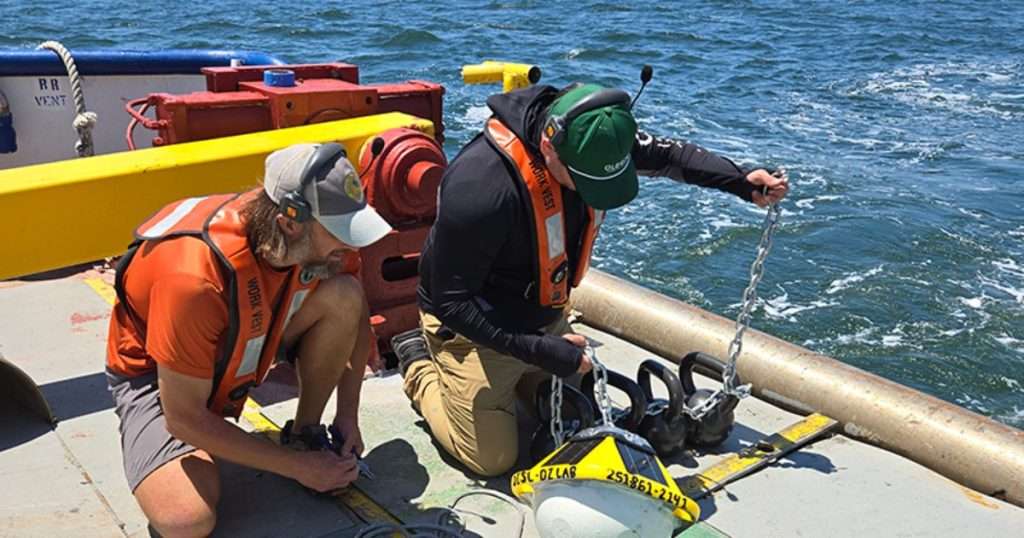
For this reason, various specialized camera systems are now being used on the MSM147. To ensure the equipment can withstand the extreme pressure at depth, the cameras have been fitted into special pressure-resistant housings developed and manufactured at GEOMAR. Red light is used for illumination to minimize disturbance to the marine animals during observation.
At the heart of the expedition is a camera developed by the research team itself, which enables high-resolution images to be taken of very small organisms measuring just a few millimeters. The so-called PIScO camera (Plankton Imaging with Scanning Optics) features a liquid lens, enabling it to adjust its precise focus up to 70,000 times per second. This is crucial for reliably imaging small, fast-moving organisms at varying distances. In addition, a light-field camera is being used to observe larger marine animals, such as jellyfish or fish. It provides real-time three-dimensional information—such as the sizes, distances, and spatial positions of animals—by capturing images from many angles simultaneously and analyzing this data in real time. Another camera will capture bioluminescent organisms. This is significant because it is estimated that around three-quarters of deep-sea animals produce bioluminescent signals. By using this specialized camera system, these animals and their behavior can be observed directly in their natural habitat.
Basic Research Into Food Webs and Carbon Transport
The deep sea is one of the least studied habitats on Earth. Anyone considering its protection or use first needs an understanding of the ecological processes: which organisms are active where, and how are these relationships linked across different depths? “What do deep-sea animals eat, and how does their food get there? These are questions that remain unanswered,” explains Taucher.
If there are synchronized migrations of marine animals, as if climbing a ladder, this is also a crucial piece of the jigsaw for a better understanding of the biological carbon pump. These vertical migrations could play a role in the transport of carbon to greater depths. When biomass sinks or is actively converted in deeper layers, carbon can be stored for the long term. Particularly below a depth of around 1,000 meters, this contributes to the ocean acting as a carbon sink.