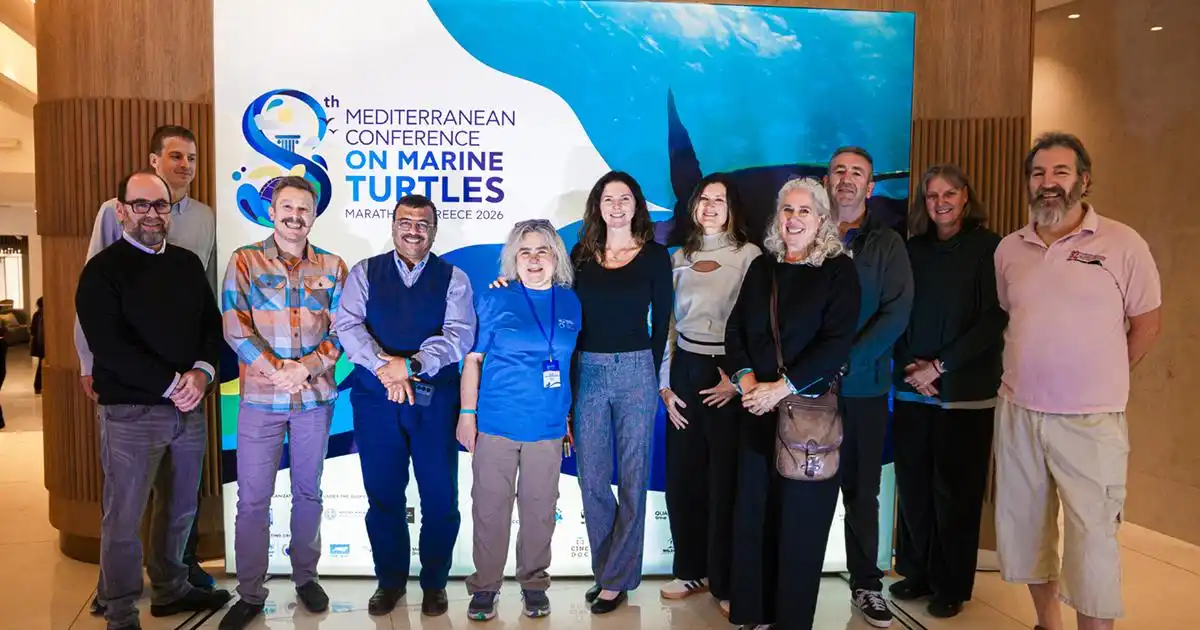
Convened as part of the 8th Mediterranean Conference on Marine Turtles under the auspices of the IUCN SSC Marine Turtle Specialist Group (MTSG), co-hosted by the IUCN SSC Important Marine Turtle Areas (IMTA) Taskforce and supported by ARCHELON, the Sea Turtle Protection Society of Greece, and the World Wide Fund for Nature (WWF)-coordinated Blue Corridors for Turtles initiative, the workshop marks the formal start of a global effort to identify and map the places that matter most for marine turtles.
IMTAs are discrete, place-based areas that are of particular biological significance for marine turtles ranging from nesting beaches, to mating and courtship areas, feeding grounds and open-ocean migration routes, critical for marine turtle survival or areas where turtles hold special cultural value. The IUCN SSC MTSG published guidelines and criteria for identifying IMTAs back in 2021. The Mediterranean region has now paved the way for the first IMTAs to be identified, setting the stage for a global process.
“Marine turtles have been the missing piece in the world’s map of prioritizing important habitat and ocean areas. With this workshop, we have kickstarted a global process for turning what we know about where marine turtles live, feed, breed and migrate into clearly defined areas that decision-makers can act on. Important Marine Turtle Areas bring together science, expertise and the knowledge held by people who have lived alongside marine turtles for generations, creating a stronger foundation for place-based management,” said Dr. Christine Madden, Chair of the IUCN SSC MTSG IMTA Taskforce and WWF Global Marine Turtle Conservation Lead.
The Mediterranean workshop is the first in a planned series of IUCN SSC-convened regional workshops that will progressively identify IMTAs around the world during the coming years. This follows the development of pilot IMTA in the west and central Africa region, and established approaches used for Important Marine Mammal Areas (IMMAs) and Important Shark and Rays Areas (ISRAs).
Participants brought together decades of knowledge and data, also drawing on a regional connectivity baseline assembled through ShellBank and Blue Corridors for Turtles. ShellBank, the world’s first traceability toolkit and global database of marine turtle DNA, reveals which genetically distinct populations exist and how they connect across habitats, and Blue Corridors for Turtles connects genetic information with nesting and satellite-tracking data to build a connected global picture of the habitats and ocean pathways used by marine turtles.
Across global regions, the combined dataset already spans 170 genetically distinct populations, more than 4,100 nesting sites across 147 countries, and over 2,700 satellite tracks for all seven species, evidence that will be vital for identifying IMTAs around the globe. At the Mediterranean workshop, proposed areas will be assessed against the IUCN SSC MTSG’s IMTA criteria before being recommended as candidates for the IMTA review process.
While the workshop is still underway, it is encouraging to see a diverse range of IMTAs being put forward, from important nesting beaches in Greece and Türkiye, to feeding areas in Italy or areas across Spain and Algeria, and migratory pathways that span the national jurisdiction of multiple countries like Turkiye, Cyprus, Egypt, and Libya.
“This is a landmark moment for marine turtles and IUCN SSC. The criteria our members developed in 2021 have now been expanded on and finally being put to work. Just as we have done for marine mammals, sharks, rays and chimaeras, Important Marine Turtle Areas will give turtles a seat at the policy table, helping countries deliver on their national and global ocean commitments including under the KMGBF—notably 30×30—and the BBNJ Agreement,” said Dr. Ronel Nel, co-chair of the IUCN SSC Marine Turtle Specialist Group.
The process already has political backing. In March 2026, at the 15th Meeting of the Conference of the Parties (COP15) to the Convention on the Conservation of Migratory Species of Wild Animals (CMS), governments acknowledged IMTAs as an important tool in providing an evidence-based foundation to support conservation priorities, marine spatial planning, environmental assessments, protected and conserved areas, fisheries measures, and other management decisions including within and areas beyond national jurisdiction.
As workshops roll out across other regions, each established IMTA will provide governments, communities, managers, and other decision makers a clear, evidence-based foundation to help guide conservation and management—so that marine turtles are protected throughout their life cycle, from the beaches where they nest to the ocean routes that connect them.