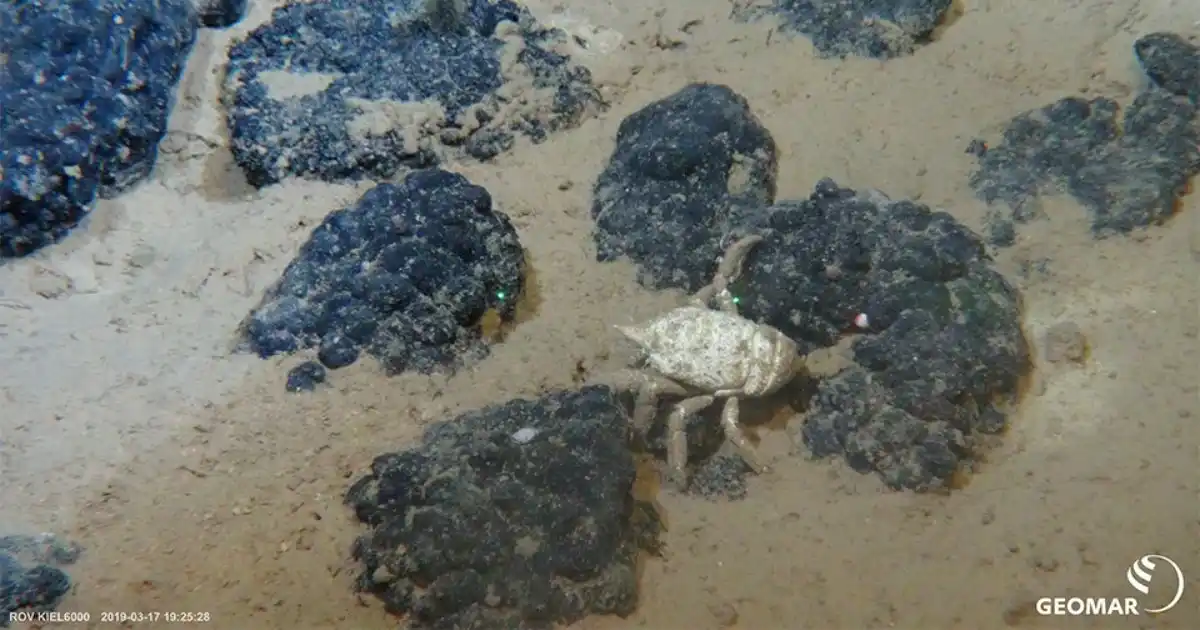
An international team led by Dr. Tanja Stratmann from MARUM—Center for Marine Environmental Sciences at the University of Bremen, Dr. Coral Diaz-Recio Lorenzo, and Dr. Sabine Gollner from NIOZ—the Royal Netherlands Institute for Sea Research—was able to demonstrate that the crevices and pores within these nodules harbor a unique community of life that differs significantly from the animals found on the surrounding seafloor. Since polymetallic nodules take millions of years to form, commercial mining would permanently destroy this unique habitat. This makes the findings important for planning protected areas in the deep sea.
A Tiny Home in the Deep Sea
Polymetallic nodules are fist-sized, dark lumps of iron and manganese oxides that grow extremely slowly over millions of years—often just a few millimeters per million years. At depths of 4,000 to 6,000 meters, they form rare hard surfaces on the otherwise soft, muddy seafloor. The researchers investigated who lives in the tiny cracks and cavities of these nodules.
Dr. Tanja Stratmann, one of the three lead authors and a deep-sea ecologist, explained: “In our study we show that the sizes of cracks inside the nodules are large enough to provide home to animals that are smaller than a millimeter in size.”
To find these organisms, the scientists used, among other things, box corers and diving robots to collect samples from the Clarion-Clipperton Zone in the central Pacific. The nodules were carefully dissected in the laboratory to extract the organisms from the crevices.
Unique Communities and Concrete Numbers
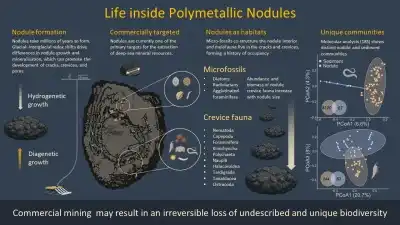
What makes this research unique is the finding that the nodules not only provide a surface but also create a three-dimensional habitat through their internal structure. An analysis of 244 nodules revealed a total of 4,139 individual animals. On average, 17 individuals lived in each nodule, although in one instance as many as 245 animals were found in a single nodule.
Dr. Coral Diaz-Recio Lorenzo, explained: “The crevices in the polymetallic nodules function as small shelters and provide home to animals that we do not encounter in the soft sediment of the seafloor.”
Although the number of animals in the polymetallic nodules is lower than in the surrounding sediment—for roundworms (nematodes), it corresponds to about 10%, and for small crustaceans (copepods), about 25% of the total in the sediment—it is nonetheless significant for the entire ecosystem. It is particularly important that the species composition differs. Genetic analyses showed that the communities within the nodules were very similar across wide distances (up to 1,000 km) but differed significantly from the animals in the sediment.
Risks Associated with Deep-Sea Mining
These findings have significant societal implications, as polymetallic nodules are considered a target for industrial deep-sea mining due to the metals they contain, such as nickel, cobalt, and copper. However, since the nodules take millions of years to form, their extraction would result in the loss of this unique habitat and all associated life. One example is the single-celled species Thurammina sp. 1, which is particularly common in the nodules. This species appears to be perfectly adapted to the sheltered spaces within the nodules. If the nodules were extracted, there would be no replacement for these specialized inhabitants. Such a loss would be permanent on geological time scales, as the nodules do not regrow within human lifetimes but need millions of years.
Prof. Sabine Gollner: “Our findings point out that commercial mining may result in an irreversible loss of undescribed and unique biodiversity associated to nodules. This needs to be considered in environmental management of deep-sea mining.”
This new knowledge underscores that the protection of the deep sea must take into account not only large animals but also microscopic inhabitants. Future research must now determine whether the loss of these local communities would lead to the global extinction of certain species or whether the animals could survive in other areas. These findings are essential for planning protected areas and assessing the environmental impacts of deep-sea mining projects. To this end, Dr. Tanja Stratmann is currently on an international research expedition to the Clarion-Clipperton Zone to further study the polymetallic nodule ecosystem. These and other follow-up studies are independently funded as part of the JPIOcean projects MiningImpact 2 and 3.
Coral Diaz-Recio Lorenzo, Tanja Stratmann, Mark Eduard de Wilt, Ranju Radhakrishnan, Lara Macheriotou, Ellen Pape, Lucille Hoogerdijk, Nadinne Jeanneth van den Hooven-Iza, Jan Tobias Krüger, Lea Kaspersmeier, Moritz Neuser, Moritz Klöckner, Martin Lauth, Mirko Schaper, Tasnim Patel & Sabine Gollner: Polymetallic nodules provide a distinct habitat for abyssal meiofauna. Scientific Reports 2026. DOI: 10.1038/s41598-026-76737-w.