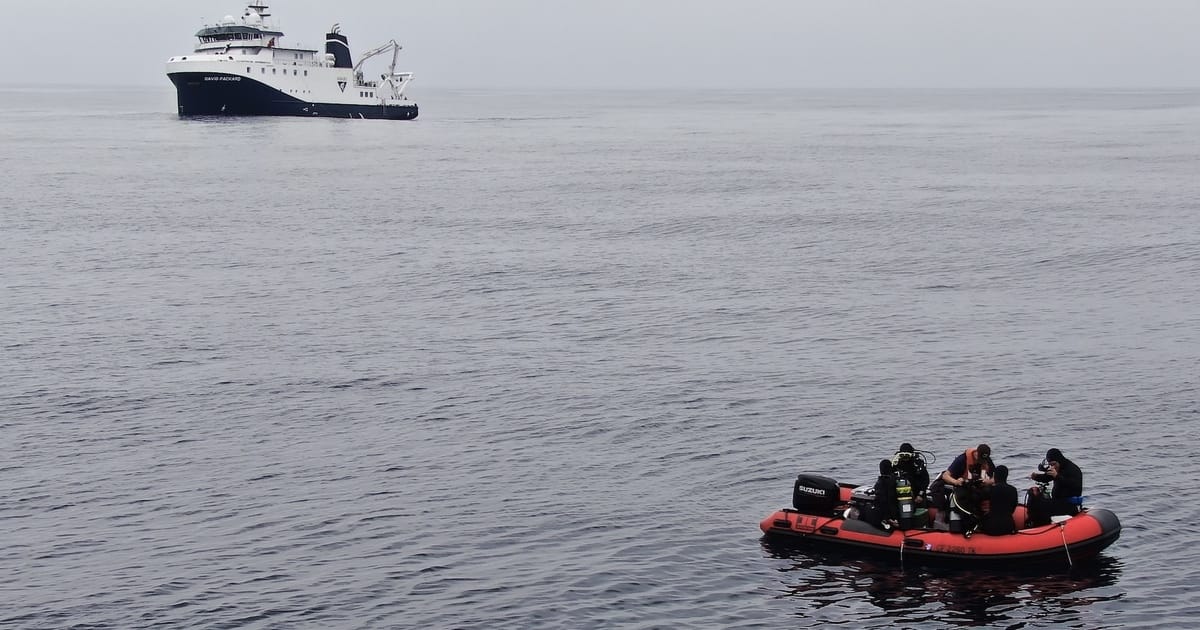
The team recently concluded a 10-day expedition from Monterey Bay to the Channel Islands aboard MBARI’s flagship research vessel David Packard to study the biogeography and physiology of gelatinous plankton.
While the open ocean and the depths below have no physical boundaries, the team has observed interesting population boundaries between Washington and Central California. The expedition to Southern California supported ongoing work to understand how these populations change further between the cooler waters off Monterey and the warmer waters to the south, offering opportunities for comparative physiology between closely related species from different temperature conditions.
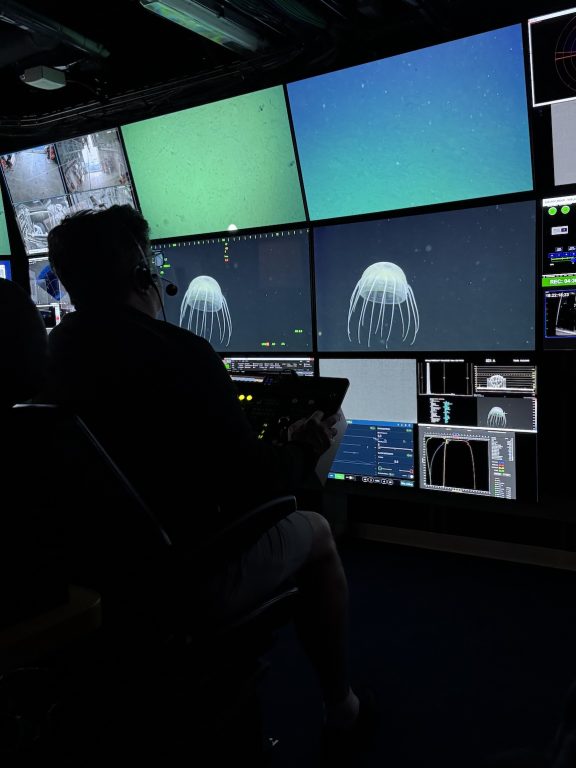
Using MBARI’s remotely operated vehicle (ROV) Doc Ricketts, they observed and collected gelatinous plankton deep underwater in the ocean’s midnight zone. A specialized low-light camera developed by MBARI scientists and engineers allowed the team to record the remarkable bioluminescence displays of these deep-sea jellies in their natural habitat. The team logged observations of several undescribed ctenophores, a new species of Erenna siphonophore with elaborate lures, and a siphonophore they had previously only seen in the waters of the Gulf of California, advancing efforts to catalog life in the deep ocean. The expedition also marked the deepest dive to date for ROV Doc Ricketts from the David Packard.
The team leveraged other research tools on the ship for a comprehensive examination of gelatinous plankton populations. Each morning, they launched the ship’s tender boat to conduct blue-water scuba operations to collect ctenophores and other jellies that live in sunlit surface waters. Each night, they conducted trawls to sample animals migrating to the surface to feed under the cover of darkness.
Expeditions like this one advance efforts towards a complete census of marine life and are critical to understanding ocean ecosystems, how they are linked, and how they might be changing.