The coastal waters where continents meet deep ocean basins are among the most productive environments on Earth. Here, coastal upwelling draws nutrient-rich water up from the deep, fueling biological productivity that extends far offshore. Despite their ecological importance, these ocean margins have remained challenging to study, and those in the tropics, like the Gulf of Guinea, are especially understudied. The Ocean Margins Initiative is building new partnerships to examine the linkages between a biologically productive coastal ocean and the pelagic ocean basins, providing fundamental data needed to support fisheries and coastal communities.
Durkin and Huffard are part of MBARI’s Carbon Flux Ecology Team, lending their extensive expertise in studying oceanographic processes in a coastal upwelling system to help train University of Ghana graduate students to lead the deployment of scientific instruments and expand research efforts to address the needs of the community year-round.
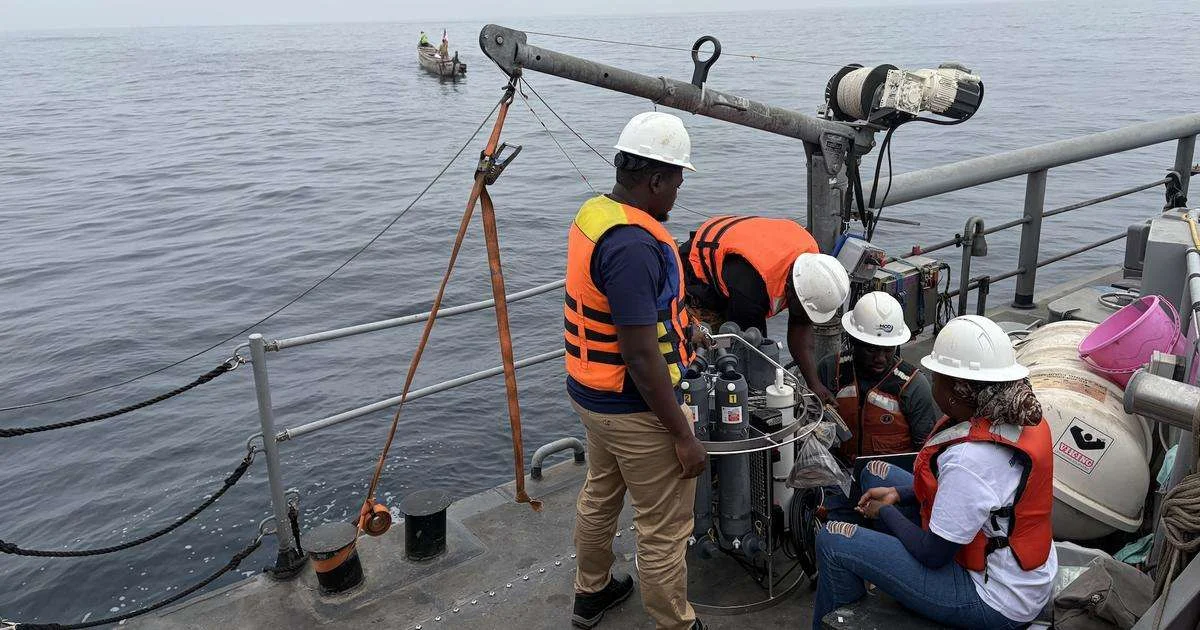
This summer’s fieldwork was based out of the recently constructed OMI Lab at the University of Ghana in Accra, and included day cruises out of Tema aboard the Ghana Navy Ship Aflao. This work was part of the Ocean Margins Initiative’s ongoing effort to create an integrated observing system to assess carbon and biogeochemical transport in response to physical processes, like upwelling, in the Gulf of Guinea.
During the 2026 OMI Summer Cruise, Durkin and team deployed sediment traps equipped with SnoCam+, an innovative open-source system for collecting photos and samples of marine snow. By quantifying the amount of organic material sinking through the water column, the team can better understand ocean carbon cycling and improve models for Earth’s changing climate. Training students to use these tools supports MBARI’s commitment to making our engineering innovation accessible on a global scale, providing communities the tools needed to understand, manage, and protect marine ecosystems and resources.
University of Ghana students helped deploy two autonomous biogeochemical Argo floats, making Ghana only the second country in Africa to deploy Argo floats. The floats will monitor ocean conditions in the Gulf of Guinea and beyond for approximately five years. Their data will be accessible to the public and the global scientific community via the Global Ocean Biogeochemistry Array (GO-BGC), an initiative funded by the US National Science Foundation and led by MBARI Senior Scientist Ken Johnson.
Education and outreach are essential to MBARI’s mission. We share our research, technology, data, and expertise to help inspire future ocean explorers. Through the Ocean Margins Initiative, Durkin is mentoring graduate students from the University of Ghana. This fall, she will host two student collaborators from the University of Ghana as visiting fellows at MBARI for hands-on training in marine science and technology, helping them build skills they can bring back to Ghana.
The Ocean Margins Initiative is supported by Schmidt Sciences Ocean Biogeochemistry Virtual Institute (OBVI).