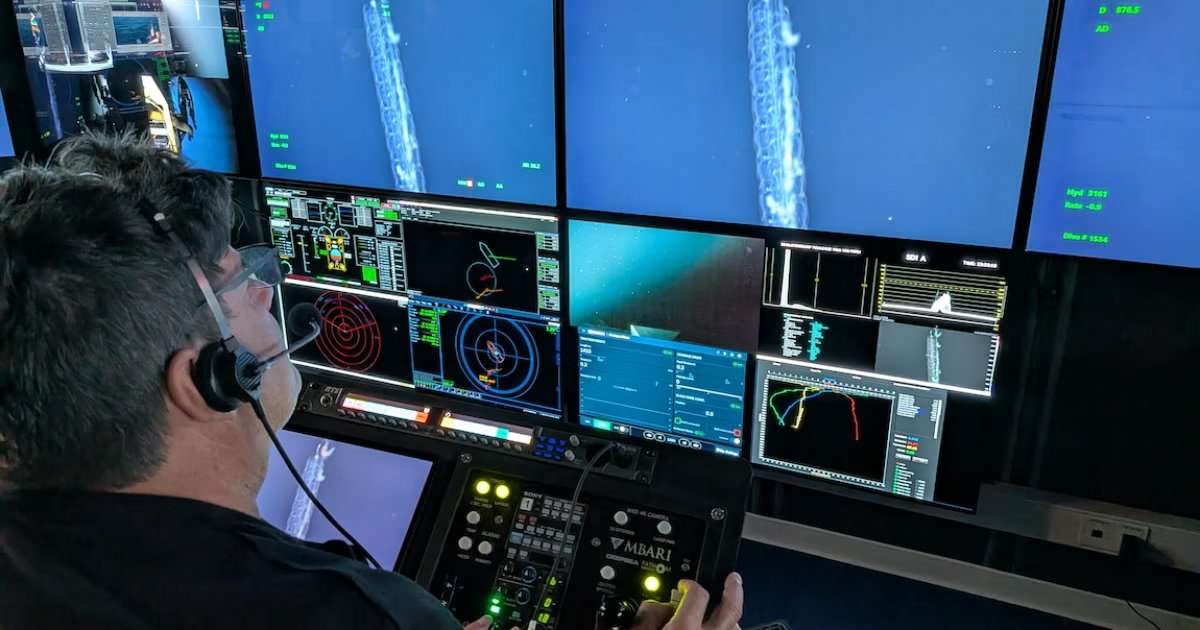
Siphonophores are elongate gelatinous animals related to jellies and corals that are some of the most dominant predators in the ocean’s midwater, the open water between the surface and the seafloor. Despite their abundance and important ecological roles, siphonophores remain challenging to study. Advanced underwater technology allows scientists in MBARI’s Biodiversity and Biooptics Team to observe the anatomy and behavior of deep-sea siphonophores in their natural environment and gently collect these delicate animals for further study in the lab.
Bargmannia are among the most streamlined siphonophores, propelled by dozens of swimming bells that jet in unison. MBARI scientists and their collaborators conducted a comprehensive examination of this widely distributed group of deep-sea siphonophores. They documented the physical features of museum specimens, cataloged habitat data from in situ observations with underwater robots, and extracted DNA for genomic sequencing. The team was even able to sequence DNA from a historical museum specimen that had been preserved in formalin. This integrative approach allowed the team to resolve historical taxonomic ambiguities that underestimated the true diversity within this group of deep-sea siphonophores.
The team identified seven Bargmannia species in MBARI’s extensive video archive, with an eighth species identified from museum collections. Two of these species—Bargmannia marlena with stretchy orange stomachs and Bargmannia pyrosa with a fiery red body—were previously unknown to science. The eight species represent two evolutionary lineages. While they overlap geographically, their distributions are structured along depth gradients, demonstrating how species evolve across a three-dimensional aquatic environment.
MBARI’s close collaborations with expert taxonomists are helping document deep-sea biodiversity. MBARI research and technology have contributed to the discovery of more than 300 new species in the depths of Monterey Bay and beyond. Each new discovery helps us better understand and protect the largest living space on Earth.
This research was supported by the David and Lucile Packard Foundation through its longtime funding of MBARI’s work, with additional support from the US National Science Foundation (Grants OCE-1829805 and OCE-1829835), the Polish National Agency for Academic Exchange (grant BPN/BEK/2023/1/00388), and the University of Gdańsk UGrants program (UGrants–start grant 1220/157/2024).
Research Publication:
Mańko, M.K., S.H. Church, D.A. Ramirez, S.H.D. Haddock, and C.W. Dunn. 2026. Integrating mitogenomes, morphology, and ecology reveals depth-structured diversification and two new species of deep-sea Bargmannia siphonophores (Cnidaria: Hydrozoa). Zoological Journal of the Linnean Society, 208(2): zlag150. https://doi.org/10.1093/zoolinnean/zlag150