Researchers mapped their observations of hyperiid amphipods against depth, association behavior (associating in orange, free-swimming in purple), and eye structure (complex in blue, simple in yellow, and reduced in green). Illustration courtesy of Vanessa Stenvers
While water depth is an important factor in driving animal adaptations in the deep sea, scientists increasingly recognize that behavioral ecology may be just as important. Some hyperiid amphipods are symbiotic hitchhikers on gelatinous animals, while others have a free-swimming, predatory lifestyle. Combining a literature review, blackwater scuba photography, and submersible observations, the team has demonstrated that association behavior is linked to both eye diversity and camouflage.
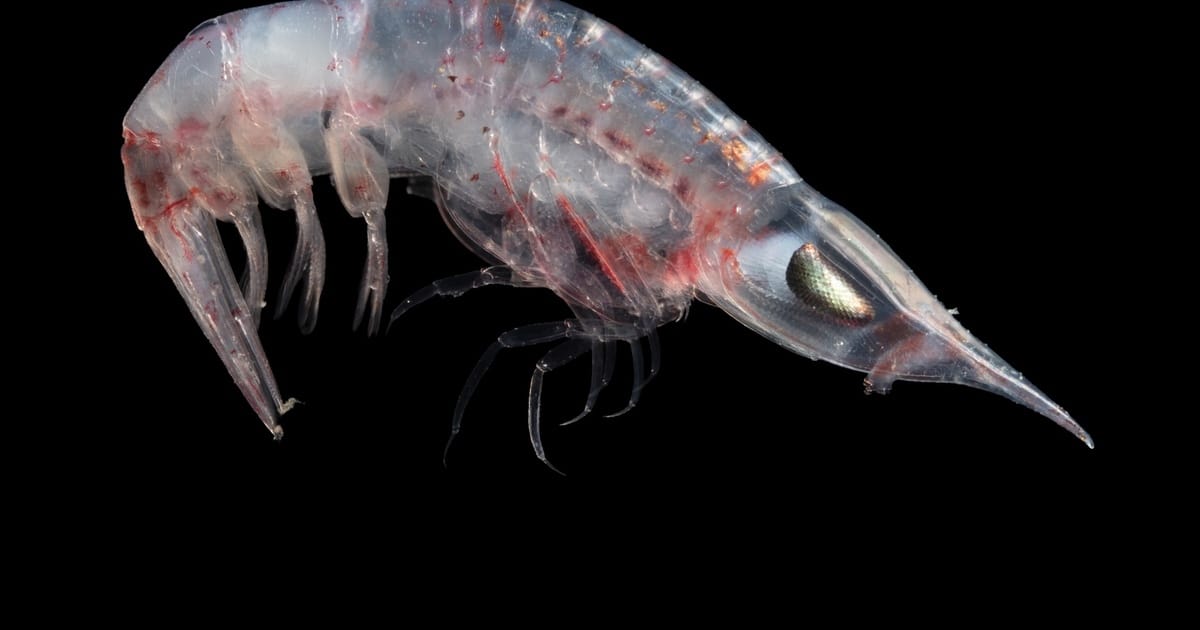
Approximately one-third of hyperiid genera have adopted a free-swimming lifestyle, challenging the longstanding assumption that these amphipods only live on or in close association with gelatinous animals. The evolution of a free-swimming lifestyle correlates with body transparency and eye structure in hyperiids living in the upper waters of the ocean’s twilight, or mesopelagic, zone.
In this environment, free-swimming hyperiids need to see both prey and predators without being seen themselves. Without a gelatinous host for protection, they use body transparency to further hide from predators. Eyes cannot be made completely transparent because pigment is required to absorb light. Some hyperiids have managed to compress the eye structures containing visual pigments—their retinas—that could make them visible against the backdrop of downwelling light in these twilight waters.
Free-swimming hyperiids that live in deeper waters of the midnight, or bathypelagic, zone, have evolved an opaque appearance. Here, a crimson color absorbs bioluminescent light produced by their neighbors and serves as camouflage. Hyperiids in these dark depths have reduced eyes adapted to see bright flashes of bioluminescence instead of the dim and low-contrast shadows of predators and prey in the upper mesopelagic zone.
Hyperiid amphipods are abundant in the midwater environment. Recognizing the true abundance of free-swimming, predatory species requires scientists to reconsider the ecological role of hyperiids in midwater communities. These results underscore the value of direct observations for uncovering evolutionary and ecological processes in the largest living space on Earth.
Research Publication:
Stenvers, V.L., J.M. Hemmi, K.L. Schlining, R. Collins, L. Iannello, H.F. Waters, C.A. Choy, S.H.D. Haddock, B.H. Robison, H.-J. Hoving, K.J. Osborn. 2026. In situ observations reveal a link between association behaviour, camouflage, and eye complexity in midwater amphipods. Proceedings of the Royal Society B, 293: 20252837. https://doi.org/10.1098/rspb.2025.2837