In a new paper in the scientific journal Philosophical Transactions of the Royal Society B, MBARI Senior Scientist Kelly Benoit-Bird and William Oestreich—formerly a US National Science Foundation postdoctoral fellow at MBARI and now the leader of the collective ecology research group at the University of Zurich—review how collective behaviors like schooling and swarming, vertical migration, and cooperative foraging help ensure the survival of pelagic animals.
Benoit-Bird leads MBARI’s Acoustical Ocean Ecology Team, using a variety of advanced acoustic technologies to investigate how animals find dinner without becoming dinner themselves, and how group behaviors like schooling or cooperation affect predator-prey interactions.
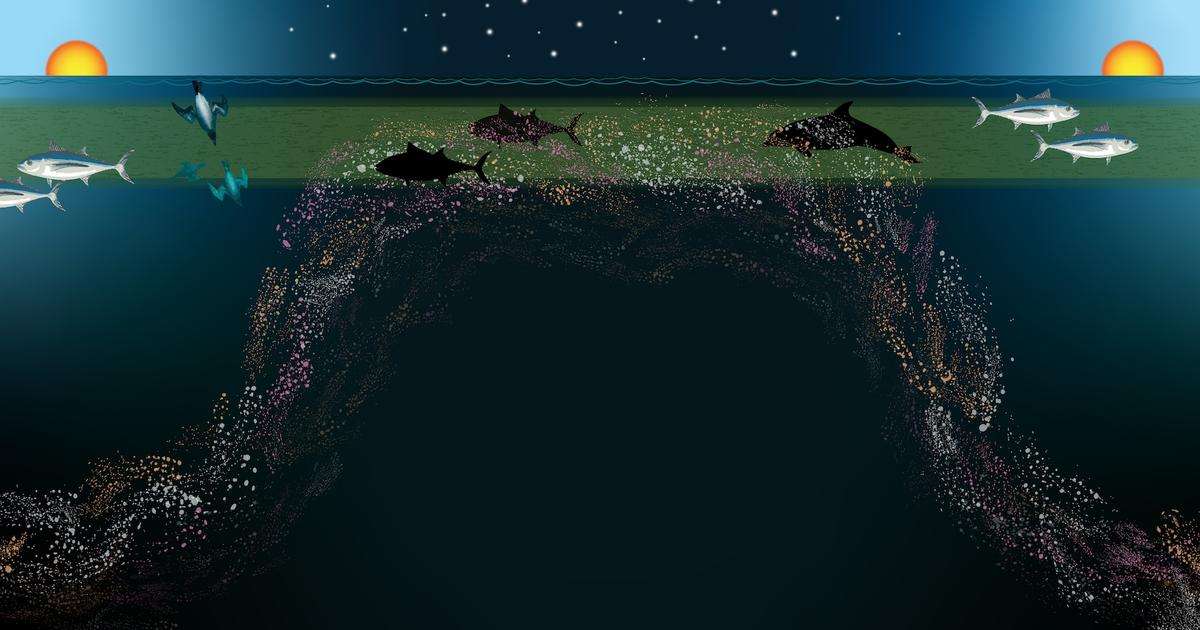
Benoit-Bird and Oestreich have found that key features of the pelagic ocean—including the limitation and patchy distribution of food resources, the lack of cover, and the motion of the medium itself—have repeatedly led to the evolution of collective behavior in marine animals. Examples from animals as small as plankton and as large as whales, from the surface to the deep sea, as well as invertebrate and vertebrate taxa illustrate how fear, physics, and food lead to the evolution of group behaviors.
Their work demonstrates how observations of life in the largest living space on Earth are providing new insights into the evolutionary drivers and adaptive significance of collective behavior and group living.
Research Publication:
Benoit-Bird, K.J. and W.K. Oestreich. 2026. Food, fear, and physics drive collective behavior in the ocean’s pelagic zone. Philosophical Transactions of the Royal Society B. https://doi.org/10.1098/rstb.2025.0208