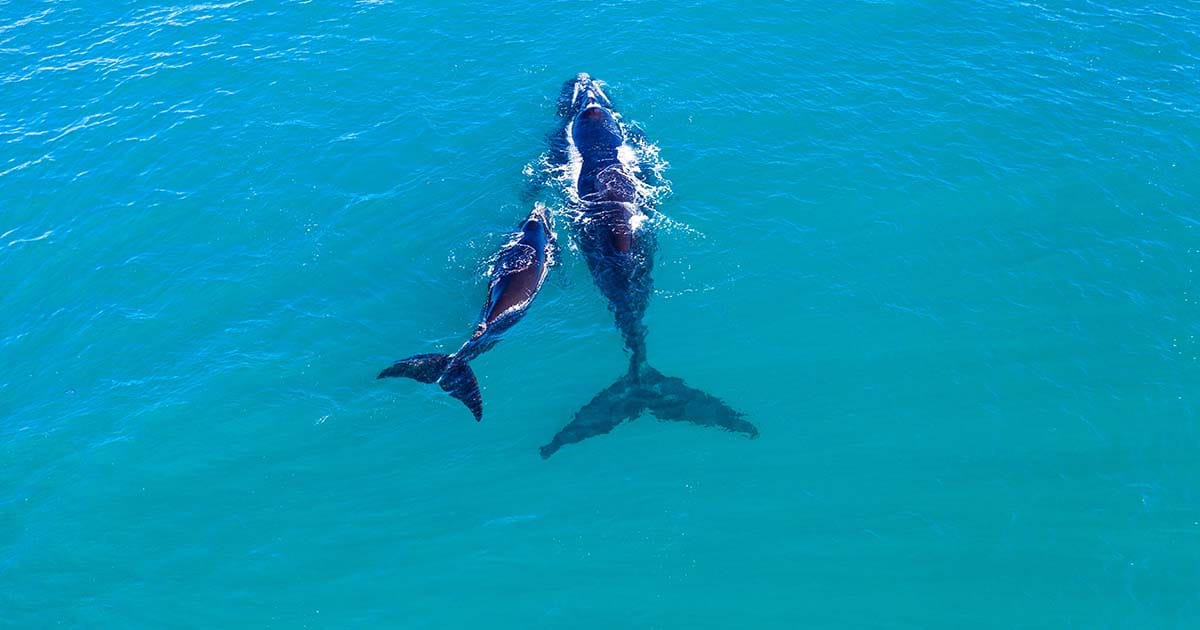
Dr. Kate Sprogis, from The University of Western Australia’s Oceans Institute and School of Biological Sciences, collaborated on the publication led by the University of Auckland/Waipapa Taumata Rau published in Global Ecology and Conservation.
“We wanted to understand where the whales’ feeding grounds are and how they use them to help inform conservation efforts,” Dr. Sprogis said.
“Historically, southern right whales from Australia were thought to head south in summer to feed in the Southern Ocean between Australia and Antarctica.”
Researchers satellite tracked 37 southern right whales from calving grounds off Australia and New Zealand. The Australian whales made vast east-west movements across the Southern Ocean, but also southerly movements, and the NZ whales headed north-west to the Southern Ocean south of Australia to feed.
The most important feeding areas for the NZ whales were south of Australia, while Australian whales used this region and also migrated west to French territories like the Kerguelen and Crozet Islands, and further south to the Antarctic ice edge.
“The Australian whales visited a wider variety of habitats, including Antarctic waters, which may provide greater resilience in an increasingly unpredictable ocean environment,” Dr. Sprogis said.
Both populations are fed near major oceanic fronts, sharp boundaries between different water masses, where prey tends to concentrate.
However, the main feeding area for the NZ whales, which is also key to Australian whales, is in waters south of Australia and currently falls outside recognized international conservation efforts.
“We found similarities and differences in their foraging strategies, and the differences in foraging locations may have implications on continued population recovery under climate change,” Dr. Sprogis said.
“As the Southern Ocean continues to be impacted by climate change, ongoing monitoring of these populations is essential to understand how changing conditions may shape the recovery and long-term resilience of the species.”
The research was funded by the Royal Society Te Apārangi Rutherford Discovery & Postdoctoral Fellowships, Live Ocean, Lou and Iris Fisher Charitable Trust, Joyce Fisher Charitable Trust, Brian Sheth/Sangreal Foundation, UOA Science Faculty Research Development Fund, International Whaling Commission – Southern Ocean Research Partnership, Antarctic and Southern Ocean Coalition, DOC, the Cawthron Institute, Marine Predator Research Group at Macquarie University, and the Rae Family Foundation to UWA.