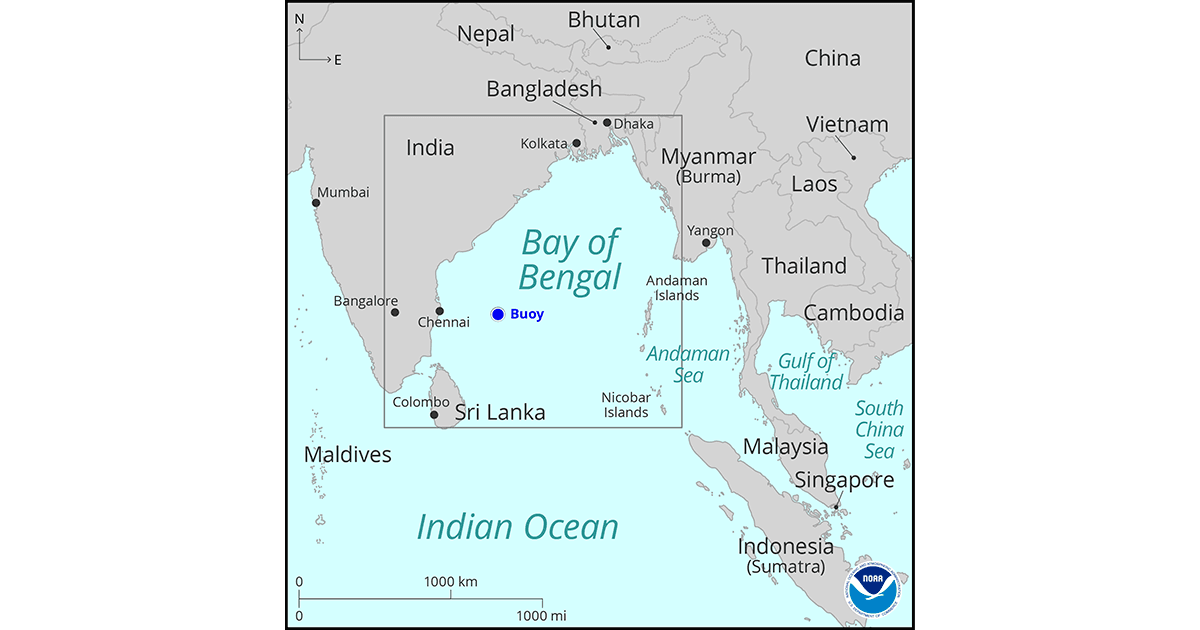
While this principle, first explained by the Swedish oceanographer Vagn Walfrid Ekman in 1905, applies everywhere on Earth, there’s more to the story, including a twist described in new research by an international team led by a scientist with NOAA’s Pacific Marine Environmental Laboratory (PMEL). In the Bay of Bengal, analysis of data collected by a long-term deepwater surface moored buoy showed currents directed to the left of the surface winds.
It’s a discovery that has potential applications for studies of weather and climate variability, marine biogeochemical cycles, ecosystem dynamics, and marine fisheries, according to lead author Michael McPhaden, senior scientist at PMEL.
“This research opens a window into an aspect of wind-forced ocean circulation that has been rarely observed and is poorly understood,” McPhaden said. “It will help scientists understand when an ocean current may veer in a direction opposite to what they expect. That will also have real-time applications for situations that call for search-and-rescue or oil spill response.”
The findings were published in the journal Science Advances.
In the paper, the research team, which included scientists from the Indian National Center for Ocean Information Services, the Kerala University of Fisheries and Ocean Studies, and the University of Zagreb Department of Geophysics, describes a surface flow in the Bay of Bengal captured by multiple years of hourly data from a buoy deployed a few hundred miles off the east coast of India.
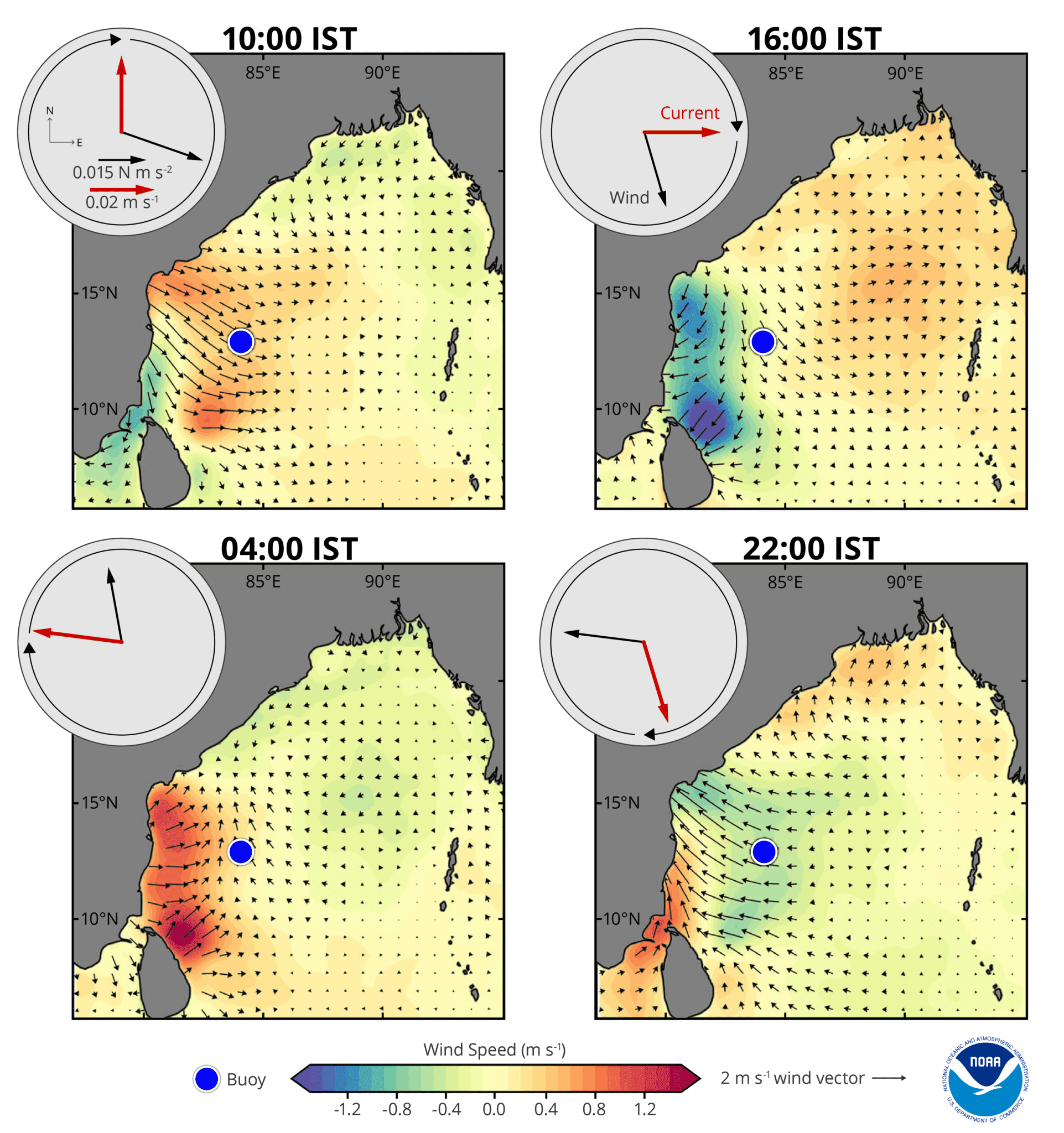
The finding is timely because this knowledge could help analysis of observations from a proposed new NASA satellite mission to simultaneously measure surface winds and ocean currents at high resolution over the global ocean, called Ocean Dynamics and Surface Exchange with the Atmosphere. The flows described in the new paper will be a prominent feature of the high-frequency satellite retrievals, particularly in the tropics, where the effect of Earth’s rotation on ocean circulation is relatively weak.
The moored buoy used in this study is maintained by India’s National Institute of Ocean Technology, one of many buoy systems in the Indian National Ocean Moored Buoy Network for the Northern Indian Ocean. This effort is coordinated with the parallel multi-national program led by NOAA and its partners, referred to as RAMA, short for the Research Moored Buoy Array for African-Asian-Australian Monsoon Analysis and Prediction. These buoy systems provide Indian Ocean data for weather, climate, and fisheries applications, especially for monsoon forecasting.
“One-third of the world population depends on monsoon-driven rainfall for agricultural production, so improving our understanding and ability to predict the monsoons has been a longstanding objective of the international scientific community,” McPhaden said.