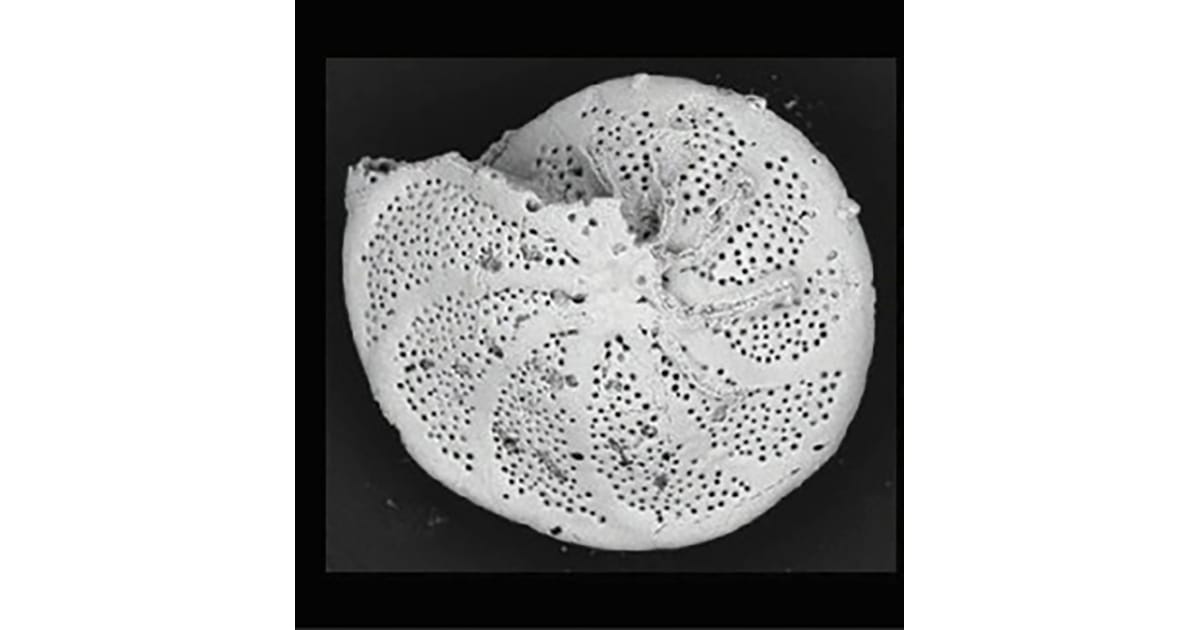
With the new funding, the researchers hope to uncover more details about the calcium carbonate formation process in foraminifera and thus be able to predict how these single-celled creatures, which are found in enormous numbers in the sea, will play a role in mitigating or amplifying the effects of climate change.
CO2 Caused Seawater to Acidify
Of all the CO2 we have emitted since the Industrial Revolution, about a third dissolved in the oceans. This has caused the seawater to acidify, which, among other things, affects the calcification of all kinds of crustaceans and shellfish. This is an important but poorly understood part of the so-called marine carbon cycle, which is important to predict future climate change.
Acidification and Warming
CO2 and calcification form a feedback loop: an increase in one slows down the other. However, this does not necessarily apply to one of the most important groups of calcifiers: single-celled foraminifera. Despite acidification, they are still able to form their calcareous skeletons. To understand how they respond to acidification and warming, medical scientists are joining forces with earth scientists. By discovering how foraminifera produce calcium carbonate, they can predict how climate change will affect the carbon cycle.
NIOZ and Radboudumc
NIOZ and Radboudumc have been looking at the nanometer scale to see how foraminifera make their calcium shells. De Nooijer said, “Just as in medical research into bone formation, we use techniques to examine the place where calcium is formed. With ordinary electron microscopy, you can only see ‘hard’ materials, whereas the calcium of foraminifera is made up of a network of ‘soft’ cell material.”
Extremely Rapid Freezing
To investigate this, the researchers use cryo-FIB/SEM. Cryo refers to the extremely rapid freezing of material, which prevents the formation of ice crystals, so that the cell material remains intact. For this, researchers use high-pressure freezing, which freezes material in milliseconds. The researchers then use a Focused Ion Beam (FIB) to shave away a few nanometers of material. They use an electron microscope (SEM) to take an image of this while the material remains frozen. By alternating between the FIB and the SEM, researchers create a 3D image of a cell in the process of making a shell of calcium carbonate.
Classical Versus Non-Classical
Using this technique, the researchers have already been able to see that calcium carbonate formation proceeds according to a so-called “non-classical” precipitation. Instead of “classical calcium carbonate growth” with a continuous accumulation of loose calcium and carbonate ions, a layer of formless calcium carbonate is first formed. This later crystallizes.
“This explains a number of unique properties of foraminiferal shells,” said De Nooijer, who has been fascinated by these creatures for twenty years.
M2 Grants
NWO M2 grants are intended for two scientists who conduct curiosity-driven, fundamental research. The funding instrument is open to questions in the (border) area of different scientific disciplines.