NOAA Launches Ocean DNA Explorer to Advance Marine eDNA Research

The power of environmental DNA (eDNA) to help us decode the mysteries of the deep is undeniable. The ability to detect marine species by the DNA they leave behind in water samples has revolutionized biodiversity monitoring and distribution mapping. Still, as a new field of study, standards for formatting eDNA data to ensure broad accessibility and usability have yet to be set.

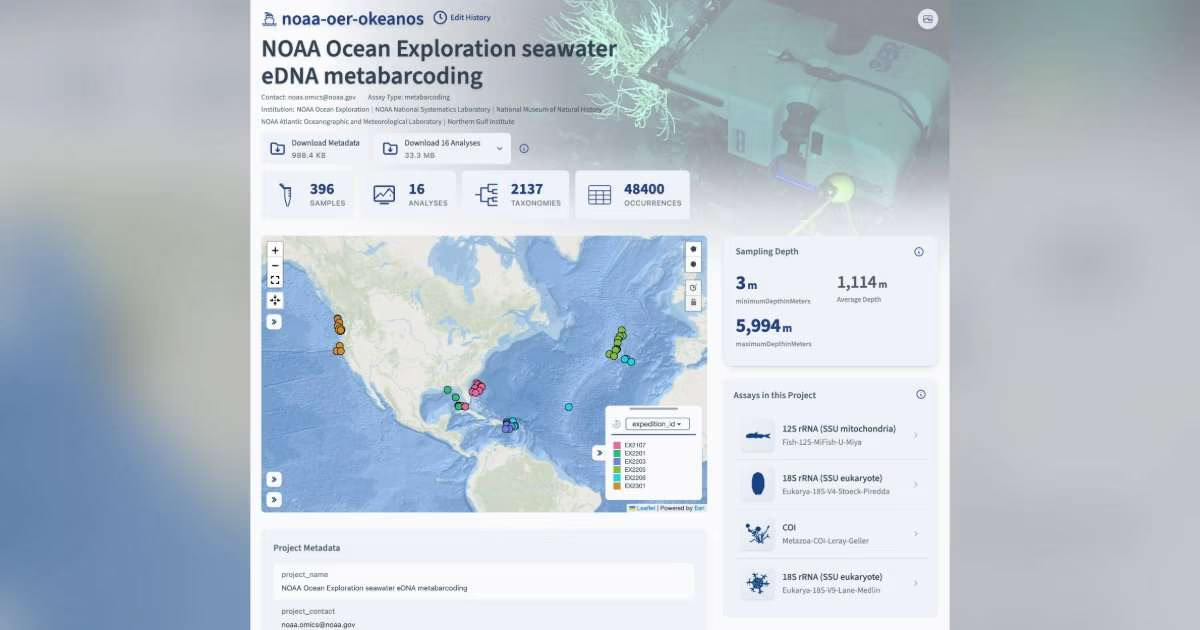
NOAA Ocean Exploration contributed environmental DNA (eDNA) data from water samples collected during remotely operated vehicle and CTD (conductivity, temperature, and depth) rosette system operations on six expeditions on NOAA Ship Okeanos Explorer between 2021 and 2023 (with more to come). Collectively, these data and their metadata make up the NOAA Ocean Exploration seawater eDNA metabarcoding project. While already available in global databases, the Ocean DNA Explorer makes them easier to analyze and visualize. (Image credit: Northern Gulf Institute/NOAA’s Atlantic Oceanographic and Meteorological Laboratory)

To standardize and accelerate the sharing and use of eDNA data and metadata, NOAA has launched the Ocean DNA Explorer, an open-source and user-friendly data portal for sharing, exploring, searching, and visualizing marine eDNA data.

What Is eDNA?

Environmental DNA (eDNA) is the genetic material left behind by organisms as they move through their environment (i.e., scales, tissue, mucus, waste, and other material) as well as whole microorganisms. Scientists collect this material from seawater and sediment samples and use it to detect and identify organisms such as bacteria, corals, fish, and marine mammals. This makes eDNA another powerful tool in the ocean exploration toolbox.

The Ocean DNA Explorer was developed by the Northern Gulf Institute at Mississippi State University in collaboration with NOAA’s Atlantic Oceanographic and Meteorological Laboratory (AOML), with funding from NOAA Ocean Exploration and NOAA Omics. It has three primary goals for marine eDNA data: render the data accurately, make the data accessible, and publish the data to a permanent repository. It’s aligned with the FAIR eDNA (FAIRe) metadata checklist to ensure data are findable, accessible, interoperable, and reusable; provides a pathway for sharing data on the Ocean Biodiversity Information System (OBIS, the global repository for marine biodiversity data); and includes a map interface and powerful search and data-retrieval tools.

The Ocean DNA Explorer is made up of projects. Projects are collections of eDNA datasets from research initiatives and sampling campaigns, such as expeditions on NOAA Ship Okeanos Explorer. These datasets consist of data associated with individual water samples collected during a project.

Each water sample record includes the number of organisms present (occurrences) and the number of taxonomies represented (based on sequencing). To make these data useful, they need to be put into context. Thus, each sample entry also includes: where and when the sample was collected, ocean properties measured when it was collected, and how it was processed, sequenced, and analyzed.

Within a single sample, there may be hundreds or thousands of occurrences (i.e., organisms present). The Ocean DNA Explorer can help users understand these occurrences in a given sample and thus at a location. This screenshot shows the phyla represented in a water sample collected off Washington during a 2023 expedition on NOAA Ship Okeanos Explorer. This doughnut chart shows that at the phylum level the most prevalent taxonomies in the sample, which contained 880 occurrences and 291 taxonomies, were worms (Annelida) and corals (Cnidaria). (Image credit: Northern Gulf Institute/NOAA’s Atlantic Oceanographic and Meteorological Laboratory)

Submitting Data

For data contributors, the Ocean DNA Explorer serves multiple purposes:

  • It provides a place for contributors to check the quality of their data and prepare their datasets for sharing with global repositories such as OBIS and the Global Biodiversity Information Facility (GBIF).
  • It enables contributors to analyze and visualize their data—and compare them with data from other contributors.

All data submitted to the Ocean DNA Explorer can be formatted using a NOAA-specific version of the FAIRe checklist, which ensures consistency across the portal and eases data sharing with OBIS and GBIF via edna2obis.

Currently, the projects and associated datasets in the Ocean eDNA Explorer are from NOAA, specifically NOAA Ocean Exploration, AOML, the NOAA Southeast Fisheries Science Center, and the NOAA Ocean Acidification Program. The portal developers encourage researchers from other organizations in the United States and abroad to contact them at noaa.omics@noaa.gov to discuss how the Ocean eDNA Explorer might work for them.

Using Data

Once data are in the Ocean DNA Explorer, they are accessible to researchers, policymakers, educators, and anyone else interested in marine eDNA. Explore, Search, and Visualize tools are designed to help users analyze and better understand these data within and across projects.

Explore lets users browse and filter data within individual data tables (i.e., projects, samples, taxonomies, and more).

Users can “explore” the taxonomies detected in water samples recorded in the Ocean DNA Explorer. This screenshot shows the occurrences of Careproctus melanurus (blacktail snailfish) in the portal, to date. According to the record shown here, this fish was detected in two water samples collected during remotely operated vehicle operations off the coast of Washington during an expedition on NOAA Ship Okeanos Explorer in 2023. Taxonomic outline images are from PhyloPic and may not be exact representations. (Image credit: Northern Gulf Institute/NOAA’s Atlantic Oceanographic and Meteorological Laboratory)

Search lets users search across data tables and display results on a map. For advanced data users, the Ocean DNA Explorer includes BLAST (Basic Local Alignment Search Tool) query capabilities and offers an API export function that enables access to query results outside of the portal.

Visualize lets users make and export data visualizations (e.g., scatter plots, bar charts, heatmaps).

Users can create data visualizations to support their analysis. Here, a treemap shows the relative abundance of families and genera of ray-finned (teleost) fish detected in all the water samples collected along the Southeast U.S. continental margin during an expedition on NOAA Ship Okeanos Explorer in 2021. (Image credit: Northern Gulf Institute/NOAA’s Atlantic Oceanographic and Meteorological Laboratory)

For users less familiar with eDNA, the Ocean DNA Explorer’s Learn page explains why eDNA matters and how eDNA data are created and analyzed.

Looking Ahead

With the launch of the Ocean DNA Explorer, marine eDNA researchers now have a place to stage and access eDNA data that’s designed especially for their research needs. It’s still in its infancy, with the number of contributors and projects expected to grow. Future enhancements will improve and add functionality, including more advanced analysis and visualization features and the ability to share data directly with OBIS.

This article was originally published by NOAA Ocean Exploration: https://oceanexplorer.noaa.gov/news/noaas-new-data-portal-advances-marine-edna-data-sharing-and-use/


got marine science news?

Send us your latest corporate news, blogs, or press releases

Search