Under a highly collaborative, five-year project recently funded by the NOAA RESTORE Science Program and led by FGBNMS and the National Marine Sanctuary Foundation, scientists at CIMAS and AOML will extend existing long-term coral reef monitoring efforts that the team currently leads into deeper waters to mesophotic coral ecosystems.
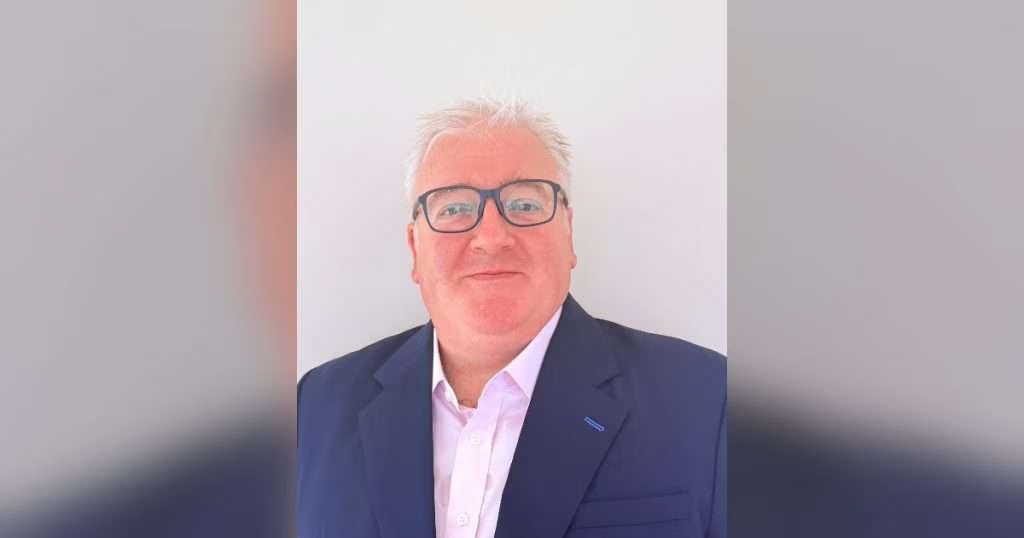
“I have spent the last 12 years collaborating with FGBNMS on various research efforts aimed at investigating the connectivity and resilience of these beautiful and unique mesophotic coral ecosystems, and I am incredibly excited to begin this new highly collaborative project,” says Michael Studivan, Ph.D., a CIMAS Associate Scientist with AOML’s Coral Program and a co-Principal Investigator on the project.
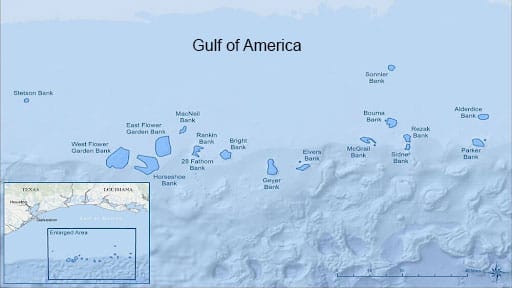
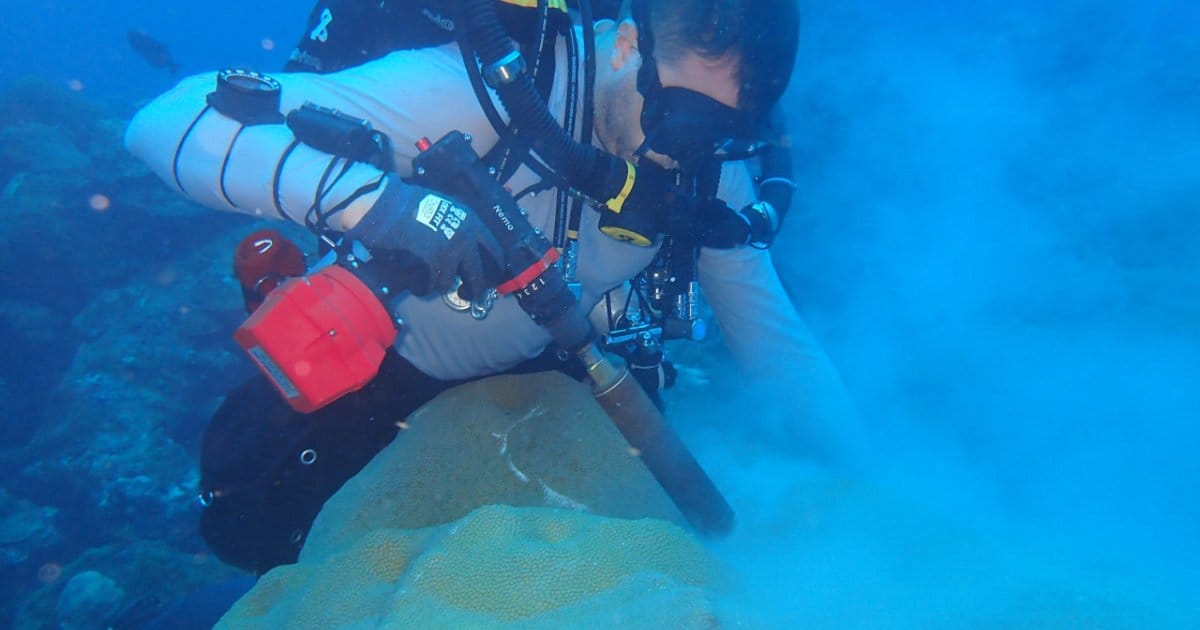
The goals of the new collaboration are to track the long-term trends in FGBNMS coral communities and oceanic conditions, and to create a comprehensive FGBNMS Reef Resilience and Adaptation Strategy. Studivan, Ph.D. and his team will lead the AOML component, expanding monitoring efforts to mesophotic coral ecosystems—in the range of 150 to 300 feet—with dive expeditions set for 2026 through 2030. However, reaching these depths requires advanced technical diving with intensive training that the team is actively completing.
“FGBNMS is part of the economic and cultural identity of the Gulf region, and plays an important role in the health and persistence of US coral ecosystems,” Studivan explains. “Exploring and characterizing mesophotic coral ecosystems requires a great deal of advanced training and care, and I consider myself extremely fortunate to have the expertise and training opportunities of the NOAA Dive Program to support and facilitate this research.”
At designated sites up to 300 feet, the team will deploy instruments assessing changes in temperature, salinity, and other ocean conditions across seasons and annually, while collecting seawater samples to analyze the carbonate chemistry of these mesophotic ecosystems. Coral cores drilled from existing colonies will unlock new information on the rates of coral growth and bioerosion in past decades—as well as the impacts of ocean acidification at these depths.
Using innovative photogrammetry-based methods developed by collaborators at NOAA’s National Centers for Coastal Ocean Science (NCCOS), they will assess reef persistence and changes in structural complexity by producing 3D photomosaic models of these sites—with the goal of developing a time series tracking major changes over years.
While the AOML Coral Program has led these efforts within FGBNMS, the Florida Keys, US Virgin Islands, and Puerto Rico under the National Coral Reef Monitoring Program since 2013, they have mainly focused on shallower reefs—those most threatened by disease outbreaks, mass bleaching events, excessive nutrient levels, and other environmental stressors.
As these conditions become exacerbated in surface waters, mesophotic coral ecosystems may act as refugia for vital marine life and species crucial to sustaining fisheries. Studies have already shown significant genetic connectivity between shallow and mesophotic coral ecosystems in FGBNMS. These reefs today provide shelter and food sources for commercially viable species of snapper, sea bass, and red porgy, a dependency that may only increase in the future.
To determine best management and adaptation practices, the team will also perform experiments testing the tolerance of mesophotic corals to greater temperatures, more acidic waters, diseases, and other stressors using innovative technology both in the field and Experimental Reef Lab, located at the University of Miami’s Rosenstiel School.
Integrating cutting-edge ‘Omics techniques, Studivan will also assess the molecular mechanisms potentially supporting the resilience of specific coral genotypes. Finally, through a collaboration with Moody Gardens Aquarium and other restoration partners, the team will identify resilient coral genotypes for land-based gene banking and restoration approaches, in order to preserve and propagate genetic diversity under changing environmental conditions.
The RESTORE project is set to produce one of the most comprehensive assessments of shallow and mesophotic reef ecosystems, their connectivity, and resilience in the face of changing environmental parameters. Understanding how reefs at these greater depths respond to rising temperatures, more acidic waters, diseases, and other exacerbated stressors will drive how we manage those natural resources we depend on. Studivan and his team are now pushing the envelope to play their role in this greater effort.
The new collaboration is led by Flower Garden Banks National Marine Sanctuary (FGBNMS) and includes NOAA’s Atlantic Oceanographic and Meteorological Laboratory (AOML), the University of Miami’s Cooperative Institute for Marine and Atmospheric Studies (CIMAS), NOAA’s National Centers for Coastal Ocean Science (NCCOS), Florida Atlantic University Harbor Branch Oceanographic Institution (FAU-HBOI), University of Alabama–Birmingham (UAB), and University of Texas at Austin–Marine Science Institute (UT-MSI).