
Critically endangered North Atlantic right whales (Eubalaena glacialis) are threatened by human activities, such as fishing and shipping. During the summer, they forage in the coastal waters of the eastern United States and Canada, using specialized plates in their mouths to sieve plankton from the water. Conservation measures, such as vessel exclusion zones, where motorized boats are prohibited, have been implemented to protect whales. However, climate change is altering the availability and distribution of their zooplankton prey, which may drive the whales away from protected areas. Most whales forage at depth, so researchers can’t directly observe them feeding. GPS tags have provided important insights into this unseen behavior, but accurately interpreting this data is challenging.
To address this problem, researchers attached special trackers to 23 North Atlantic right whales in the Gulf of St. Lawrence off the coast of Canada. The trackers were equipped with accelerometers, gyroscopes, magnetometers, depth recorders, underwater microphones, video cameras, and light sensors, allowing the researchers to determine the body position, movement, and behavior of the whales as they swam. They used the camera footage and tracking data to train machine learning models to identify movement patterns associated with feeding behavior.
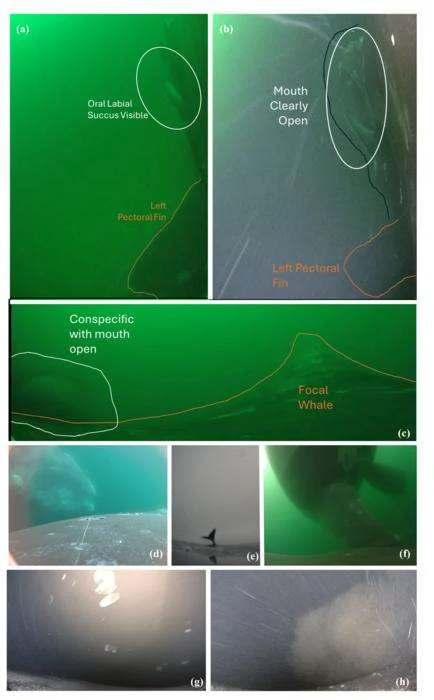
The best-performing machine learning model agreed with the researchers’ manual identification of feeding behavior 95% of the time. The data revealed that North Atlantic right whales spend between 11% and 76% of their time feeding, averaging 11.4 hours per day. During the day, whales fed close to the seafloor, but moved to the surface to forage at night, likely following the movements of zooplankton prey. This nighttime surface feeding had not previously been reported for North Atlantic right whales. The data showed that the whales spent around 25% of their time feeding outside of the vessel exclusion zone, putting them at risk of collisions with boats.
The study provides the first video footage of North Atlantic right whales feeding at the seafloor. It also reveals gaps in our understanding of their nighttime feeding behavior. Previously unreported surface foraging trips may have reduced the effectiveness of conservation protection measures, the authors say.
To read the full article in PLOS One, visit: https://plos.io/4qWO7Mq