“Vegetative reproduction as an alternative mode of reproduction is widespread in the animal, fungal, and plant kingdoms,” explains research leader Dr. Thorsten Reusch, Professor of Marine Ecology at the GEOMAR Helmholtz Centre for Ocean Research Kiel. These so-called “clonal species” produce genetically similar offspring by branching or budding and often reach the size of a football field or more. However, these offspring are not genetically identical. Previous work by a team led by GEOMAR researchers had already shown that somatic mutations accumulate in vegetative offspring, a process similar to cancer. Now, a team led by Prof. Dr Reusch, Dr. Benjamin Werner (Queen Mary University London, QMUL), and Professor Dr. Iliana Baums (Helmholtz Institute for Functional Marine Biodiversity at the University of Oldenburg, HIFMB) has used this mutation accumulation process to develop a novel molecular clock that can determine the age of any clone with high precision.
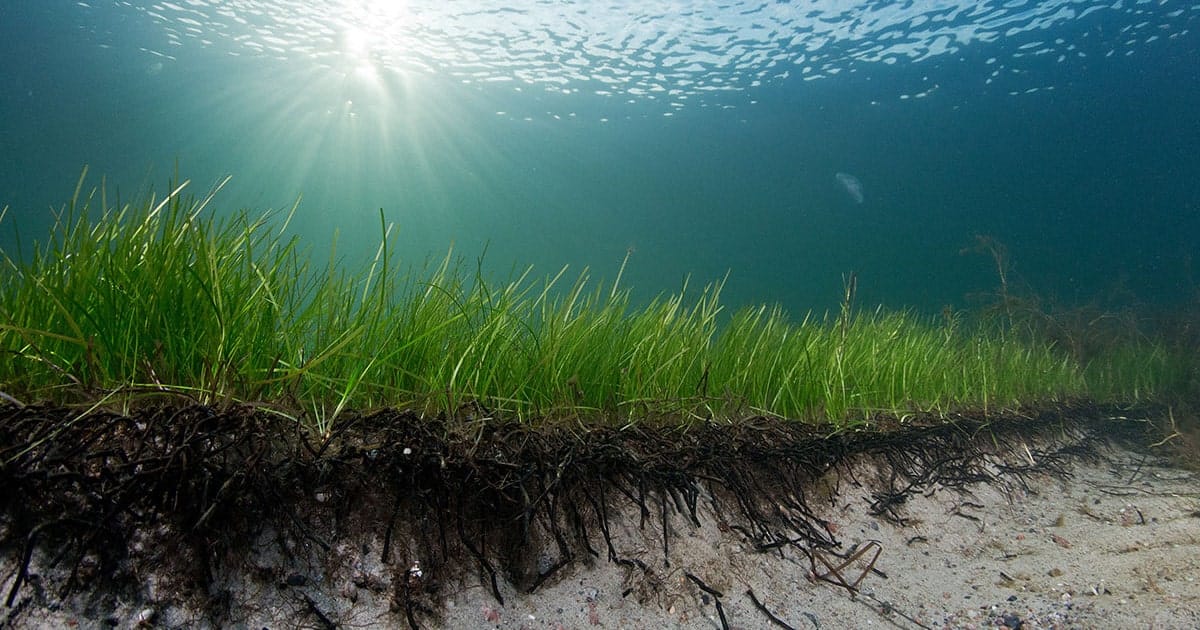
Researchers at the University of Kiel, led by Professor Reusch, applied this novel clock to a worldwide dataset of the widespread seagrass Zostera marina (eelgrass), ranging from the Pacific to the Atlantic and the Mediterranean. In Northern Europe, in particular, the team found clones with ages of several hundred years, comparable to the age of large oak trees. The oldest clone identified was 1,402 years old and came from the Baltic Sea. This clone reached this advanced age despite a harsh and variable environment. This makes the eelgrass clone older than the Greenland shark or the Ocean Quahog, which lived only a few hundred years.
These new age and longevity estimates for clonal species fill an important knowledge gap. Particularly in marine habitats, many fundamental habitat-forming species such as corals and seagrasses can reproduce vegetatively, and their clones can become very large. The continuous production of small, genetically identical but physically separated shoots or fragments from the parent clone means that age and size are decoupled in these species. The new study now provides a tool to date these clones with high accuracy. “Such data are, in turn, a prerequisite for solving one of the long-standing puzzles in conservation genetics, namely why such large clones can persist despite variable and dynamic environments,” says Thorsten Reusch.
Once a high-quality eelgrass genome was available, work could begin. Another key factor in the study was that colleagues at the University of California, Davis (UC Davis) had kept a seagrass clone in their culture tanks for 17 years, which served as a calibration point. “This paper shows how interdisciplinary interactions between cancer evolutionary biologists and marine ecologists can lead to new insights,” adds Dr. Benjamin Werner, Lecturer in Mathematics and Cancer Evolution at QMUL, who focuses on the somatic evolution of tumors which also develop clonally. Professor Dr. Iliana Baums, molecular ecologist at the HIFMB, adds: “We can now apply these tools to endangered corals to develop more effective conservation measures, which we urgently need as unprecedented heat waves threaten coral reefs.
“We expect that other seagrass species and their clones of the genus Posidonia, which extend over more than ten kilometers, will show even higher ages and thus be by far the oldest organisms on Earth,” says Thorsten Reusch. These will be the next objects of study.