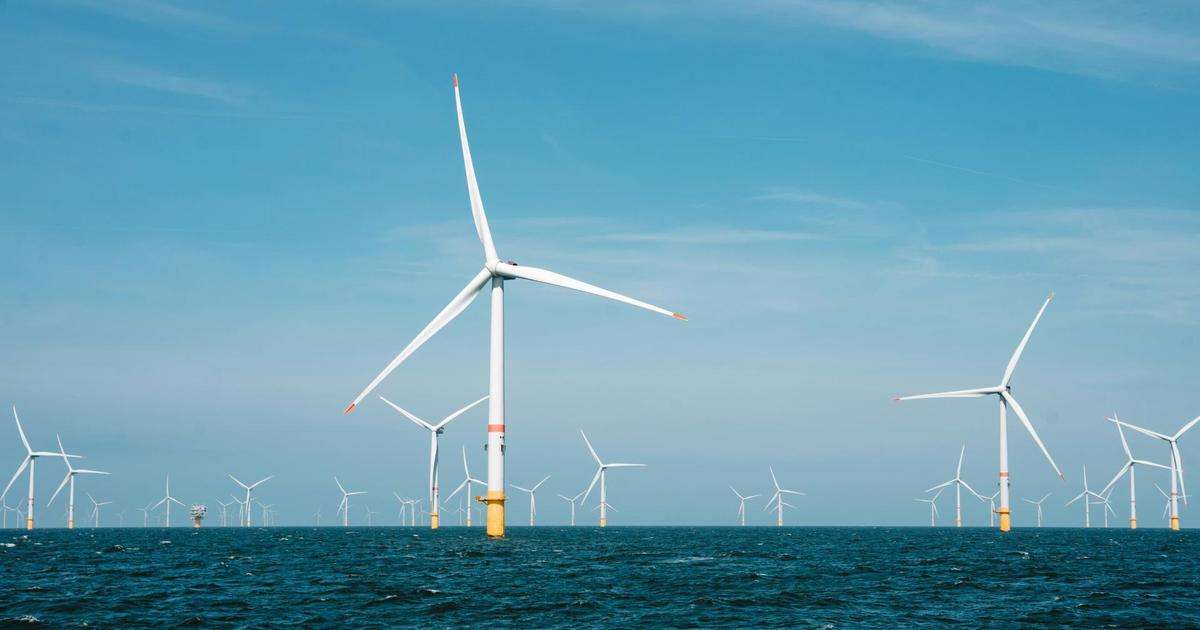
As offshore wind farms become an increasing part of the UK’s renewable energy future, scientists are working to better understand how they interact with the marine environment.
A team of scientists, led by NOC’s Michela De Dominicis, have found that while offshore wind turbine structures can alter ocean mixing and temperature, their effects depend strongly on the surrounding conditions.
Using a combination of advanced computer modeling and real-world observations collected at Seagreen Offshore Wind Farm, Scotland’s largest offshore wind farm, researchers investigated how turbine foundations influence the movement of water in the ocean.
The modeling results, published in the journal Scientific Reports, suggest that the underwater structures can enhance the natural mixing of seawater, bringing cooler water towards the surface and warmer water towards the seabed. In the model simulations, turbine-related mixing was associated with reductions in summer sea surface temperatures of around 0.1 C to 0.3 C within and around the wind farm. During the modeled 2023 marine heatwave conditions, cooling exceeded 0.5 C in some locations.
But the study shows there is not just one type of offshore wind farm effect. Instead, the type and level of impact depends on factors such as the season, tidal conditions, and how layered the water column is. Some areas are much more sensitive to additional mixing than others, particularly transitional zones between mixed and stratified waters.
Dr. Michela De Dominicis, Senior Research Scientist at NOC and lead author, said: “Offshore wind farm structures can increase mixing in the ocean, but this does not always lead to changes that we can easily detect. Environmental conditions determine when and where these effects are strongest.
“By combining computer models with field measurements, we can identify when and where these changes are most likely to be detectable, and which areas are most sensitive to change. This could contribute evidence to future offshore wind site planning, as well as help to inform the design and environmental monitoring.”
The research may help to explain why previous studies have sometimes struggled to identify clear changes caused by offshore wind farms. In many cases, the effects can be similar in size to natural variations in the ocean, making them difficult to detect.
To overcome this challenge, the team—including researchers from NOC, University of Aberdeen, and the Scottish Government Marine Directorate—combined field measurements with numerical models. The models helped identify when and where offshore wind farm impacts were most likely to occur, while observations collected by oceanographic instruments and autonomous gliders were used to assess and support the modeled findings.
The University of Aberdeen’s Professor Beth Scott, Principal Investigator of the PELAgIO project, added: “We, the PELAgIO team, are very excited to see all the hard work of designing and executing a successful aspect of the novel fieldwork that allowed validation of values and approaches in the complex modeling of the effects of offshore wind farms (OWF) on the ocean environment.
“The validated modeling has allowed the most accurate and evidence-based estimates to date of the physical effects of OWF in deeper, stratified waters and is already allowing wider scale modeling of cumulative effects of these seasonal changes on the habitats of a variety of marine animals along with comparisons of climate change effects.”
The work offers valuable new insights for both scientists and decision-makers.
It provides a clearer framework for understanding when offshore wind farm impacts are most detectable and how future monitoring programs can be designed more effectively.
The results suggest that carefully targeted observations, particularly during strongly stratified periods, are more likely to capture changes caused by turbine structures.
Read the paper ‘Environmental controls on the detectability of hydrodynamic changes induced by offshore wind farm structures’ here: https://rdcu.be/Z3RFCZ1bXpRa
The authors were supported by the PELAgIO project (Physics-to-Ecosystem Level Assessment of Impacts of Offshore Wind Farms) under the ECOWind Programme, which is funded by The Crown Estate’s Offshore Wind Evidence and Change Programme (OWEC), The Crown Estate Scotland (CES), and the Natural Environment Research Council (NERC).