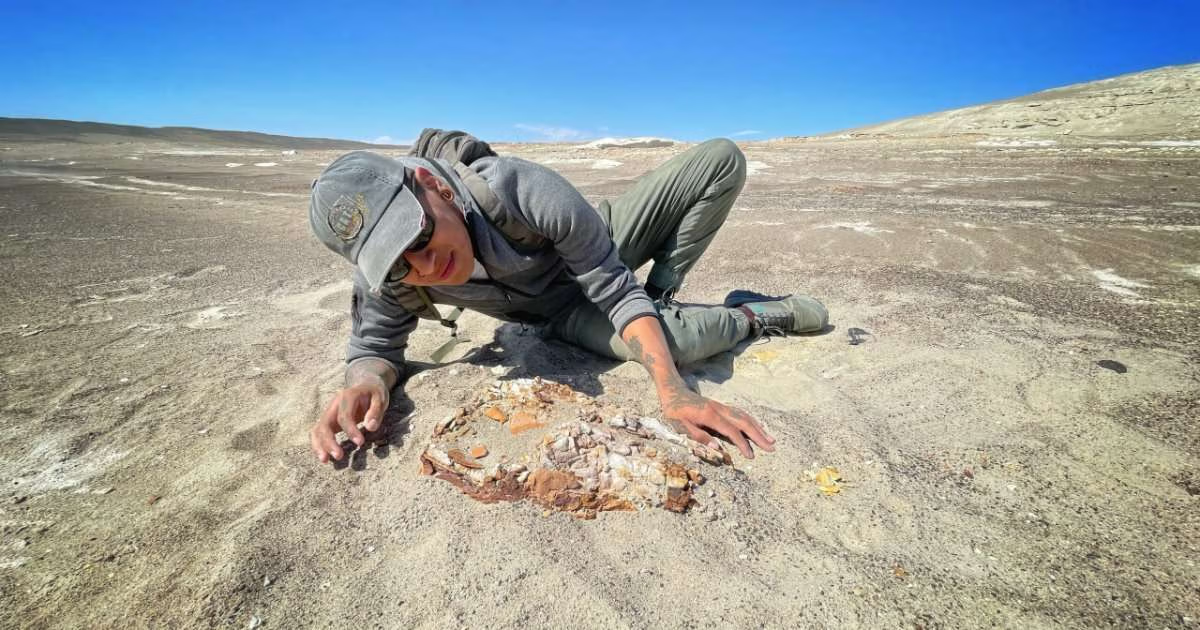
He quickly disproved the initial theory that tectonic forces within the Earth were responsible for the skull’s bizarre shape.
“The species obviously possessed this extravagant appearance when it was alive,” explained the paleontologist, who continued analyzing the fossil at the University of Zurich, where he earned his doctoral degree in 2025. The crooked skull likely served a vital biological function for prehistoric sperm whales six million years ago.
In modern sperm whales, a lesser degree of cranial asymmetry creates space for a massive organ that generates extremely loud clicking noises. When these mammals dive into the pitch-black ocean depths—sometimes exceeding 3,000 meters—they use these noises as a form of biosonar. If the sound waves hit an object, they bounce back, and the specialized skull organ registers the echoes. This allows sperm whales to navigate and detect their primary prey, squid, in complete darkness.
A Prehistoric Vacuum Cleaner on the Ocean Floor
Six million years ago, the sperm whale’s bizarre relative relied on a similar method to find food, albeit in much shallower coastal waters.
“Scaphokogia huachafo likely foraged along the seabed near the coast,” said Benites-Palomino. The animal’s body evolved precisely for this hunting style. “Like its modern counterparts, this species presumably targeted octopuses and squid,” explains FAU paleontologist Benites-Palomino. This type of prey is highly abundant on coastal seabeds and in the deep ocean.
To hunt these mollusks efficiently, many whale species have used a suction-feeding mechanism for millions of years, drawing in large volumes of water and filtering out food. However, much like a vacuum cleaner, suction feeding only works if the nozzle is close enough to the debris. To get close enough to bottom-dwelling octopuses, the fossil sperm whale’s snout evolved in a highly specialized way: the bones of its massive snout were solid, and the cartilage had completely ossified.
This immense weight shifted the 2.7-meter-long animal’s center of gravity forward. Because the snout angled downward at 31 degrees from the rest of the skull—and the animal could tilt its head down by an additional 55 degrees—this prehistoric sperm whale could swim perfectly parallel to the ocean floor. As it cruised just above the seabed, its sonar scanned the soft sediment for hidden prey. Scaphokogia huachafo then vacuumed up its food directly from the ocean floor. While its completely distorted face might look grotesque to humans, this extreme anatomy enabled the small sperm whale to hunt effectively and thrive six million years ago.