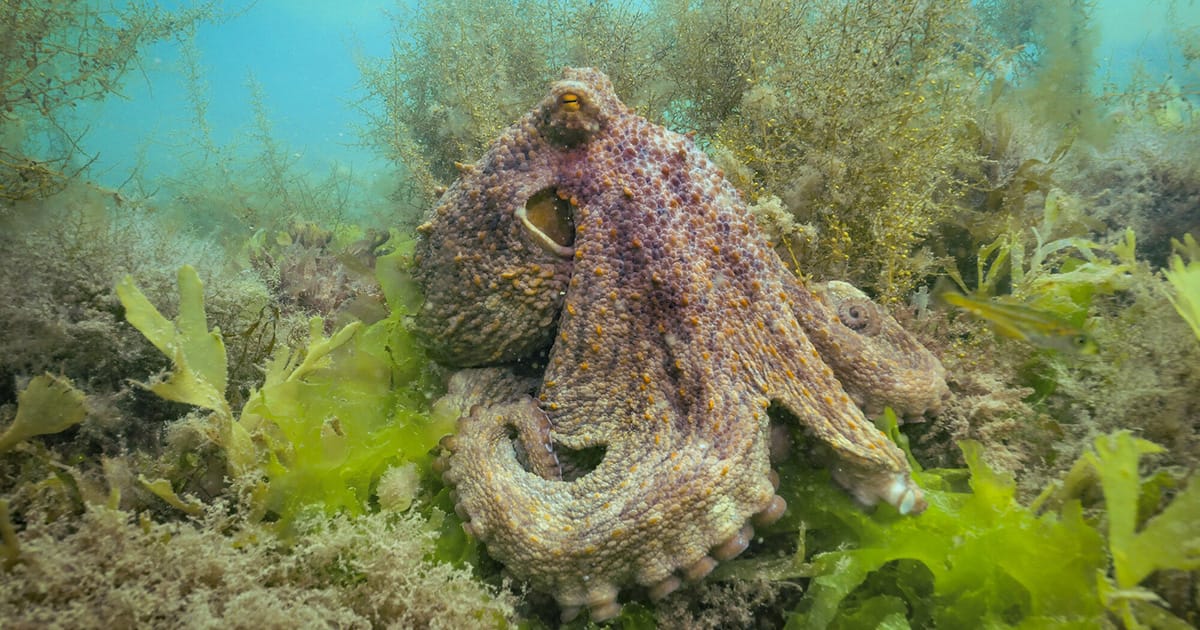
Following the unexpected bloom of common octopus reported by local fishermen since early 2025, Plymouth City Council Leader Cllr Tudor Evans OBE reached out to neighboring local authorities and Fisheries Minister Daniel Zeichner MP for support in commissioning a study to better understand the phenomenon and its impact on fishermen and the wider marine environment.
Beautiful brow, yellow, orange, and green octopus on the seafloor, surrounded by vivid green kelp and ocean flora.
As a result, Devon County Council has agreed to support and partner with Plymouth City Council. The Department for the Environment, Food and Rural Affairs (Defra) has also agreed to support the work and extend the project to include additional scientific investigations and data collection.
MBA Senior Research Fellow Dr. Bryce Stewart is leading the project in collaboration with scientists from the University of Plymouth, Plymouth Marine Laboratory, and independent scientific consultant Dr. Simon Thomas.
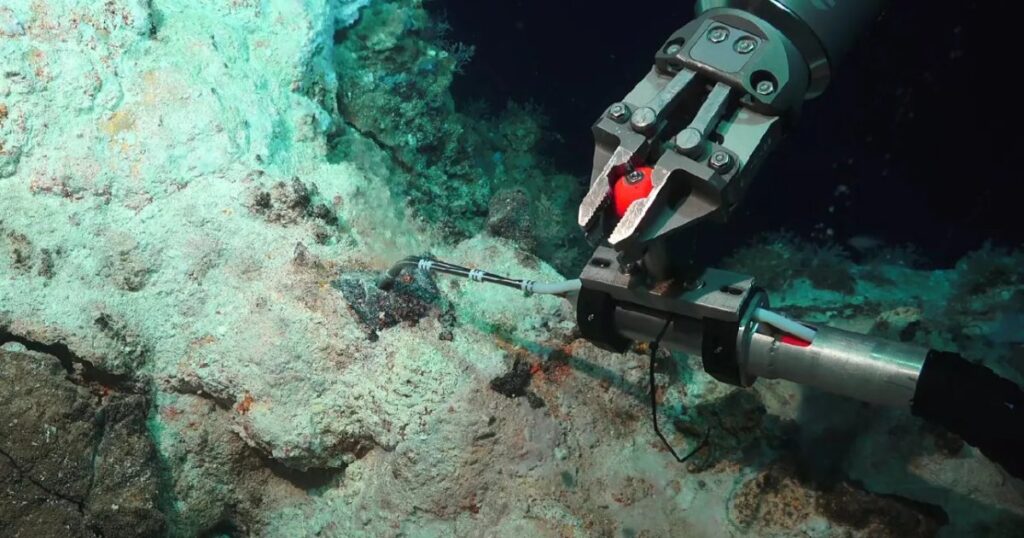
The broader piece of work commissioned by Defra and led by Dr Stewart includes the use of advanced survey methods to better understand the current bloom and develop a potential early warning system to detect future blooms. These methods include deploying baited remote underwater videos (BRUVs) in different habitats, and fitting time-lapse cameras to crab and lobster pots to observe octopus interactions with fishing gear.
Dr. Stewart said: “This research simply wouldn’t be possible without Plymouth City Council taking the lead and the backing of Devon County Council and Defra, and we’re extremely thankful for their support. Our goal is to uncover the reasons behind this octopus bloom, assess its impact on fishing communities, and work out how best to respond if we see it happen again. As our seas warm due to climate change, we can expect unusual events like this to become increasingly common, making it all the more important to survey now to help us predict what may happen in the future.”
Local Knowledge at the Heart
Former fisherman and scientist Dr Simon Thomas will lead engagement with the fishing community throughout the project, visiting quaysides across the Southwest to collect first-hand accounts of the octopus bloom. He’ll work closely with fishermen to explore where the octopus may have come from, whether they bred locally, and what this means for other marine species and livelihoods.
Dr. Simon Thomas said, “Fishermen have been at the forefront, watching this bloom unfold and shift from day to day. Their knowledge and experience are invaluable in piecing together the phenomenon. My role is to gather their insights, combine them with historical records and environmental data, and work out why we’re seeing so many octopus and whether this is a one-off or the start of a new pattern.”
Get Involved
As part of the research, two dedicated online surveys have been launched to gain the insights of those involved with fisheries and with observing marine life in Southwest waters:
- Fishermen survey: to gather insights into how the bloom has affected catches and livelihoods.
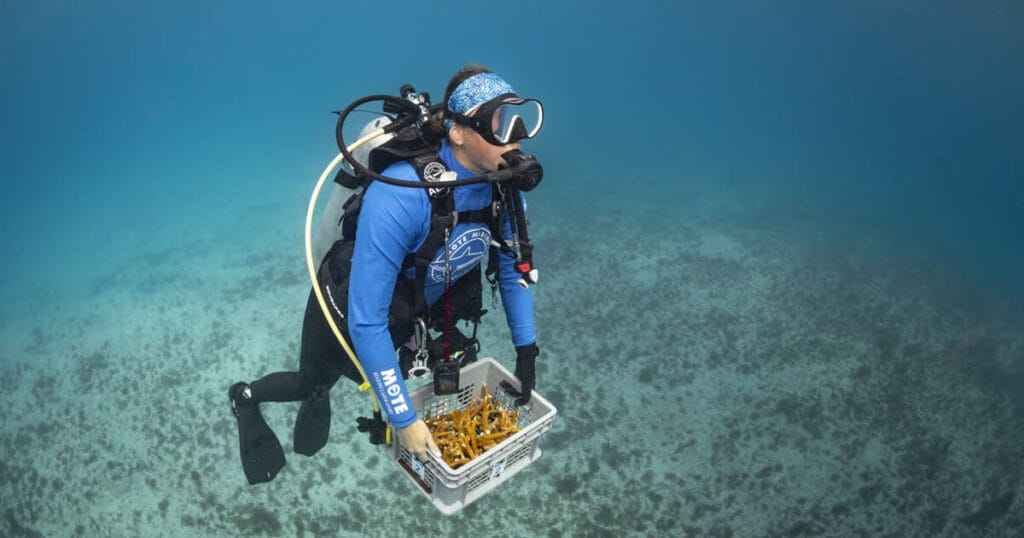
- Scuba diver and snorkeler survey: to record octopus sightings, abundance, behavior, and breeding activity.
The fishermen survey and the scuba diver and snorkeler survey both close at midnight Sunday, September 14, 2025.
A Collaborative Effort
Councillor Tudor Evans, Leader of Plymouth City Council, said: “This extraordinary octopus bloom is a wake-up call about the changing nature of our seas. Plymouth has always been at the forefront of marine science, and when our fishing communities raised the alarm, we knew we had to act fast. That’s why we brought together partners across local government and national agencies to launch this vital study. It’s a brilliant example of science and community working hand-in-hand, and it’s exactly the kind of rapid, collaborative response we need as climate change continues to reshape our marine environment.”
Professor of Marine Ecology at the University of Plymouth, Emma Sheehan, said: “I am really excited about this collaborative research project. It is a great opportunity to use the University of Plymouth’s long-term monitoring underwater video research to record octopus occurrence and study their habitat interactions.”
Project partner Professor Tim Smyth added: “Plymouth Marine Laboratory is proud to contribute to this project, which unites some of the world’s longest-running marine time-series datasets. By integrating these records, we are hoping to uncover the environmental drivers behind this remarkable octopus bloom.”
Councillor Julian Brazil, Leader of Devon County Council, added: “On a personal level, living near Salcombe and Dartmouth, this is having a direct effect on the fishing community in my area and across the whole of Devon. We’re pleased to be supporting this project, which is important for our environment and economy. Climate change is warming our seas and oceans, and we’re now seeing the additional challenges that it’s bringing with it, so it’s vital that we gain a better understanding of how this is impacting local marine life and the knock-on effect on our local fishing industry.”
The project is guided by a Steering Group including representatives from the fishing industry, the Devon and Severn IFCA, the Cornwall IFCA, Cefas, and the Marine Management Organisation.