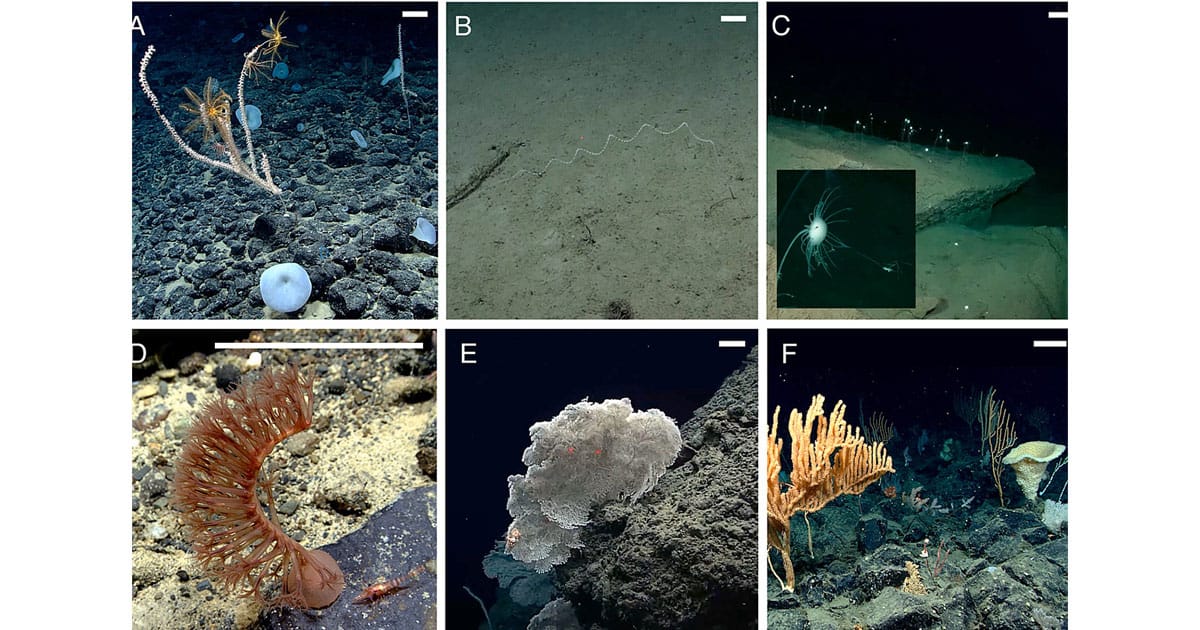
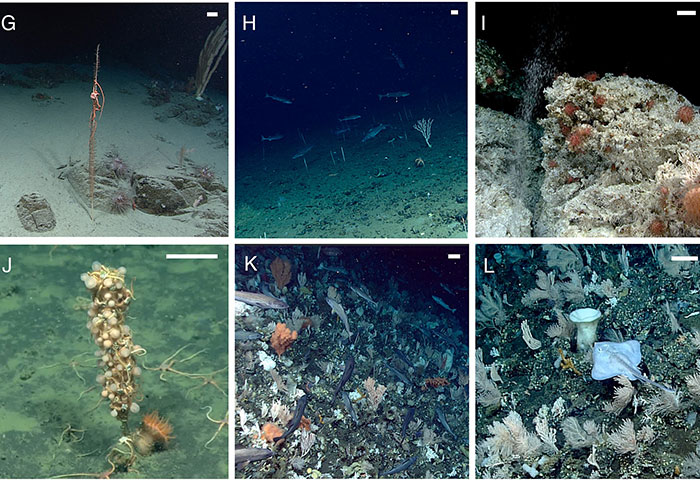
Lara Maleen Beckmann and her co-authors combed through 75 hours of video and data from Seascape Alaska expeditions in 2023, including dive recordings from previously unexplored sites between 380 and 3,200 meters (1,200 to 10,000 feet) below the surface. Along with expanding the known ranges for multiple species, the authors catalogued diverse and densely populated habitats and documented over 164 distinct morphotypes (organisms that share physical characteristics). Dominant species ranged from deepwater corals to sticklike carnivorous sponges. Amazingly, 63% of coral and sponge types identified by the researchers were only seen at one dive site.
Sponges and corals create habitat for a wide range of other animals, including commercially important species such as rockfish, king crabs, and cod. During their research, Beckmann et al. identified eight sites visited during the Seascape Alaska expeditions that qualified as high-density Vulnerable Marine Ecosystems (VMEs). At some of the sites, the researchers found over 20 sponges per square meter. In their paper, the authors note that understanding which areas are known to harbor VMEs helps inform effective fisheries management and stewardship measures.
Studying deep-sea coral and sponge communities provides an essential ecological baseline for understanding biodiversity in regions that remain poorly sampled. Equally important, though, is the question of what causes different communities to form at different sites. As part of their research, Beckmann et al. examined how environmental conditions shape the distribution of coral and sponge types across the deep North Pacific. While you might expect that depth or distance between locations would be the main factors structuring these communities, the results show a different pattern. Beckmann et al. found that a dive site’s community composition was most strongly associated with the currents and water mass structure (water with similar properties like temperature and oxygen) surrounding the site. Dive sites within the same ocean current or water mass tended to host similar assemblages, even across different depths.
“These findings provide one of the first quantitative demonstrations of these ecological patterns in Alaskan deep waters,” said Beckmann. “The importance of oceanographic structure compared to other factors like depth reinforces the need to incorporate oceanographic structure when interpreting deep-sea biodiversity patterns.”
Knowing which variables influence seafloor communities helps researchers predict the types of animals that may be discovered at similar sites. That knowledge also helps researchers and managers understand how habitats will move and change as ocean conditions shift. High-definition video from the deep sea, such as the publicly available recordings collected by NOAA Ocean Exploration, supports research on these topics around the world.
This new study was led by Lara Maleen Beckmann, a Ph.D. candidate at the University of Gothenburg. It was co-authored by Johanne Vad from the University of Edinburgh and Rhian G. Waller from the University of Gothenburg. Beckmann and others also used NOAA Ocean Exploration footage in another paper published in February 2026, which focused on deep seamounts in the North Atlantic.
Beckmann et al. (2026) Diversity and environmental drivers of deep-sea sponge and coral communities in Alaska. Deep Sea Research Part I: Oceanographic Research Papers, Volume 229. Access the full article online.