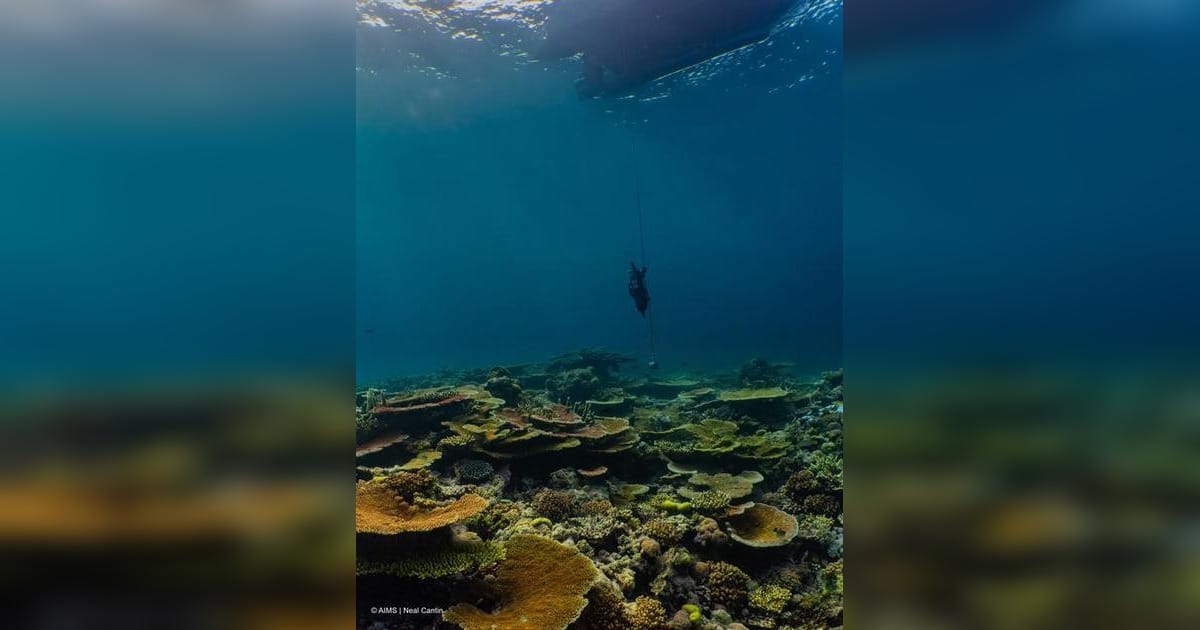
This invisible community was documented using DNA found in samples of seawater from 48 reefs, by a research team led by The University of Queensland and the Australian Institute of Marine Science (AIMS).
The authors believe this is the first time that the microbiome of the open waters of reef systems on the Great Barrier Reef has been comprehensively surveyed. They have created the Great Barrier Reef Microbial Genomes Database which is available to all reef researchers.
“Now, we can start to explore what makes a healthy reef microbiome, and how these invisible communities respond to changes on the Great Barrier Reef such as bleaching, storms, sediment, fishing and other stresses,” Professor Philip Hugenholtz, a microbiologist at the University of Queensland and a senior author on the paper said.
Researchers from James Cook University, University of Melbourne and University of Tasmania also contributed to the study.
Twenty years ago, it was almost impossible to identify and document the members of the vast but invisible communities of microbes that live in association with humans, plants and animals and are essential to life on Earth.
Dr. Yun Kit Yeoh is a senior author on the Nature paper and a senior research scientist at AIMS. His career studying microbes has taken him from plants to humans and now to the microbes of the Reef.
“Advances in DNA sequencing have allowed us to document and start to modify the communities of microbes contributing, for example, to plant health and human health. The latest advances have now enabled us to study microbiomes across a massive ecosystem, the Great Barrier Reef,” he said.
“These microbes are important. Microalgae produce most of the oxygen we breathe and underpin food chains in the open oceans,” Yun Kit says. “They are eaten by krill and other zooplankton which are then consumed by other animals from the smallest coral polyps to the largest whales. But, until now, we couldn’t see these communities,” Dr. Yeoh said.
Dr. Steven Robbins, team lead at the University of Queensland and first author on the paper, said collecting and sequencing microbial DNA in the oceans was “challenging.”
“The ocean likes to mix everything up,” he said. “A single drop of water can contain thousands of different, but often very closely related microbes—they’re really complex communities. And many ocean microbes are adapted to low-nutrient conditions typical of ocean ecosystems, which leads to them having low levels of G and C, two of the four bases that form the double helix of DNA. It’s the combination of that low-GC and the complexity of the communities that has hindered this kind of research.
“In this study, we used new ‘long-read’ sequencing technologies that bypass these issues and make it much easier to assemble the jigsaw puzzle of each microbial genome. What was a puzzle with tens of thousands of pieces becomes a simple puzzle, with far fewer pieces for the average microbial genome.
Highlights of the team’s discoveries include:
- Identifying 5,283 different bacterial and archaeal genomes, representing 876 distinct species of which two-thirds are new to public databases and available to study for the first time.
- Identifying 362,802 different kinds of viruses including Crassvirales, a virus that infects bacteria and was first found in human guts in 2014. It was originally thought to be a potential indicator of the presence of human or animal waste, but as this study shows, it is also found in the open ocean waters of the Reef.
- Recovery of complete chromosomes from Bathycoccus and Ostreococcus directly from seawater, two of the most abundant microalgae on the Reef.
“This study will complement long-term monitoring of the Great Barrier Reef, which has been conducted by AIMS for over forty years,” said Yun Kit.
The Great Barrier Reef Microbial Genomics Database was developed with the support of the Integrated Marine Observing System (IMOS) with funding from the Queensland Government. It is hosted by the IMOS Australian Ocean Data Network.