Marine clouds form on airborne particles, and cloud droplet number concentrations, and hence cloud albedo, depend on the number of particles available rather than on their mass. Sea spray aerosol produced by bubble bursting at the ocean surface contains sea salt together with organic material originating from phytoplankton and bacteria. Marine primary organic aerosols, or mPOA, have been characterized in terms of mass for two decades; their number concentration and size distribution, which govern their contribution to cloud condensation nuclei, had not previously been measured directly.
The absence of such measurements has been a persistent limitation for model development. The parameterizations adopted in several major models, including GEOS-Chem, UKESM, and CMAQ, infer mPOA number concentrations indirectly from mass. Other configurations, including E3SM and CESM2, represent mPOA without any size-resolved description. The magnitude of the resulting bias had remained unquantified.
The team isolated mPOA by exploiting a difference in hygroscopic behavior. At 90 percent relative humidity, sea salt and sulfate particles grow markedly with increasing humidity, whereas mPOA particles are considerably less hygroscopic. Using a humidified tandem differential mobility analyzer to separate particles according to their growth factor, together with concurrent measurements of particle size, number, and chemical composition, the researchers resolved the mPOA number size distribution down to 35 nanometers.
The measurements were made at the Mace Head Atmospheric Research Station on the west coast of Ireland, a site frequently exposed to clean marine air masses from the North Atlantic.
The derived size distribution is bimodal, with one mode centered near 60 nanometers and a broader mode between 100 and 200 nanometers. The parameterization used in several major models produces a unimodal distribution centered at 120 nanometers, with no representation of the smaller mode.
These differences are reflected in the integrated number concentrations. For particles larger than 35 nanometers, the parameterization underestimates the total mPOA number concentration by approximately threefold; between 30 and 70 nanometers, the underestimate is five- to sevenfold. Expressed as cloud condensation nuclei, the mPOA contribution is underestimated by about 16 percent at 0.25 percent supersaturation and 64 percent at 0.5 percent supersaturation, assuming a 30 percent reduction in surface tension.
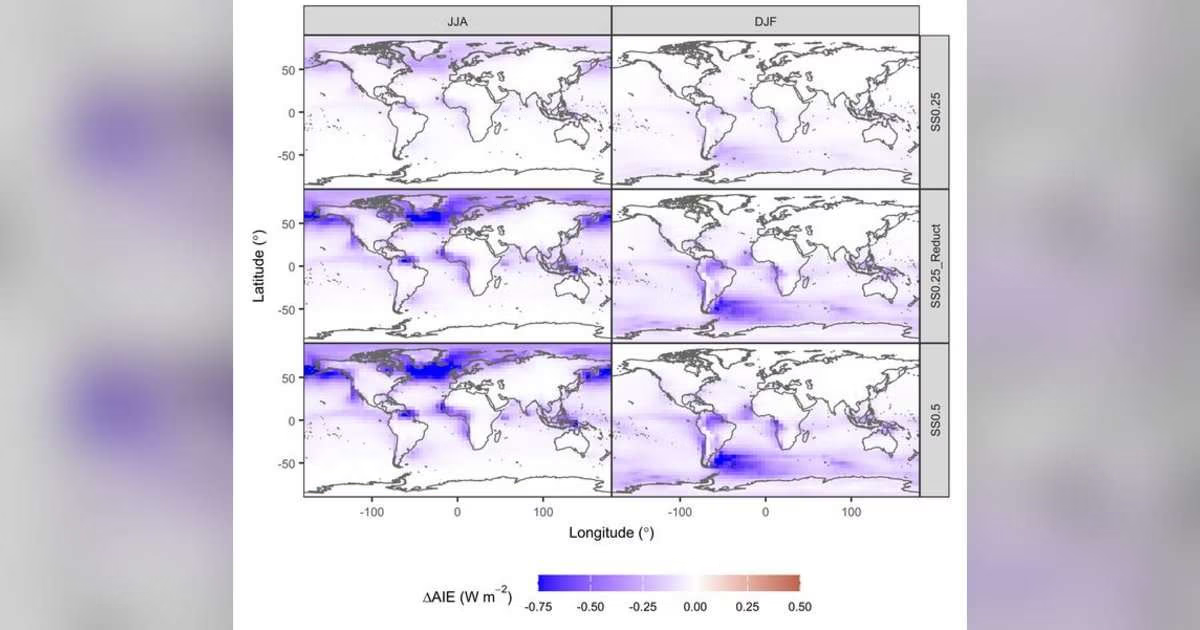
The researchers further estimated the radiative implications of this difference by combining satellite observations of cloud properties with simulations from the GEOS-Chem model. As an order-of-magnitude estimate, the additional particles correspond to a first aerosol indirect effect of approximately -0.03 to -0.04 watts per square meter averaged over the global ocean. Over biologically productive waters, where mPOA emissions are highest, the effect is substantially larger, reaching -0.1 to -0.2 watts per square meter when a reduction in surface tension is taken into account.
The authors emphasize the limitations of the analysis. The global radiative effect is presented as a sensitivity calculation, quantifying the magnitude of the mPOA influence that would obtain if the size distribution derived at Mace Head were representative of the global ocean. Because the observations come from a single site, the authors caution that regional differences in phytoplankton community composition, sea state, and atmospheric aging may modify the size distribution. Chlorophyll-a concentrations and wind speeds at Mace Head, which range from approximately 0.1 to 10 milligrams per cubic meter and 5 to 20 meters per second, respectively, encompass a substantial portion of the global ocean parameter space, although not all of it.
The results are relevant beyond the correction of a single parameter. Aerosol-cloud interactions remain among the largest sources of uncertainty in climate projections, and an underestimate of a natural aerosol source propagates into estimates of anthropogenic forcing. The findings also bear on assessments of marine cloud brightening, whose feasibility depends on an accurate characterization of the natural marine aerosol baseline.
The work was supported by the National Natural Science Foundation of China and other funders.