Ammonia-oxidizing archaea (AOA) are some of the most abundant microorganisms in the ocean and play a key role in nitrogen cycling. Yet, despite their ubiquity, scientists have long puzzled over how these microbes can flourish in the nutrient-poor waters of the open ocean, where their main nitrogen and energy source, ammonium, is often vanishingly scarce.
A new study led by researchers at the Max Planck Institute for Marine Microbiology in Bremen, Germany, now uncovers a key part of this mystery: Some AOA rely on urea, a common organic nitrogen compound, in addition to ammonium as both an energy and nitrogen source.
The research team studied the two dominant AOA groups in the oceans: Nitrosopumilus, typically found in nutrient-rich coastal waters, and Nitrosopelagicus, which dominates in the open ocean. The study combines data from expeditions to three very different ocean regions: The Gulf of Mexico, where ammonium is plentiful, the open ocean waters of the Angola Gyre, where ammonium is almost entirely absent, and the Black Sea, which has high ammonium concentrations in deeper waters and almost no ammonium in its shallow parts. Their results, published in Nature Communications, reveal why different groups of AOA thrive in these distinct marine environments and how these differences drive their global distribution.
Two Microbes, Two Strategies
The study shows that the coastal genus, Nitrosopumilus, prefers ammonium and uses urea only when ammonium is scarce. “Nitrosopumilus grows fast when ammonium is available. It is thus well-equipped for life in high-ammonium coastal waters,” said first author Jördis Stührenberg.
The open-ocean genus, Nitrosopelagicus, behaves very differently. It uses both ammonium and urea equally well, and keeps using urea even when ammonium is plentiful. These archaea seem perfectly adapted to life in nutrient-poor waters.
“Nitrosopelagicus cells have more options,” said Katharina Kitzinger, co-first author of the study. “If both ammonium and urea are present, they may even double their growth rates by using both at once.”
Most studies focus on ammonium-based nitrification, but this research suggests that urea and potentially other organic nitrogen compounds may play a much larger role in sustaining ocean productivity than previously thought. “We may be underestimating nitrification rates in the vast, nutrient-poor ocean,” said co-author Hannah Marchant.
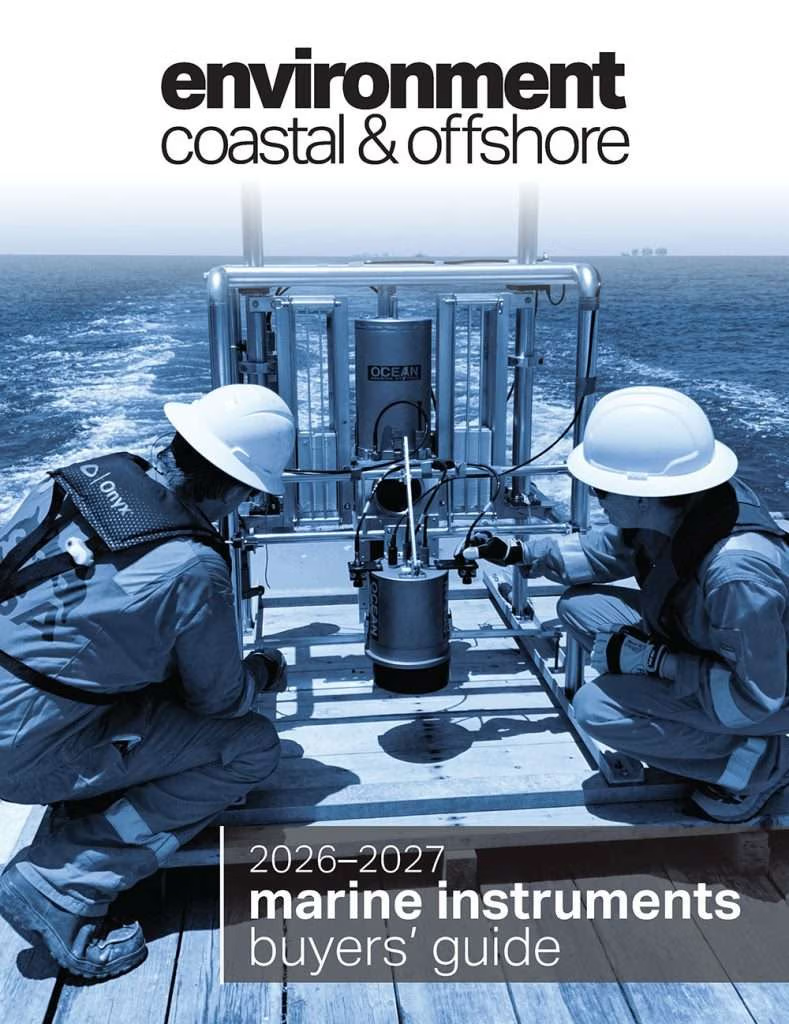
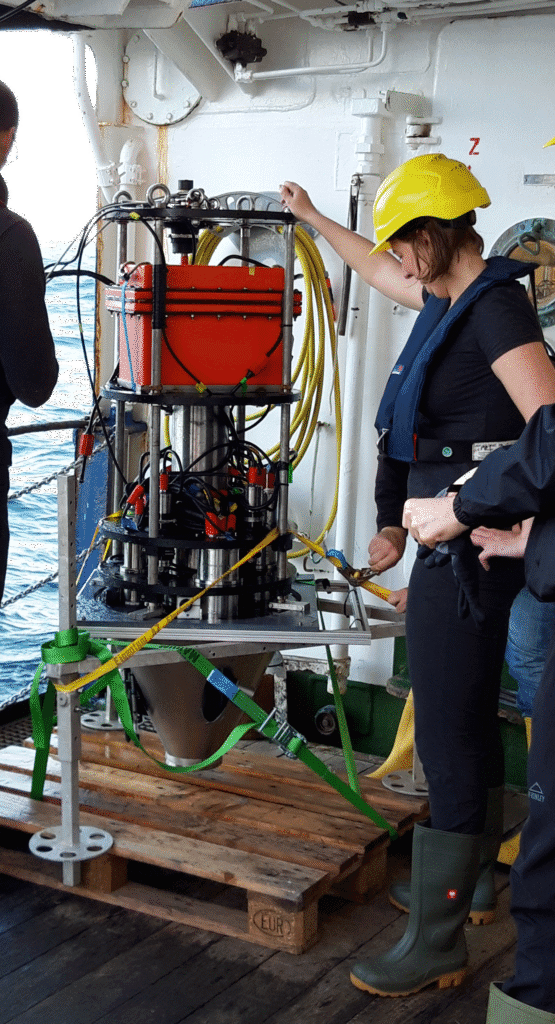 Preparing the pump-CTD in the Black Sea. (Image credit: Jana Milucka, Max Planck Institute for Marine Microbiology)
Single-Cell Evidence for Different Lifestyles
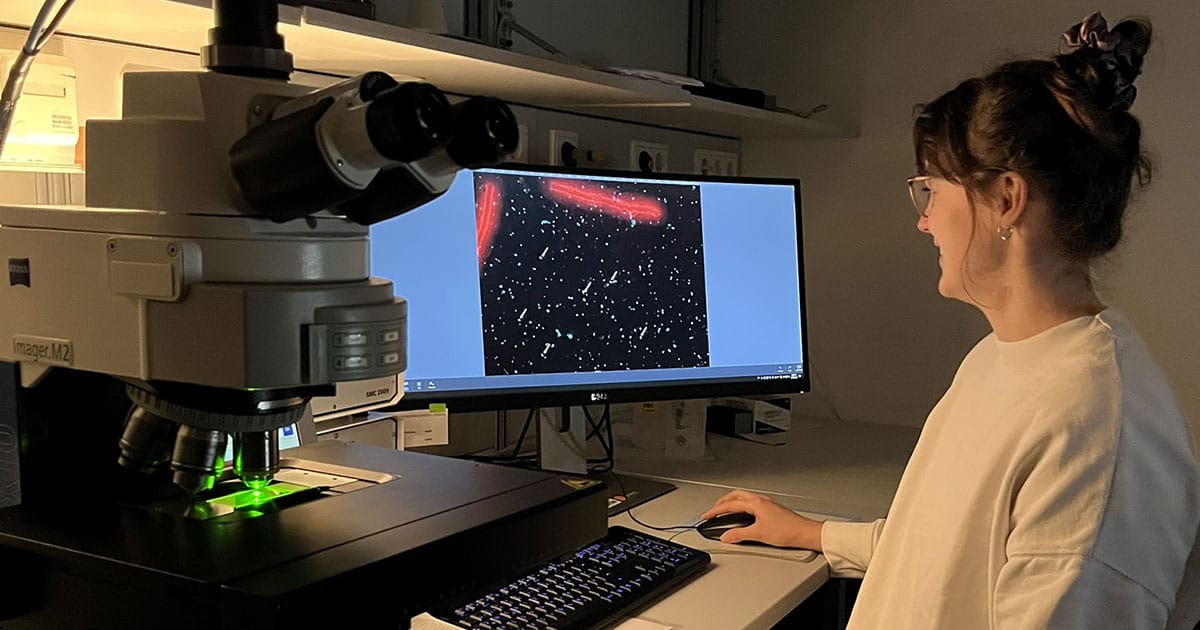
To pinpoint which AOA were using which nitrogen sources, the researchers needed to tell Nitrosopumilus and Nitrosopelagicus apart, which existing molecular tools couldn’t do reliably. Thus, the team needed to design new, highly specific probes to visually distinguish the two groups under the microscope. With these probes in hand, the researchers were able to track how each group assimilated nitrogen at the single-cell level, using NanoSIMS-imaging. “The new probes allowed us to see who was doing what in mixed communities like those in the Black Sea,” said Stuehrenberg. “Combined with the NanoSIMS analyses, we show that Nitrosopumilusgrew mainly on ammonium while Nitrosopelagicus readily used both ammonium and urea, and continued to use urea even when ammonium was abundant.”
Implications for Global Nutrient Cycling
AOA, in particular Nitrosopelagicus, are among the most abundant microorganisms in the oceans. Their ability to use urea and other organic nitrogen sources could significantly influence marine nutrient availability, primary productivity in the open ocean and the global carbon cycle.
“Understanding what fuels these microorganisms is crucial,” said Marcel Kuypers, senior author on the paper. “They are major players in nitrogen cycling, and their activity helps regulate the nutrient availability in the ocean and the global carbon budget.”
Original Publication
Joerdis Stuehrenberg, Katharina Kitzinger, Jan N. von Arx, Jon S. Graf, Gaute Lavik, Sten Littmann, Jana Milucka, William D. Orsi, Sina Schorn, Daan R. Speth, Aurèle Vuillemin, Siqi Wu,Hannah K. Marchant & Marcel M. M. Kuypers (2025): Urea use drives niche separation between dominant marine ammonia oxidizing archaea. Nature Communications. 16, 10946 (2025).