Mouser, a leading global distributor of electronic components, has supported an innovative conservation project bringing together Tandem Ventures and marine mammal charity Whale Wise to develop WHASER, a pioneering drone attachment designed to transform whale research.
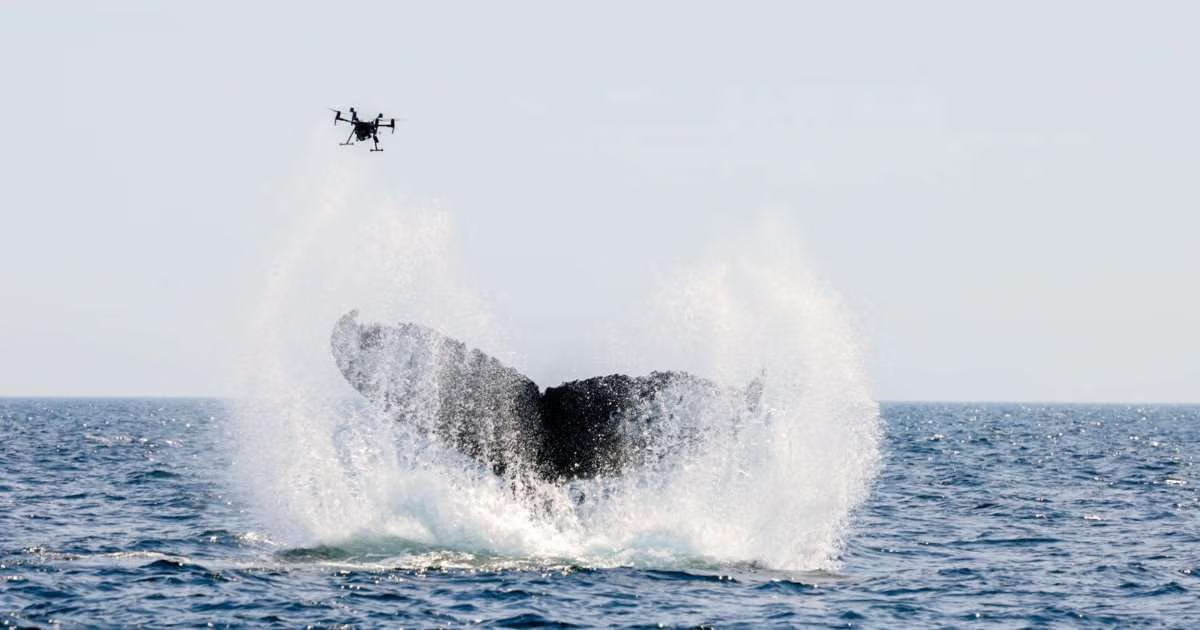
Mounted on a standard consumer drone, WHASER uses LiDAR to measure the drone’s exact altitude above the whale below. Combined with overhead imagery, this lets researchers calculate a whale’s length and body condition accurately, without approaching or touching the animal. It has already been deployed with organizations including NOAA, Ocean Alliance, IFAW, and the Center for Coastal Studies, which has also used it on grey seals.
From a boat, you can only glimpse a whale’s back, a fluke (the tailfin), and a spout, so your imagination has to fill in the rest. The new drone technology is designed to give a bird’s-eye view from directly overhead, revealing the enormity of the whole animal in its own world: how it moves, rolls, and turns, how it behaves alongside others, the condition of its body, and the scars it carries. WHASER turns that view into data, giving researchers accurate measurements of each animal’s size and condition.
In Massachusetts, WHASER was flown alongside Ocean Alliance’s drone-based tagging tool, which places a suction-cup tag on a whale’s back from the air. The tag records how the whale dives, moves, and behaves below the surface, capturing footage from the animal’s own perspective, before releasing and floating free to be collected. Paired with WHASER’s measurements of the same animal from above, the result is a thorough dataset on size, body condition, and behavior, collected non-invasively and without boats needing to close in on the whale.
Why whale research matters
Studying whales provides valuable insights into the health and undiscovered world of marine ecosystems. Accurate measurements and behavioral observation help scientists assess individual animal health, monitor populations, and better understand the wider ocean environment.
However, traditional research techniques have often required close approaches and physical interaction, potentially disturbing whales and putting researchers at risk.
Drone technology offers a safer, less intrusive alternative, allowing scientists to collect accurate and repeatable measurements from above. Beyond supporting scientific research, aerial footage also provides the public with rare views of whales in their natural environment, helping raise awareness and encourage greater support for endangered marine species.
The team behind WHASER
Following fieldwork with Whale Wise in Iceland, Tandem Ventures identified several limitations with existing photogrammetry equipment, including fragile construction, lengthy set-up times, and limited feedback for operators.
Tandem Ventures worked with Whale Wise to engineer an improved solution: WHASER, a reliable, lightweight, and rugged drone attachment built with components from Yageo Group and Molex, supplied by Mouser, combining mechanical precision and advanced electronics.
“Most researchers measuring whales are working with kit that’s fragile, slow to set up and gives them very little feedback in the field. We wanted something that would just work, on the drones people already own, in the conditions they actually face. Having Mouser behind us meant we could keep improving it between field seasons rather than waiting a year for the next chance,” said Edwin Towler, co-founder of Tandem Ventures.
Mark Patrick, Director of Technical Content for EMEA at Mouser, explained: “The quality of every component is absolutely central, as the environment is unforgiving and there is no second attempt. Salt corrosion, constant vibration and remote deployment will find any weak link you leave in the design, and a single intermittent connector or out-of-spec passive can cost a full day on the water, or an entire field season if it fails somewhere remote.”
Conservation fieldwork runs to an unforgiving timetable, as Mark added: “Quick access to reliable, traceable components is close to make-or-break, because conservation work runs to a calendar you don’t control. Field seasons are short, weather-dependent and often tied to the few weeks a year that animals gather.
Miss that window, and you wait another year for it to come round. If a part is unavailable, or a revision takes weeks to arrive, that season is gone. Being able to source dependable parts quickly, and to get an updated version in hand within days, is what lets teams like Tandem Ventures iterate between field trips, takes risk out of the design and have units ready when the researchers are.”
WHASER integrates a range of electronic technologies, including LiDAR, GPS, orientation sensors, onboard storage, battery systems, and a microcontroller. Together, these components enable precise distance measurements, synchronized data capture, and reliable operation in challenging marine environments.
By supporting the development of WHASER, Mouser demonstrates how high-quality electronic components and engineering innovation can help overcome some of the biggest challenges in conservation research.
The project highlights how technology can make marine research more accessible, improve scientific understanding, and inspire greater public appreciation for the species that depend on healthy oceans.