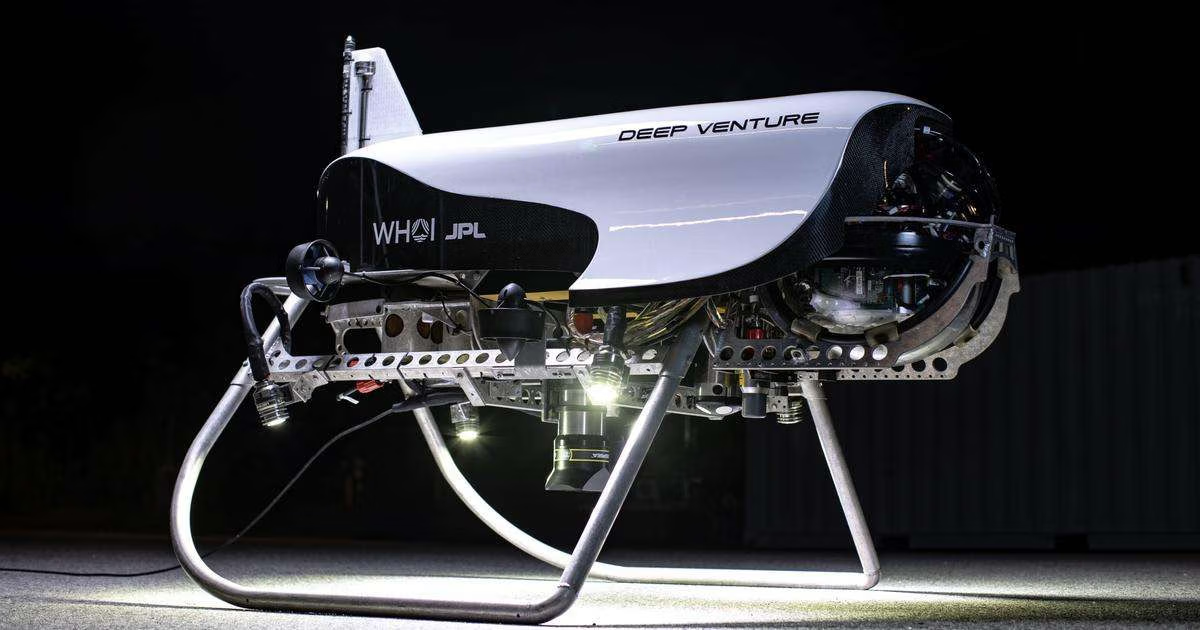
Providing research flexibility with a configurable design that can be tailored to different missions, Deep Venture can be deployed from a wide range of research vessels with minimal specialized support, expanding access to deep-ocean research. This differs from existing deep-sea AUVs, which have traditionally been designed for specific missions, requiring specialized equipment, support personnel, and access to limited research vessels.
“Deep Venture can be deployed by a small team from a wide range of vessels, and can operate untethered and autonomously after deployment,” said Allisa Dalpe, a WHOI research engineer and part of the Deep Venture team. “Because it’s lightweight, compact and modular, we can reconfigure it for different mission types with minimal changes to the vehicle, making it a real workhorse for oceanographic research.”
High-resolution imaging and photogrammetry provide detailed seafloor observations, mapping, and 3-D reconstruction, and the ability to land on the seafloor enables sample collection and other close-up investigations. A modular science payload bay lets researchers integrate new sensors and samplers, enhancing scientific utility. These capabilities make Deep Venture a versatile platform for deep-ocean research.
Deep Venture in Action: A Companion to Alvin
A key characteristic of Deep Venture is its ability to serve as a scouting and mapping companion for other vehicles. This capability was demonstrated during a June 2026 expedition near Bermuda when it operated in conjunction with the human-occupied vehicle (HOV) Alvin. Before an Alvin dive, Deep Venture descended approximately 6,000 meters (about 3.73 mi) and collected high-resolution imagery of the seafloor, helping the Alvin team pinpoint the most relevant dive locations.
According to Robin Littlefield, a senior engineer at WHOI who leads the program at WHOI, pairing Deep Venture with other human-occupied or remotely operated vehicles illustrates how autonomous vehicles can complement, not replace, other systems. “By surveying an area in advance, an AUV like Deep Venture can provide researchers with information that helps determine where and how to deploy other vehicles like Alvin,” said Littlefield. “This can help inform dive planning and maximize scientific value.”
“Looking ahead, we envision building more of these vehicles at WHOI, to be used for science, allowing researchers to increase survey coverage or deploy different scientific payloads simultaneously,” Littlefield added.
Expanding Ocean Exploration
The technology used by Deep Venture, including its ability to operate autonomously in harsh conditions and with limited communications, could inform future exploration of extreme environments here on Earth. Expanding access to deep ocean environments like the US Exclusive Economic Zone (EEZ) can improve understanding of natural resources and ecosystems, providing the data and knowledge needed to inform decisions about marine ecosystems and resources.
“The deep ocean remains one of the least explored and observed places in our global ocean,” said Anna Michel, Chief Scientist for the National Deep Submergence Laboratory at WHOI.
“Improving our knowledge of the ocean gives decision-makers a foundation to help guide how we approach exploration, resource use, and environmental stewardship.”
The Deep Venture vehicle builds upon the successful WHOI/JPL hadal research program, which culminated in 13 autonomous dives as deep as 5,000 meters (about 3.11 mi) in the Gulf of Alaska in 2024 in support of Alvin scientific dives. Now, Deep Venture extends the research program to a state of operational readiness.
“Deep Venture represents a new approach to deep-sea exploration: a compact, adaptable autonomous platform capable of reaching the deepest parts of the ocean while expanding how researchers collect, map, and act on scientific information,” said Littlefield.
“By combining full-ocean-depth capability with modular payloads, autonomous navigation, seafloor sampling, and coordinated vehicle operations, Deep Venture is designed to gather more information from the deepest parts of our ocean.”
Deep Venture at a Glance
- Developer: Woods Hole Oceanographic Institution (WHOI), in collaboration with NASA’s Jet Propulsion Laboratory (JPL)
- Vehicle Type: Autonomous underwater vehicle (AUV)
- Depth rating: Full ocean depth 11,000 meters (36,000 feet/6.83 miles)
- Weight: 250 kilograms (550 pounds)
- Dimensions: 72″ L × 60″ W × 56″
- Seafloor capabilities: Landing and sampling
- Imaging: High-resolution imaging and photogrammetry
- Science payload: Modular payload bay for chemical and biological sensors and samplers
- Deployment: Designed for small-team operations and a wide range of vessels
- Mission model: Standalone or coordinated operation with human-occupied and remotely operated vehicles
- Design Inspiration: The charismatic, deep-sea fish chimera