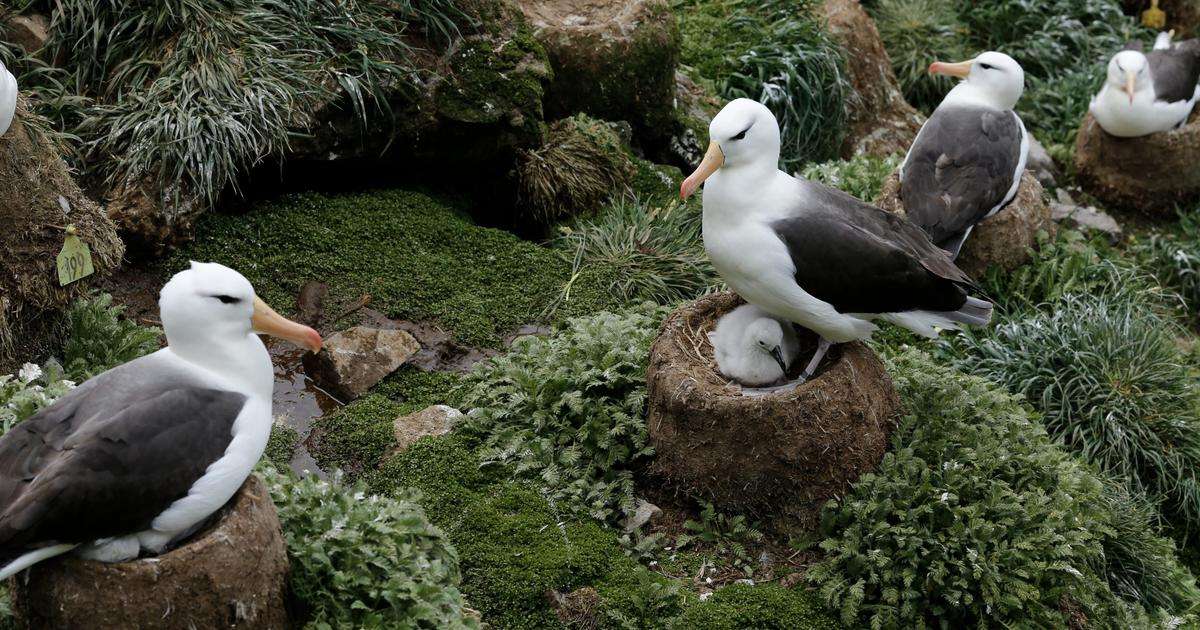
A new study published in the Proceedings of the National Academy of Sciences (PNAS) suggests that, for at least one long-lived seabird, the answer is generally no. Although evolutionary adaptation can improve the prospects of black-browed albatross populations, the study finds that evolution alone is unlikely to prevent population declines under projected climate change, but substantially limiting greenhouse-gas emissions improves the species’ chances of survival, reducing projected extinction probability by approximately half.
“Climate mitigation contributes more to population persistence than evolutionary adaptation in a long-lived seabird”, co-authored by Woods Hole Oceanographic Institution (WHOI) senior scientist Stéphanie Jenouvrier and colleagues, the study combines more than three decades of demographic and phenotypic data on black-browed albatrosses, a seabird native to the Southern Ocean and surrounding seas. The species is pelagic, meaning it spends most of its life gliding far out at sea.
Researchers used an eco-evolutionary population model and climate projections to examine not only how climate affects population dynamics, but also how natural selection and evolutionary change might alter the population’s response.
“Evolution can help populations cope with environmental change, but our results show that it has limits,” said Jenouvrier. “For this long-lived seabird, limiting the magnitude of climate change has a much greater effect on population persistence than evolutionary adaptation alone.”
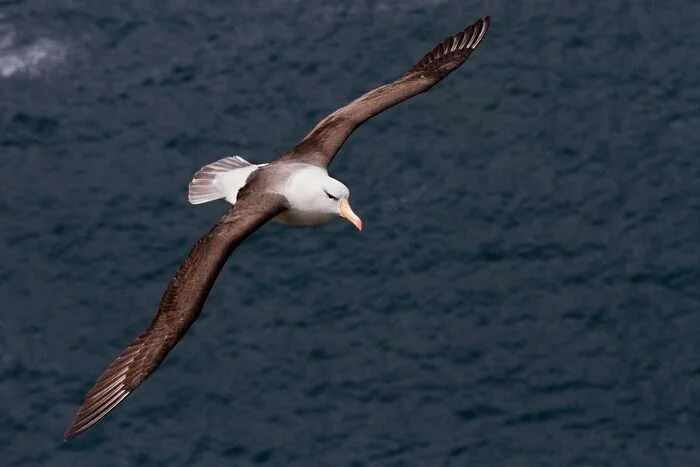
“Evolutionary rescue” occurs when adaptive evolutionary change allows a population to avoid extinction following environmental deterioration. It is often proposed as a potential buffer against biodiversity loss as the climate changes. But whether evolutionary responses can occur quickly enough remains uncertain, particularly for long-lived species. Because these species have relatively long generation times, environmental conditions can deteriorate, and populations can decline before evolutionary responses have time to substantially impact population trajectories.
“Some traits, such as wing length, can help young birds survive, but the key question is whether evolutionary changes in those traits can happen fast enough to keep pace with climate change,” said co-author Joanie Van de Walle of the Université du Québec à Rimouski.
Researchers built a computer model that combined information about albatross demography, how traits are passed from parents to offspring, and projections of future climate. The model tracked how differences among individuals in physical traits, behavior, and breeding timing affected survival and reproduction, allowing natural selection and evolutionary change to emerge over time. It also accounted for uncertainty in population changes and natural fluctuations in climate.
Under the relatively stable climate conditions of the past, allowing the albatross population to adapt through evolution led to larger projected populations. But under future warming scenarios, evolutionary changes generally were not enough to prevent the population from declining. The researchers also found that passing traits from parents to offspring did little to reduce the risk of extinction. This suggests that a species’ ability to adapt to climate change depends on more than its capacity to pass traits to the next generation; it also depends on how strongly natural selection favors those traits, how environmental changes affect survival and reproduction, and how quickly the climate is changing.
The study reinforces that the capacity for adaptation depends strongly on the environmental conditions under which evolution occurs. When climate change is sufficiently limited, evolutionary responses can contribute to persistence. Under stronger warming, those responses are generally not enough.
Co-author Marika Holland is a scientist at the National Center for Atmospheric Research. “The rate and magnitude of future climate warming impacts the effectiveness of evolutionary adaptation. Reducing future climate change by decreasing greenhouse gas emissions slows population decline and enables evolutionary adaptation to promote population persistence.”
“Our results show that evolutionary rescue depends not only on how quickly the environment changes, but also on where evolution acts across the life cycle,” said Jenouvrier. “Evolution can help when adaptation improves the parts of the life cycle that matter most for population growth, but limiting the rate and magnitude of climate change gives adaptation a much greater chance to contribute to population persistence.”