In a pair of papers recently published in Environmental Biology of Fishes and Fisheries Research, the teams recorded the first-known seasonal breeding ground of the nurse shark in the Virgin Islands, and conducted the first-ever survey of recreational anglers who have experienced depredation—when a predator eats the fish they’ve hooked—in the Northeast Shelf Large Marine Ecosystem, which stretches from northern Maine to North Carolina. Together, the papers will help efforts to protect critical breeding grounds and better educate anglers to sustain recovering marine populations.
This is how they do it; shark mating is rarely observed and critically important
It is incredibly rare to observe sharks mating in the wild. While scientists may know how they do it, where is largely a mystery, and so it is extremely difficult to protect the mating grounds that many species of sharks return to year after year. Given that many species, like the Caribbean’s nurse shark, mate infrequently, have long gestation periods, and give birth to only a few pups at a time, anything that negatively affects their preferred mating spots risks destabilizing their populations.
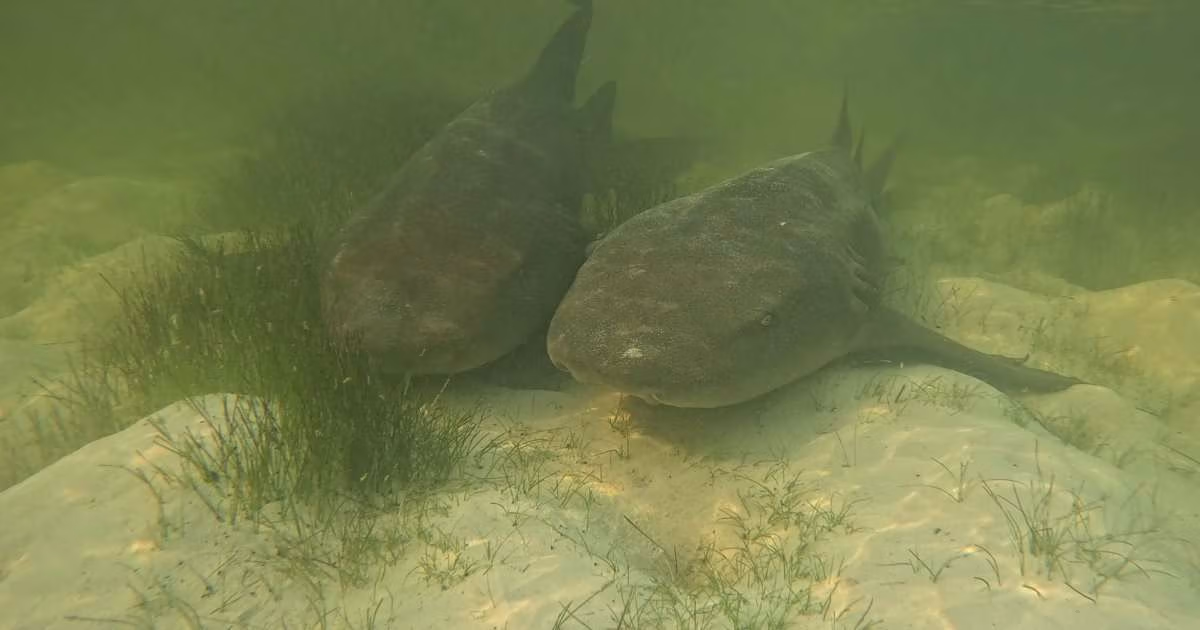
Which is why when lead author Grace Casselberry, a postdoctoral researcher at UMass Amherst, got a tip that nurse sharks were mating in the shallow waters off Windlass Bight, in the Virgin Islands’ Anegada, she was so excited. “The only other place in the world where similar numbers of mating nurse sharks has been recorded is in the Dry Tortugas,” she said. “One day we witnessed 27 nurse sharks in tightly packed groups, in shallow water, mating happening throughout the day.”
“This is the bedroom for these sharks,” said Andy Danylchuk, professor of fish conservation at UMass Amherst and one of the paper’s senior authors. “There’s something quite special about this particular location.”
It turns out that nurse sharks prefer to mate in the shallows, near shore. “Knee deep is the sweet spot,” says Casselberry, “and it’s all happening in an area about 150 meters long, which means that the spot is sensitive to human disruption. If this stretch of shoreline were to be developed, it would erase this group of nurse shark’s mating grounds.”
In fact, even the researchers’ presence seemed to disturb the sharks, who would rather mate unobserved—which means sites like Windlass Bight should be preserved, and more work undertaken to find, and protect, shark breeding grounds.
More anglers, more sharks, more seals…more conflict
“Humans can do terrible things,” said Evan Prasky, Ph.D. student at UMass Amherst and the author of a new paper on depredation in the Northeast Shelf Large Marine Ecosystem, “but we can also learn how to coexist. We need to move toward a more coexistent model of ecosystem management and conservation.”
One of the unintended consequences of the conservation measures that have successfully helped to reverse declines in sharks, seals, and other marine predators is that the fish recreational anglers love to hook, like striped bass, have become easy targets for hungry animals.
“Seals are a great conservation success story,” said Prasky. “There were only several hundred left in the Northeast Shelf a few decades ago, they had bounties on their heads and hunters could kill as many as they wanted because they were seen as competition for fish. But now, there are up to 27,000 individuals. The populations are rebounding.”
Many species of sharks, too, are starting to show some signs of recovery—as any visitor to Cape Cod, with its resident population of great whites, can attest.
At the same time, recreational angling is more popular than ever, the gear more specialized and effective.
With conditions like these, conflict between predator and angler is almost inevitable, and yet upwards of 50–60% of people don’t believe recreational fishing has an impact on the surroundings, Prasky found. “This is a big red flag from a policy and management perspective,” he says, “because it hampers conservation efforts.”
“Prasky is a social scientist,” said Danylchuk, the paper’s senior author, “and a survey, like his, that uncovers anglers’ perceptions of depredation in the Northeast Shelf has never been done before. We’re getting ahead of the curve by establishing a baseline about angler perceptions, especially as shark populations continue to recover and their distributions move north because of climate-warmed waters.”
What Prasky and his colleagues found after receiving survey responses from 954 anglers is that seals and sharks are both depredating in the Northeast Shelf, but that the chance of encountering either a seal or a shark depended on latitude and how far offshore the angler was. The farther south and the farther out an angler ventures, the more likely they were to encounter a shark. Seals were more common in more northern, close-to-shore fishing spots.
He and his team also found that the more frequently an angler lost their catch, the more likely they were to support reducing populations of the prey species.
Finally, in regions where both seal and shark depredation occurred, anglers were more likely to focus their anger on seals, rather than sharks.
“This is a human problem,” said Prasky. “We need to understand that it’s good for the entire marine ecosystem when there are more sharks and seals, and so we have to work to shift toward a model of co-responsibility—where a conservation ethic is embedded in the culture as well as in management practices.”
“Shark conservation, depredation, and anglers’ responses, are all only going to get more complex as the oceans warm and shark populations recover,” said Danylchuk, “which is why we need both social and natural scientists to help inform what we do.”