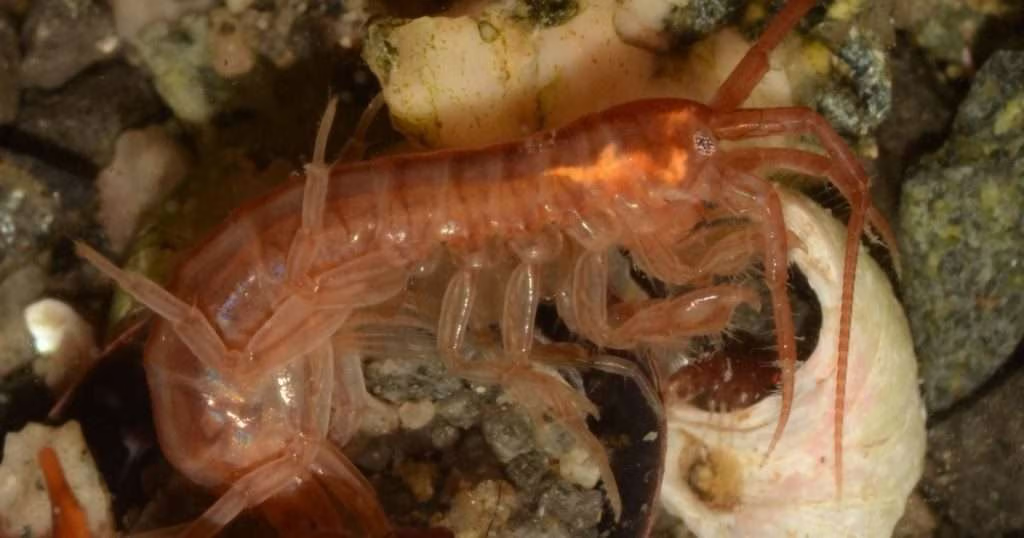
![Researchers documented the distinctive benthic [deep-sea] behaviors of three peristediid (armored searobin) fishes observed in the South China Sea: Scalicus engyceros, Paraheminodus murrayi and Peristedion liorhynchus. (Image credit: Kedong Yin)](https://ecomagazine.com/wp-content/uploads/2026/08/researchers-film-deep-sea-armored-searobin-walking-sideways-.avif)
The team published their paper, “Walking Fish,” on July 30 in the journal Ocean-Land-Atmosphere Research.
“[Our] study delivers a paradigm-shifting revelation: the deep-sea fish Scalicus engyceros, a representative of fishes characterized by highly specialized free pectoral-fin rays, is among the few fish species known to walk. Commonly known as the armored searobin, this extraordinary creature boasts a striking shrimp-fish hybrid body appearance, earning it the nickname ‘fish-prawn hybrid’ in U.S. local media,” said Han Tian, primary author and a doctoral researcher in School of Marine Sciences at Sun Yat-sen University.
The team’s filmed observation confirmed the speculation that searobins used their free pectoral-fin rays for walking. Searobins were first described by Albert Günther back in 1872, but no one predicted the fish could walk both sideways and backward, a movement that has never been observed in other fishes.
“Another unique trait is its outward-extending barbels, which looks like a farmer’s rake. The structure is awkward for moving around, but it allows the searobin to sense and probe potential prey in seafloor sediment or even dig into the surface sediment for efficient foraging. Meanwhile, the creature retains the pectoral fins, which have evolved into flat, round plates, improving balance during walking and swimming, while its shrimp-like fin rays and tail enable explosive, jerky shrimp-style leaps when threatened,” said Tian.
Another impressive feature is the searobin’s large eyes. The organism could not see the approaching vehicle, but it did roll its eyes at the vehicle’s light beam. This suggests that the searobin’s eyes have retained some sensitivity to light, which may reflect some light history during its life cycles. The three live armored searobin (peristediid) fish Scalicus engyceros, Paraheminodus murrayi and Peristedion liorhynchus were also observed in different locations in the South China Sea, which raises the hypothesis of local specialization forces in action.
“Deep sea life remains mysterious today with so many unknowns. Modern deep-sea diving vehicles allow not only discovery of new species but also add a new in situ, functional dimension to the study of species based solely on the morphology of preserved specimens. By observing deep sea animals alive in their surrounding environment, we can gain insight into the adaptation and evolution of the species. These walking fish harbor far more novel behavioral and evolutionary adaptations than previously assumed. By further exploring the co-evolution of the fish’s unique rake-shaped appendages, walking locomotion and deep-sea foraging strategies, our team aims to establish a new framework for understanding benthic [deep-sea] fish adaptive evolution. Ultimately, this research will reshape scientific perceptions of deep-sea biodiversity and reveal how extreme marine environments drive the emergence of one-of-a-kind biological structures and behaviors unseen in any other aquatic organism on Earth,” said Tian.
Wei Xie, Mingting Li and Kedong Yin from the School of Marine Sciences and the Guangdong Provincial Key Laboratory of Marine Resources and Coastal Engineering at Sun Yat-sen University, and the Southern Marine Science and Engineering Guangdong Laboratory in Zhuhai, China also contributed to this research.