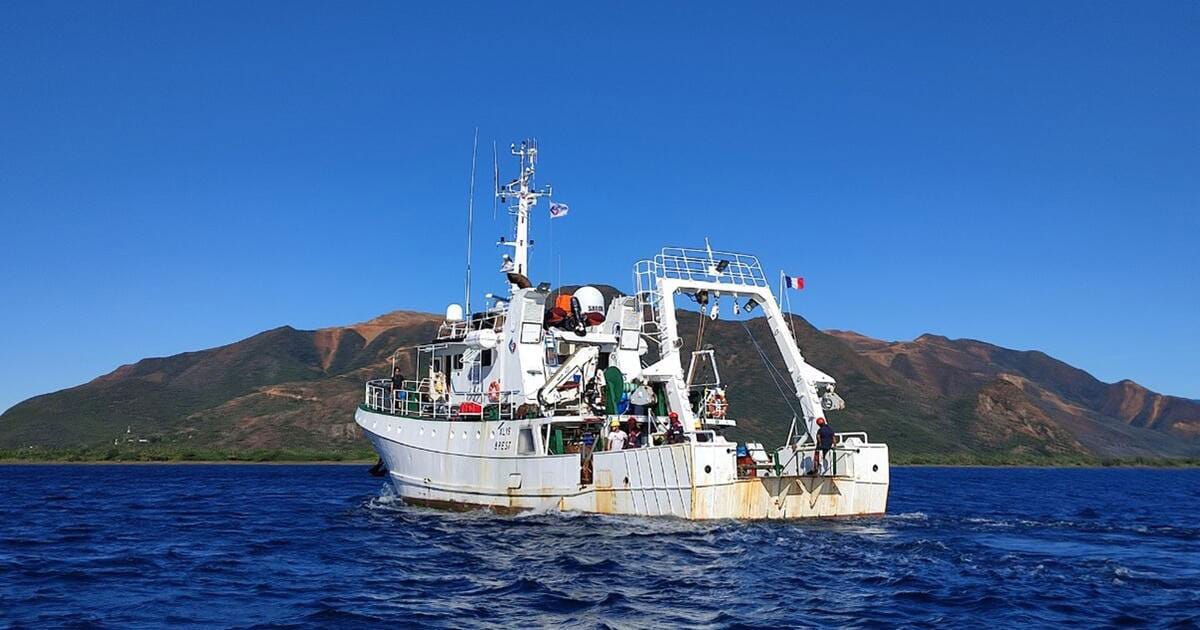
Human activities on land have direct consequences for coastal marine environments, but these impacts remain poorly quantified over the long term. Through the ECOMINE project, launched in 2022, scientists sought to understand how and to what extent changes in terrestrial landscapes can be transmitted to marine ecosystems via rivers.
They focused their efforts on a coastal area located downstream of the Thio River on the east coast, where the first nickel deposit ever mined in the history of New Caledonia is located.
“We chose this site because the upstream watershed has little urban development and little agricultural activity. This allowed us to clearly isolate the impact of mining on the microbial communities that form the base of the food chain any coastal ecosystem. Any change in the composition of this component of marine biodiversity can have an impact on all other species,” explained Raffaele Siano, an environmental genomics researcher at Ifremer and the coordinator and principal investigator of this research.
To trace the site’s environmental history, they analyzed a sediment core collected in 2022 from the lagoon, 1 km off the coast. A veritable natural archive, this 2.26-meter-long sample allowed researchers to go back nearly 1,000 years and track changes in the marine environment before, during, and after the rise of mining activity.
The scientists dated and analyzed the chemical composition of the sediments, including concentrations of nickel and other metals; measured sediment particle size and sedimentation rates; characterized foraminifera assemblages; and screened ancient sedimentary DNA. This multidisciplinary approach made it possible to simultaneously track the physical, chemical, and microbiological changes in the coastal ecosystem over time.
A Sudden Shift in the 1950s
The study shows that mining, which began in 1875, has gradually altered sediment input into the lagoon. It highlights a major turning point starting in the 1950s, with the mechanization of mining extraction tools. This period corresponds to a sharp acceleration in the erosion of nickel-rich soils, which, carried by rivers, accumulated in the nearby lagoon. Between 1950 and 1975, approximately 27 million tons of mining waste (tailings) were dumped into the Thio watershed.
“For centuries, marine microbial communities remained relatively stable. But following the mechanization of mining operations, sedimentation rates and nickel concentrations in the lagoon increased fivefold, and microbial biodiversity declined sharply,” said Mathisse Meyneng, postdoctoral researcher at Ifremer and a specialist in paleoecology and environmental genomics.
Scientists have observed, in several samples from the period 1950–1975, the total disappearance of foraminifera, some of which are highly sensitive to environmental disturbances. In contrast, more tolerant microalgae such as Desmodesmus, never previously detected in ancient sediments, became dominant.
“Environmental regulations and measures implemented by mining operators begun in 1975 and have significantly reduced sediment inputs associated with mining operations in the Thio Lagoon. However, the sedimentation rate remains still very high today, averaging 0.9 cm/year, compared to 0.1 cm/year before mining began. Certain microbial communities have gradually recolonized the environment, a sign of the effectiveness of the management measures implemented, though this has not yet allowed them to return to their original composition,” said Hugues Lemonnier, marine biology researcher at Ifremer and Scientific Director of the Ecomine project.
The sediment core collected at Thio has not yet revealed all its secrets. Scientists are continuing their analyses and are seeking, in particular, to understand the origin of the still-elevated sedimentation rates observed today, which are not solely associated with recent mining activity. They are specifically studying the impact of recurring wildfires, which are known to contribute to soil erosion.
Ancient DNA in the Service of Environmental History
To investigate the lagoon’s past, scientists used cutting-edge techniques based on the analysis of ancient DNA contained in marine sediments. This approach, known as paleogenetics, makes it possible to reconstruct the evolution of biodiversity over time. In 2021, it revealed the impacts of World War II and intensive agriculture on microbial communities in Brest Harbor. In this new study, scientists once again demonstrate the potential of this paleogenetic approach.
Protecting Coastal Ecosystems
Beyond the case of New Caledonia, this study serves as a reminder of just how closely linked terrestrial and marine environments are. Scientists are calling for more integrated management of the “land-sea continuum,” particularly in regions subject to high levels of human activity. They also urge the strengthening and expansion of coastal observation programs to better track changes in biodiversity, assess the effectiveness of environmental management policies, and understand the resilience of coastal ecosystems in the face of human pressures.