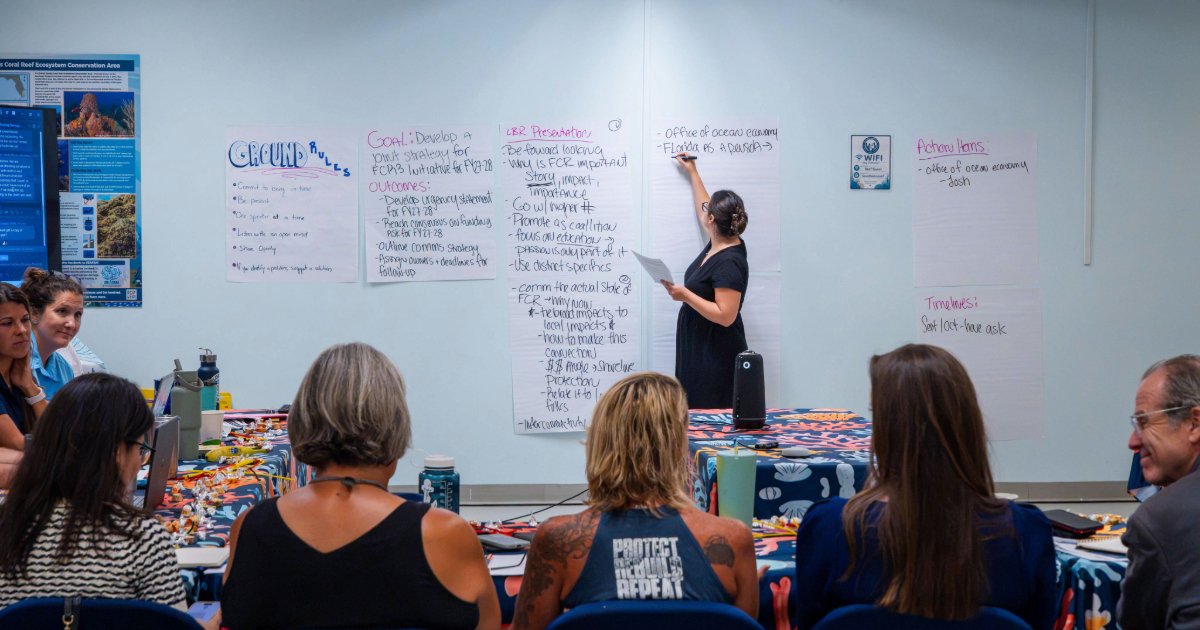
Attendees, including Rep. Emily Gregory, Reef Renewal USA, and Harbor Branch Oceanographic Institute, met with Leneita Fix, Executive Director of The Reef Institute, to learn how the organization is preserving coral species, advancing restoration science, and helping safeguard Florida’s Coral Reef, the only living coral barrier reef in the continental United States.
The Reef Institute’s coral biobank was established through support from the Florida Coral Reef Restoration and Recovery Initiative (FCR3), a statewide effort designed to restore and enhance Florida’s coral reef ecosystem. The recent loss of state funding has effectively halted the multi-year initiative aimed at restoring 25% of Florida’s 350-mile coral reef tract by 2050. The setback comes at a critical time, as less than 10% of Florida’s coral reefs remain alive today.
“When people see the coral biobank for the first time, they quickly understand that its impact extends far beyond research,” said Leneita Fix, Executive Director, The Reef Institute. “It is a lifeline for some of Florida’s most threatened coral species. We were grateful for the opportunity to show our elected leaders the tangible results of the state’s investments in conservation, including the Florida Coral Reef Restoration and Recovery Initiative, and the importance of continuing this critical work.”
Earlier this month, the organization hosted a behind-the-scenes tour with Representative Kelly Skidmore, Representative Rob Long, and delegates representing US Senator Rick Scott, members of the Palm Beach County Legislative Delegation, and additional state and federal offices. The visit provided officials with a firsthand look at the impacts of conservation investments and the role organizations like The Reef Institute play in responding to challenges such as coral disease, bleaching events, and habitat degradation.
The Reef Institute remains committed to its mission of conserving coral through education, research, and restoration while continuing to collaborate with government agencies, academic institutions, and conservation partners throughout Florida.