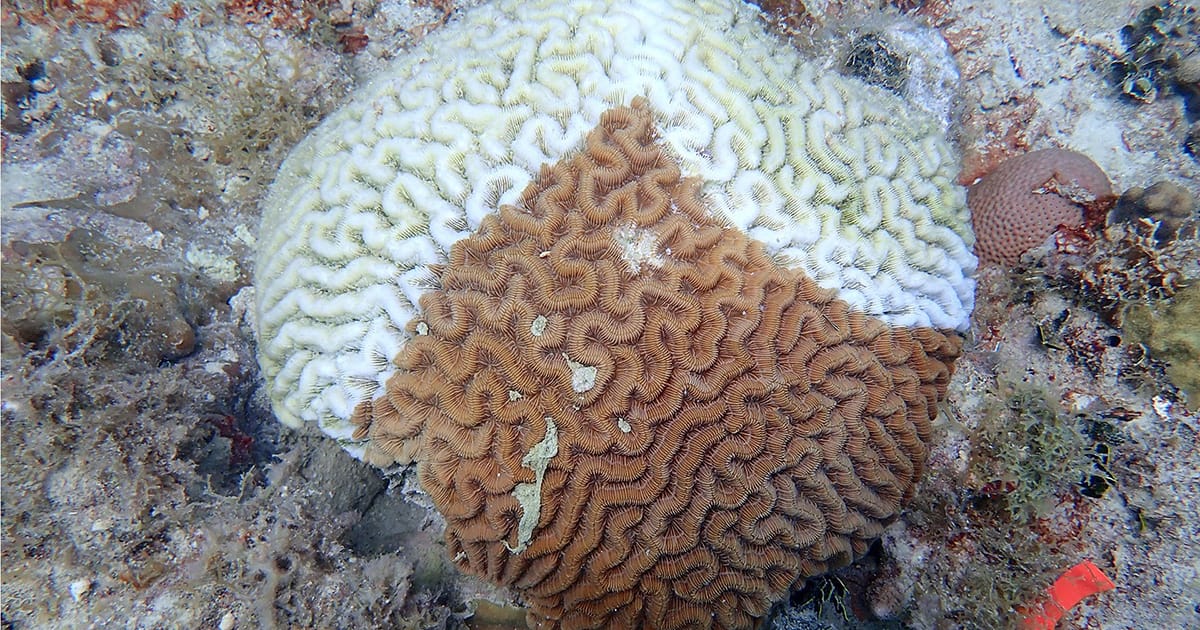
Coral reefs support more than 25 percent of all marine life and underpin the livelihoods of roughly one billion people globally. Yet forecasting coral disease remains a major challenge, with most diagnoses relying on visual inspections by divers after the disease is already well established. The new study, published in Cell Reports Sustainability, demonstrates that changes in the seawater microbiome adjacent to corals can reveal disease presence more clearly than microbes living within coral tissue itself.
“This study shows that the ocean water surrounding a coral can tell us a lot, including when that coral is sick,” said Jeanne Bloomberg, lead author of the study and a WHOI–MIT Joint Program graduate student. “By identifying a strong disease signal in the surrounding seawater, rather than in the coral tissue, we’re laying the groundwork for a diagnostic tool that is both effective and non-invasive.”
The research team followed the same colonies of brain coral (Colpophyllia natans) over four years on reefs near St. John in the US Virgin Islands, beginning before the arrival of stony coral tissue loss disease (SCTLD), providing baseline data to track disease before, during, and after the outbreak. Between 2020 and 2024, scientists repeatedly sampled both coral tissue and the seawater immediately surrounding each colony. Using genetic sequencing to identify the microbes, the researchers found that the microbes living inside coral tissue varied, even when the corals appeared healthy. In contrast, the microbes in the surrounding seawater were stable near healthy corals but changed sharply when corals became diseased during the SCTLD outbreak.

“These seawater microbes seem to react to material released by diseased corals,” Bloomberg said. “This effect was strongest during the height of the outbreak, when disease was most widespread on the reef.”
SCTLD is one of the most devastating coral diseases ever recorded, having spread across much of the Caribbean over the past decade. While antibiotic treatments can slow or halt disease progression on individual corals, the exact pathogen responsible remains unknown.
“Our findings provide compelling evidence that seawater microbiomes can be used to diagnose coral disease and potentially other reef disturbances,” said Amy Apprill, an associate scientist at WHOI, project lead on the WHOI Reef Solutions Initiative, and Director of the Francis E. Fowler IV Center for Ocean and Climate. “If paired with automated sampling and rapid genetic detection, this approach could form the basis of an early warning system, allowing managers to respond before disease causes irreversible damage.”
For reef managers in the Caribbean, earlier detection could be transformative.
“We have seen severe losses of reef-building corals to stony coral tissue loss disease, with significant economic and ecological consequences,” said Marilyn Brandt, research professor at the University of the Virgin Islands, and a co-author on the study. Developing diagnostic tools for coral disease based on this work could help us respond faster and more strategically to protect what remains.”
By demonstrating that reef seawater carries a measurable disease signal, the study opens new pathways for scalable, non-destructive reef monitoring, an urgent need as coral reefs face increasing pressure from warming oceans, pollution, and emerging diseases. As coral reefs continue to decline globally, tools that allow scientists to forecast reef health, rather than simply document loss, are critical. This research represents an important step toward protecting reefs before irreversible damage occurs.
“This work highlights WHOI’s commitment to advancing innovative, practical solutions for ocean health,” Apprill added. “Understanding the invisible microbial world around corals may be key to safeguarding reefs for future generations.”
This research was funded by the National Science Foundation and conducted with permitting support from the University of the Virgin Islands Department of Planning and Natural Resources.