Soon, monitoring protocols developed at an August gathering of scientists on the island campus will enable professors and students in coastal areas across the Americas, and eventually beyond, to contribute to a sandy beach database for the Smithsonian’s Marine Global Earth Observatory (MarineGEO).
“They’re going to replicate what we’ve been doing here,” said Dr. Guilherme Corte, an assistant professor of marine biology in the College of Marine Sciences and Maritime Studies at TAMUG and a principal investigator for MarineGEO.
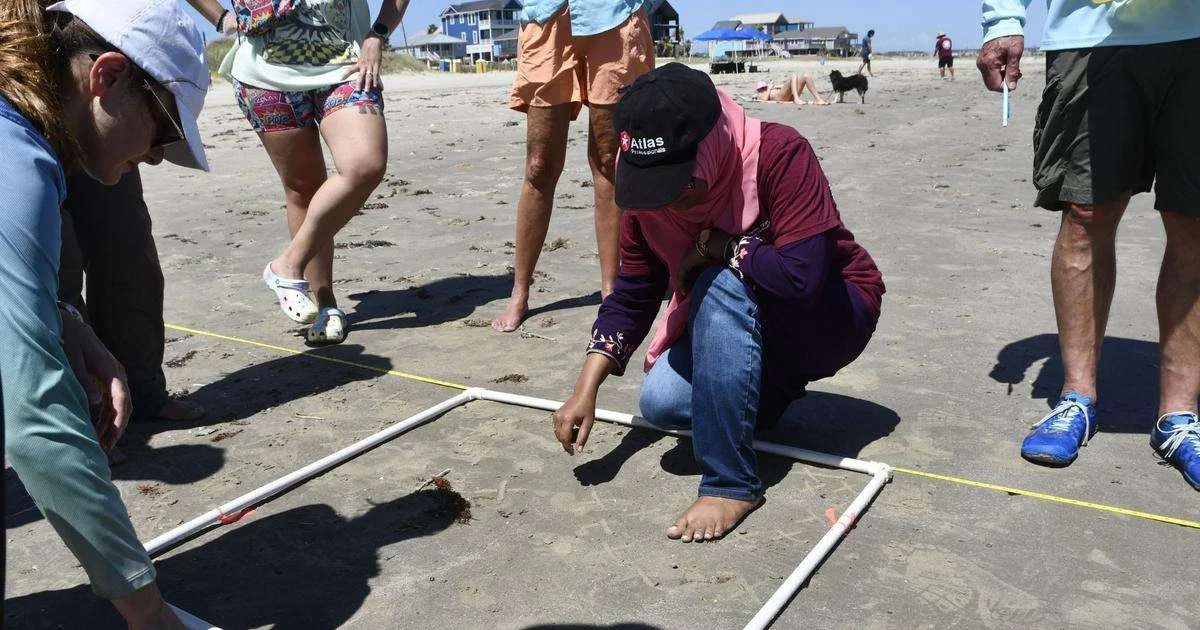
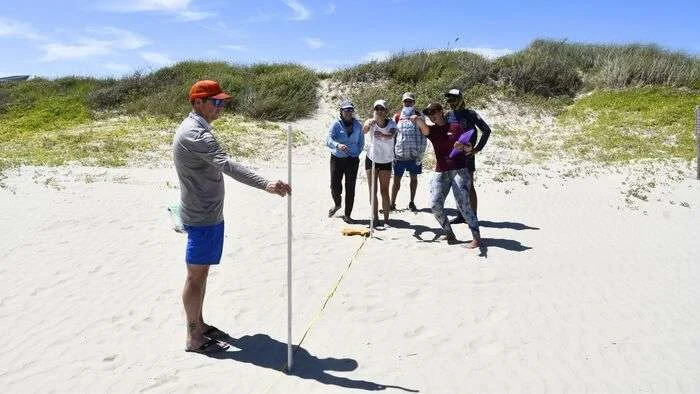
Students and faculty working in Corte’s Benthic Ecology Lab regularly visit beaches to collect data and specimens. The Sea Aggie scientists measure the slope and distance from the dunes to the waterline, count the burrows of ghost crabs and shrimp, and sift the sand to collect species within the sediment such as marine worms and sand fleas.
This provides snapshots of beach health so Corte’s team can compare and monitor the impacts of erosion, nourishment projects, and other environmental changes over time.
To broaden that work, Corte, with input from domestic and international colleagues and support from MarineGEO, is revising sandy beach research protocols and associated college course modules for use by faculty and students all over, beginning in September.
“Beaches are disappearing, and erosion rates are very high,” the Brazilian ecologist said. “By replicating the same sampling design periodically again and again and again to build a long-term dataset, we’re going to assess how the environment is changing and how that influences the biodiversity.”
Other leaders of the effort, called the Tides of Opportunity Project, include the Smithsonian Marine Station, Smithsonian National Zoo and Conservation Biology Institute, Smithsonian Environmental Research Center, and University of Miami.
Dr. Katelyn DiBenedetto, program manager for MarineGEO at the Smithsonian Environmental Research Center in Edgewater, Maryland, said the implementation testing phase would involve 21 institutions and likely run through February 2027.
The initial participants are located on all mainland US coasts and in Puerto Rico as well as in Brazil, Peru, Trinidad and Tobago, and Uruguay.
The Smithsonian Environmental Research Center will host a follow-up meeting, likely in March 2027, to collect feedback from professors and students about their experiences implementing the protocols.
“I think probably what we’ll uncover is where some partners struggle,” DiBenedetto said, adding such information should help organizers make final revisions, if any, to the protocol and determine what types of partners can use it best.
“The idea is that we’ll have a final sandy beaches protocol by the end of this knowledge-sharing workshop next year,” DiBenedetto said, explaining the importance of using the same protocol each time to collect consistent, comparable data.
In launching a Sandy Beaches Network, MarineGEO is expanding on the collaborative science it supports for other nearshore ecosystems.
Thirty-two other MarineGEO partners already monitor key nearshore ecosystems, including seagrasses, coral reefs, oysters, and fouling communities such as docks where organisms, including invasive species, collect.
DiBenedetto hopes many of the Tides of Opportunity Project participants will become permanent MarineGEO partners and that many of the 32 existing observatory and monitoring partners will add sandy beaches to the habitats they monitor.
“Many of those partners have sandy beaches,” DiBenedetto said.
Over the next five to 10 years, participants in the Tides of Opportunity Project aim to increase awareness of the importance of studying sandy beaches as vital marine ecosystems while giving students more hands-on scientific experiences.
Corte explained that the college course modules would help faculty of a variety of levels introduce students to real research opportunities and so much more.
“We are building the future workforce and enabling them to do research on sandy beaches,” Corte said.
Soon the work could expand beyond the Western Hemisphere.
“Sandy beaches are understudied,” DiBenedetto said. “Our mission over the next couple of years is to truly have a global presence and bring sandy beaches to the forefront of conversations that marine scientists and managers and other ocean stakeholders are having.”
As TAMUG proves, “Aggieland does not stop at the water’s edge.”
By working together with collaborators such as MarineGEO, the influence of TAMUG research is extending for good well beyond Galveston and the Texas Gulf Coast.