
Tidal Forces Induce Pronounced Temporal Variations in Seismic Velocity Within Fault Fracture Zones

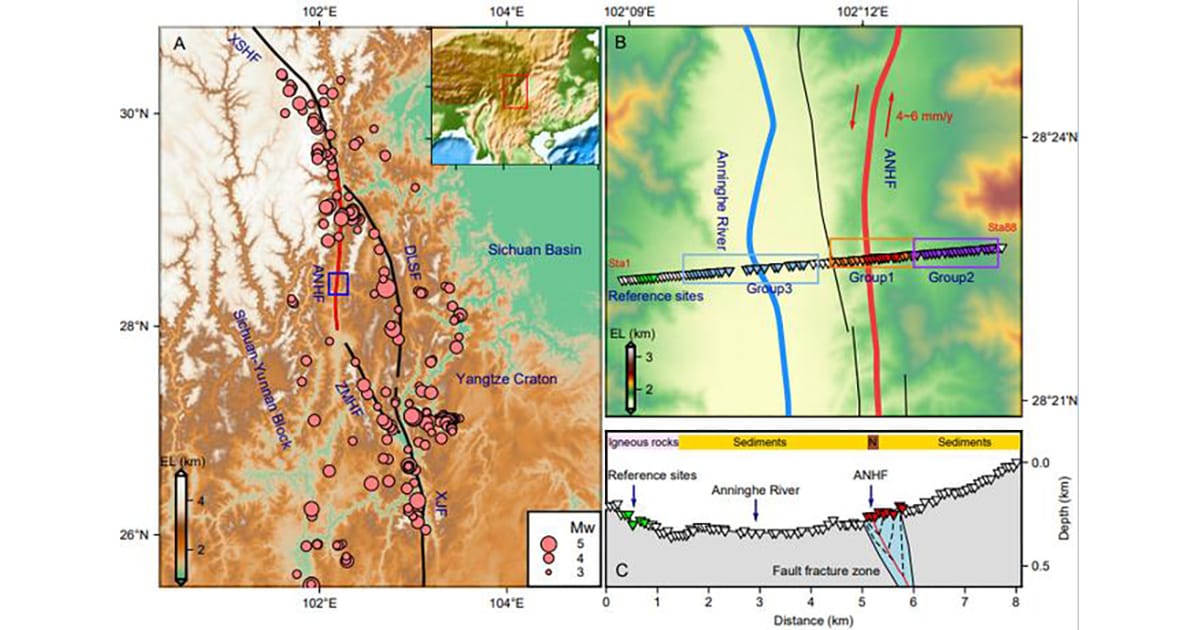
Figure 1. (A) The distributions of tectonic units and earthquakes. (B) The triangles indicate positions of the seismometers. Orange triangles represent Group 1 stations situated in proximity to the fault zone. Purple and light blue triangles represent Group 2 and Group 3 stations, respectively, located farther from the fault zone. (C) is a schematic illustration depicting the fault fracture zone and the associated local geological maps. (Image credit: Science China Press)
This study was led by Prof. Huajian Yao from the University of Science and Technology of China. The team has used a dense array along the Anninghe fault zone in the southeastern margin of the Tibetan Plateau to analyze temporal seismic velocity changes (Figure 1). Using seismic interferometry techniques on continuous ambient noise data, they monitored temporal variations in seismic velocity in the Anninghe fault zone.

Their findings reveal clear periodic patterns in seismic velocity changes on daily, semi-daily, and monthly timescales (Figure 2, C-F), with these variations being most pronounced within the fault zone. Comparing these results with theoretical tidal strain models, the researchers observed strong correlations across all three timescales (Figure 2, D-F), indicating that tidal forces are a primary driver of these temporal fluctuations.
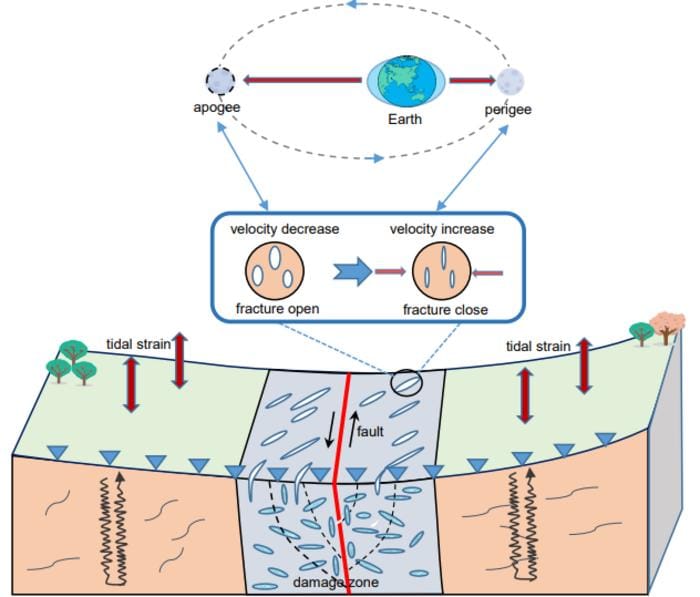
Figure 2. (A) Daily resolution dv/v after removing the influence of environmental factors. (B) The average spectral ratio results along the array. The location of the fault fracture zone is denoted by red lines. (C) Comparison of the spectra of dv/v at hourly resolution (blue curve) and the tidal strain in the vertical component (brown curve). (D) Comparison of the average dv/v of stations within the fault fracture zone and monthly vertical tidal strain time series. The purple dashed line marks the perigee date. (E) Comparison of diurnal dv/v time series with vertical tidal strain. (F) Comparison of semidiurnal dv/v time series with vertical tidal strain. (Image credit: Science China Press)

Further analysis using a spectral ratio method from teleseismic waveforms showed that the fault fracture zone exhibited significantly higher spectral ratio values (higher amplification) than surrounding areas, indicating a higher degree of subsurface fracturing (Figure 2B). Tidal forces affect seismic velocity by causing tiny underground fractures to open and close periodically—velocity decreases when fractures open while increasing when they close. Due to its highly damaged nature, the fault fracture zone is particularly sensitive to these tidal influences (Figure 3).
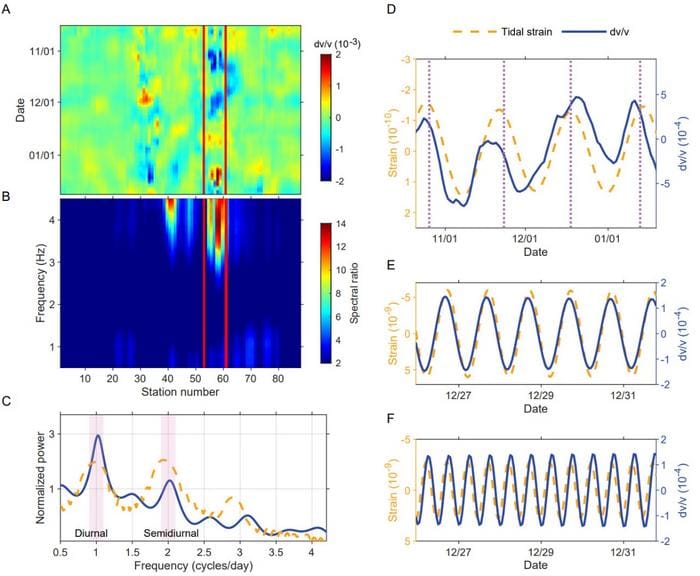
Figure 3. The schematic diagram depicts how tidal strain impacts seismic velocity changes within the fault zone. The fracture zone around the Anninghe fault contains multiple fractures, and the opening and closing of these fractures due to tidal strain can modulate relative seismic velocity changes. (Image credit: Science China Press)

This study, utilizing an ambient noise-based monitoring approach, provides new insights into how tidal forces impact fault systems. It offers valuable information for understanding fault dynamics, earthquake nucleation processes, and seismic hazards.

latest edition
By translating complex ocean data into actionable strategies, the applied marine science community plays a pivotal role in ensuring the long-term resilience of coastal environments while bolstering the global Blue Economy.

got marine science news?

Send us your latest corporate news, blogs, or press releases

Search