The results were published in March in the journal Global Change Biology.
“We observed that the effects of warming aren’t cumulative for some strains of this species, which gives us hope regarding the impact of climate change on fish, at least as far as reproductive aspects are concerned,” said Maira da Silva Rodrigues, co-author of the study, which was conducted during her doctoral studies at the Botucatu Institute of Biosciences of São Paulo State University (IBB-UNESP) in Brazil with a scholarship from FAPESP.
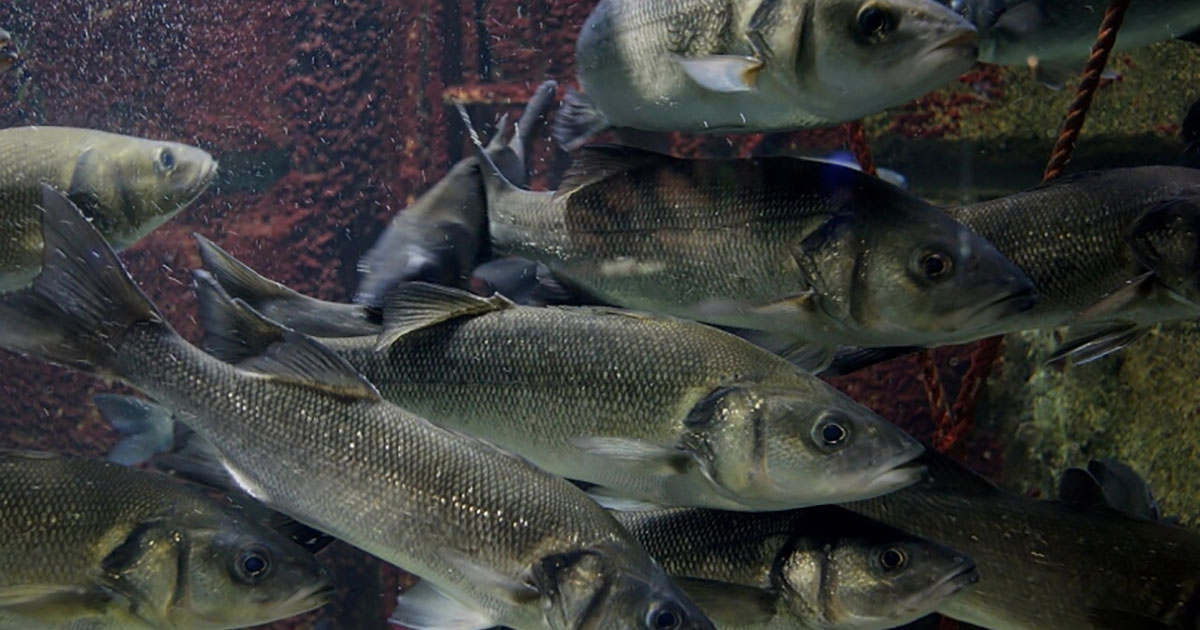
Under the guidance of Rafael Henrique Nóbrega, a professor in the Department of Cellular and Molecular Biology at IBB-UNESP, supported by FAPESP, Rodrigues analyzed the gonads, testes, and ovaries of the third generation of European seabass in the experiment.
“The higher number of males is a phenomenon that affects populations of fish species whose sex is partially determined by water temperature. There has long been debate over whether a warmer planet could lead to the extinction of these species, since there would theoretically be no more females. What the study shows is that, at least for the species analyzed, a compensatory mechanism occurs that could counteract this harmful effect of warming,” explained Nóbrega.
However, the third generation—the grandchildren of the first generation and the children of the second generation studied—was not entirely immune to the effects of developing in a warmer environment (21 °C instead of 16 °C for the control populations).
“The males of the most recent generation, which had more females, experienced a significant delay in gonadal maturation. We don’t know what might happen to the next generation because of that. The females, on the other hand, didn’t experience any disruption in gonadal development,” said Rodrigues.
Environmental Messengers
The study was conducted on a Northern Hemisphere species that lives in typically colder waters than those of the tropics. Despite its Portuguese name, robalo-europeu, it is a distant relative of the fish known as robalo in Brazil and exhibits a different pattern of sexual development.
The effect of warming over generations on tropical and neotropical species, such as those found in Brazil, is not yet known. For this reason, the researchers are expanding their studies to include Brazilian species, starting with the lake tetra (Astyanax lacustris).
“One of the most innovative focuses of this research is the role of microRNAs present in semen, which can act as environmental messengers capable of transmitting information from the father to the offspring,” says Nóbrega.
According to Nóbrega, these small RNAs can directly influence embryonic development, fertility, and the adaptive capacity of future generations of fish. This opens a new frontier for understanding paternal inheritance in vertebrates.
In a previous study supported by FAPESP (projects 20/15237-0 and 18/10265-5), the Botucatu group, in collaboration with researchers from Argentina and Canada, showed that heat directly alters the sex ratio and activates deep hormonal mechanisms.
Experiments with the Japanese rice fish (Oryzias latipes) demonstrated that thyroid hormones, especially T3, play a key role in temperature-induced masculinization.
Exposure to heat activates the stress axis, increasing cortisol levels. This, in turn, stimulates the thyroid axis, raising T3 levels and promoting testicular development. Blocking this stress response stops masculinization, showing that the process depends on the interaction of different hormonal systems.
“The findings are changing how we view the effects of climate change. Instead of simple, linear responses, we show that there’s a complex scenario in which hormones, genes, environmental history, and transgenerational inheritance interact to shape the fate of populations,” Rodrigues notes.
“It isn’t yet known to what extent these mechanisms will be sufficient to offset the impacts of global warming. But it’s clear that to predict the future of biodiversity, it’ll be essential to look beyond a single generation and understand how life responds, adapts, and possibly resists over time,” Nóbrega concludes.