Murakami has been known as one of Japan’s leading salmon-producing regions along the Sea of Japan coast since the Heian period (794–1185). In recent years, however, climate change has altered the distribution of marine species, resulting in increased predation on released salmon juveniles by species such as yellowtail and Spanish mackerel that have expanded northward into the region. Consequently, the number of salmon returning to local rivers has declined dramatically.
According to the Japan Fisheries Research and Education Agency, the nationwide average salmon return rate in 2025 fell to 0.66%, the lowest level recorded since 1989. In Niigata Prefecture, the return rate dropped to just 0.06%, meaning that almost none of the released fish returned to their natal rivers.
In response to this crisis, Murakami has turned to land-based aquaculture as a potential pathway to revitalize its salmon industry and partnered with Associate Professor Toshimasa Yamamoto of the Department of Bioscience at Okayama University of Science.
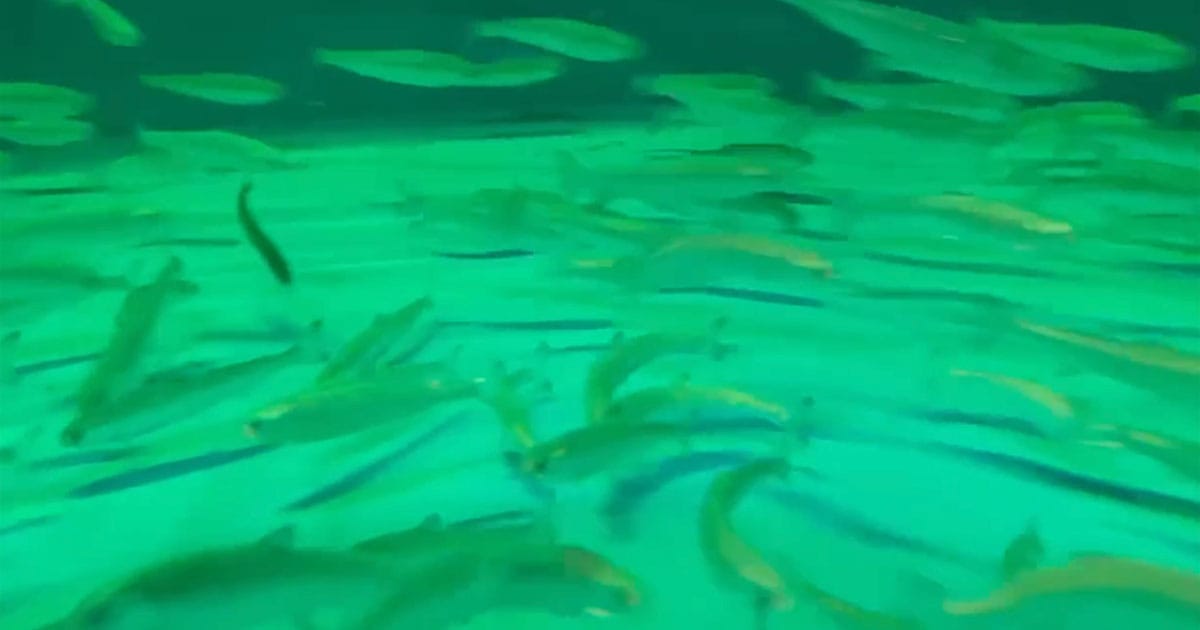
The juvenile salmon arrived at the Next-Generation Aquaculture Center at an early developmental stage and were initially reared in small tanks. Once they reached approximately 8–9 centimeters in length and about 5 grams in body weight, they were transferred to a 7-ton tank. On May 4, after growing to an average length of 13 centimeters, they were moved to a 35-ton tank. At that point, 2,080 fish had survived and were actively swimming. Researchers expect salmon to reach approximately 1 kilogram within one year and between 1.5 and 3 kilograms within two years.
The center aims to establish fully closed-cycle aquaculture using the Third Water-based closed recirculation aquaculture system (c-RAS). If successful, it would represent the world’s first fully closed-cycle land-based aquaculture system for chum salmon.
Associate Professor Yamamoto is optimistic about the project’s prospects, drawing on his previous experience rearing several dozen chum salmon at the center in 2015. During that earlier effort, some fish developed into high-quality “Tokishirazu,” a premium chum salmon highly valued for its rich fat content.
“If we succeed in establishing a fully closed-cycle aquaculture system for chum salmon, it could fundamentally change the future of salmon production,” Yamamoto said. “The ability to raise salmon sustainably on land would have an enormous impact on fisheries around the world.”
Looking ahead, Yamamoto said the research team will continue evaluating the results of the current project while working closely with Murakami City to determine how land-based production can reduce dependence on ocean-based salmon resources and contribute to the long-term sustainability of the industry.
The aquaculture project is led by Associate Professor Yamamoto together with Seiichi Tsumura, Visiting Professor at the Next-Generation Aquaculture Center, and technical staff members Kaori Saito and Keisei Yamauchi.