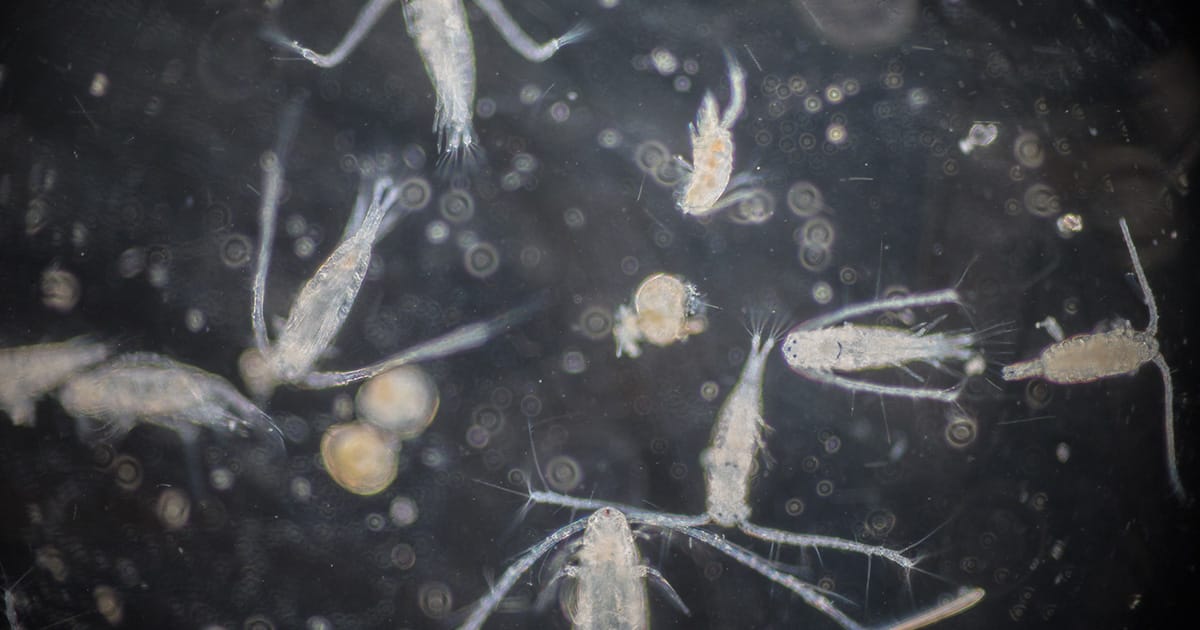
Mesozooplankton play a vital role in marine food webs and biogeochemical cycles, connecting primary producers and higher trophic levels. Accurately predicting their dynamics has been a longstanding challenge due to the intricate interplay of environmental factors. Using spectral-temporal GNNs (StemGNN), the researchers achieved remarkable improvements in forecasting accuracy by integrating inter-series relationships and temporal dependencies among input variables.
Key Highlights:
Improved Forecasting: The StemGNN model outperformed Long Short-Term Memory (LSTM) models, achieving up to a 111.8% improvement in predictive accuracy.
Seasonal Insights: The study identified how environmental variables like rainfall and sunlight impact mesozooplankton abundance, providing new perspectives on seasonal ecological dynamics.
Broader Applicability: Graph-based visualizations of ecosystem interactions enable the model to be extended to other ecological forecasting, such as predicting algal blooms.
Lead author Minhyuk Jeung stated, “Our approach provides transformative insights into marine ecosystem management, enabling more accurate and scalable forecasting models to support environmental sustainability.”
This pioneering research lays the groundwork for expanding ecosystem models to include other key variables, such as phytoplankton and predators, and emphasizes the importance of accounting for ecological interactions.