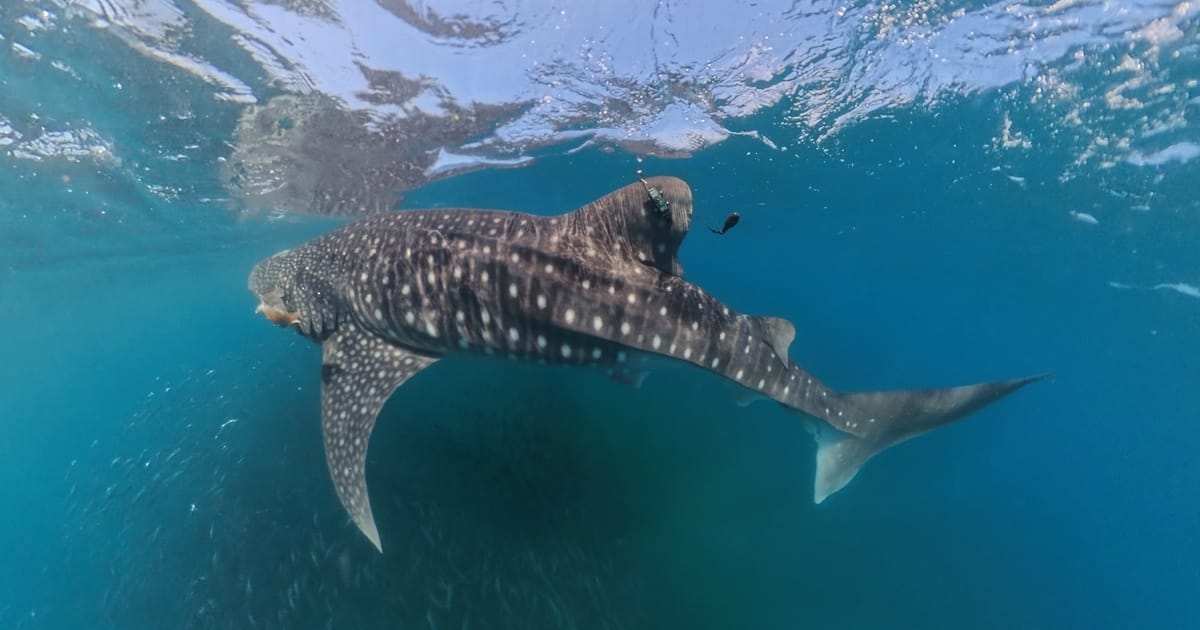
Published in Springer Nature, the research—Methods for tagging whale sharks: insights into performance and best practices with a focus on clamp attachments—brings together global expertise to assess the performance of different tagging methods, with a particular focus on innovative clamp-based attachments that are becoming increasingly widely used in whale shark research.
Dr. Womersley led the study alongside colleagues from the MBA’s Sims Group, including Project Technical Officer Ronan Conlon, Ph.D. student Amy Jeffries, Project Scientific Officer Dr. Emily Southall, and Senior Research Fellow Professor David Sims, as part of a large international collaboration.
“People are often amazed to learn that the world’s largest fish can travel thousands of kilometers across the ocean. By tracking whale sharks, we can begin to understand these extraordinary journeys and the challenges they face along the way,” said Dr. Womersley.
Improving How Scientists Track an Ocean Giant
Tracking whale sharks (Rhincodon typus) is essential for understanding their movements, behavior, and exposure to threats such as ship strikes and climate change. However, attaching tags to these huge, free-swimming animals, which can exceed 10 meters in length, remains a significant scientific challenge.
The new study synthesized insights from researchers worldwide to evaluate the effectiveness of clamp-based tagging systems, which attach devices to the dorsal fin without the need for more invasive techniques such as drilling.
“This study was really about bringing together years of collective experience from researchers around the world. Everyone has faced similar challenges when tagging whale sharks, so it made sense to pool that knowledge and identify the approaches that work best,” said Dr. Womersley.
The findings found that clamp systems are:
- More versatile and widely applicable than traditional drill-based methods
- Capable of long-term deployments, with some tags transmitting data for over 200 days
- Suitable for a wide range of electronic tracking devices.
“Advances in technology can help answer fundamental questions about the natural world. The better and more reliable our tools become, the more we can learn about species that are otherwise incredibly difficult to study,” said Dr. Womersley. “Every time we successfully deploy a tag, there’s a chance we’ll discover something we’ve never seen before. That’s what’s so exciting about studying whale sharks. There are still huge gaps in our understanding of how they move through the ocean and respond to a changing environment.”
The study also reveals important challenges. Tag performance can vary widely depending on factors such as clamp design, placement on the fin, and deployment conditions. In some cases, tags detached prematurely or caused minor fin damage, underlining the need for further refinement.
Encouragingly, the research shows that well-designed clamp systems can achieve data quality comparable to more invasive methods, offering a promising path toward less harmful yet highly effective tagging approaches.
From Research Paper to Real-World Testing
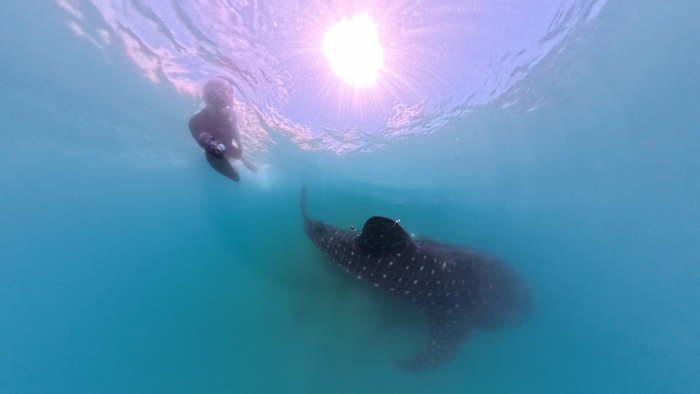
The publication comes as the MBA Sims Group put these methods into practice in the field. In May 2026, the team traveled to La Paz, Mexico, on an ambitious whale shark tagging expedition in the Gulf of California.
Alongside satellite tracking devices, MBA researchers deployed advanced, custom-built tags that measure:
- Oxygen levels
- Temperature
- Depth
- Body movement
These tags are designed using many of the principles highlighted in the new study, including refined clamp systems developed in collaboration with international partners and tested in MBA facilities.
The expedition focused on large adult female whale sharks, and its aim was to uncover how these animals behave in the oxygen minimum zone, a challenging environment shaped by warming seas and declining oxygen levels.
Supporting Conservation in a Changing Ocean
By improving tagging success and data quality, the research is expected to unlock critical insights into whale shark ecology, information that is urgently needed to protect this globally endangered species.
Satellite tagging already plays a key role in revealing migration routes, diving behavior, and interactions with human activities, all of which are essential for effective conservation planning.
“Every time we successfully deploy a tag, there’s a chance we’ll discover something we’ve never seen before. That’s what’s so exciting about studying whale sharks. There are still huge gaps in our understanding of how they move through the ocean and respond to a changing environment,” said Dr. Womersley.
The Mexico expedition investigates how environmental stressors influence whale shark behavior, including whether changing ocean conditions increase the time animals spend near the surface, where they are more vulnerable to ship strikes, a growing cause of mortality.
Professor David Sims said the new research will deliver “fundamental data” needed to guide conservation strategies as oceans continue to warm.
A Collaborative Step Forward
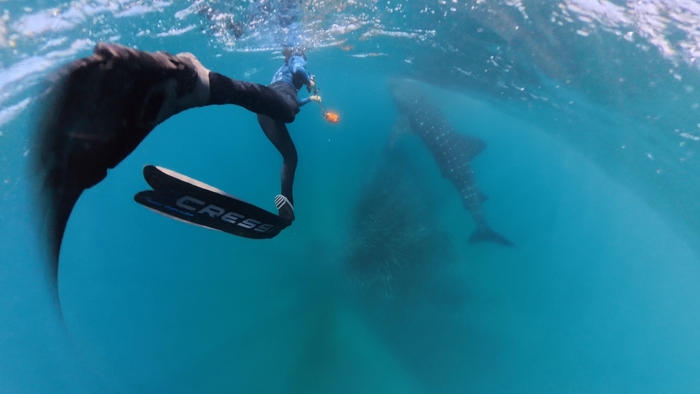
Dr. Womersley’s tagging study underscores the importance of global collaboration in tackling complex conservation challenges. By pooling knowledge from researchers across multiple institutions, the team has created a shared foundation of best practice that can improve future tagging efforts worldwide.
For Dr. Womersley and colleagues, the work represents both a scientific milestone and a practical toolkit—one that is already shaping ongoing fieldwork and helping to ensure that researchers can gather better data while minimizing impacts on the animals themselves.
These advances in tagging technology are set to play a crucial role in revealing the hidden lives of whale sharks and in safeguarding their future in rapidly changing oceans.
“As ocean conditions continue to change, understanding how whale sharks respond to environmental pressures is becoming increasingly important. Improved tagging methods allow us to collect the long-term data needed to inform conservation strategies for the future,” concluded Dr. Womersley.
Read the paper in full here.