In large parts of the world’s oceans, however, growth is limited by a lack of iron, which is an essential nutrient. For this reason, researchers have for decades been investigating whether the ocean’s CO2 uptake can be increased by adding dissolved iron to iron-deficient areas.
But how effective is this method, and what are its consequences for marine ecosystems? Professor Adam Martiny, DTU Aqua, has investigated this in a new study, which has been published in the prestigious scientific journal Nature.
Using an advanced ocean model, the researchers have simulated 60 years of iron addition in ten different ocean regions to investigate both the climate impact and the effects on marine ecosystems.
“There is a big difference depending on where you add iron to the sea. In some places, the iron has very severe consequences for the ecosystems, while in others the impacts are relatively limited. What is new about our study is that, for the first time, we can demonstrate the trade-off between CO2 uptake and ecological consequences across different ocean regions,” says Adam Martiny.
He adds that once iron has been added to the ocean, it does not always remain in a single area but can move with the ocean currents, thereby affecting the chemistry and biology elsewhere in the world’s oceans.
The Southern Ocean Offers the Best Balance
The researchers find that the Southern Ocean around Antarctica offers the most favorable combination of CO2 removal and limited ecological consequences. Here, ocean currents transport both iron and nutrients to other areas, where they can continue to support biological production and carbon storage.
At the same time, the simulations show that the Southern Ocean is more resilient than the other areas studied. When the iron supply stops, the ecosystem returns relatively quickly to its original state, and the ecological impacts are less long-lasting than in, for example, the equatorial Pacific.
The equatorial Pacific Ocean also removes large quantities of CO2, but here the consequences are significantly greater. When plankton blooms following iron addition, it consumes large quantities of other nutrients. Ocean currents then transport this nutrient-poor water to other areas, which can reduce plankton production and affect food chains far away from where the iron was added.
Consequences Can Be Felt Far Away
The study shows that even relatively local interventions can have global consequences.
In the simulations, iron addition in the equatorial Pacific led to reduced biomass of larger zooplankton, which constitute an important food source for fish. At the same time, areas of low oxygen content in the ocean expanded. The effects extended across areas many times larger than the area where the iron was added.
“There will almost always be an ecological cost to manipulating marine ecosystems. That is why it is a matter of identifying the locations where the climate impact is greatest and the consequences for nature are least,” says Adam Martiny.
The advanced model is based on many years of work describing the ocean’s cycles of carbon, nutrients, and oxygen, as well as the interactions between different types of plankton.
The research team has also compared the model’s results with previous field experiments, in which researchers physically added iron to the ocean and observed the effects on plankton and carbon uptake.
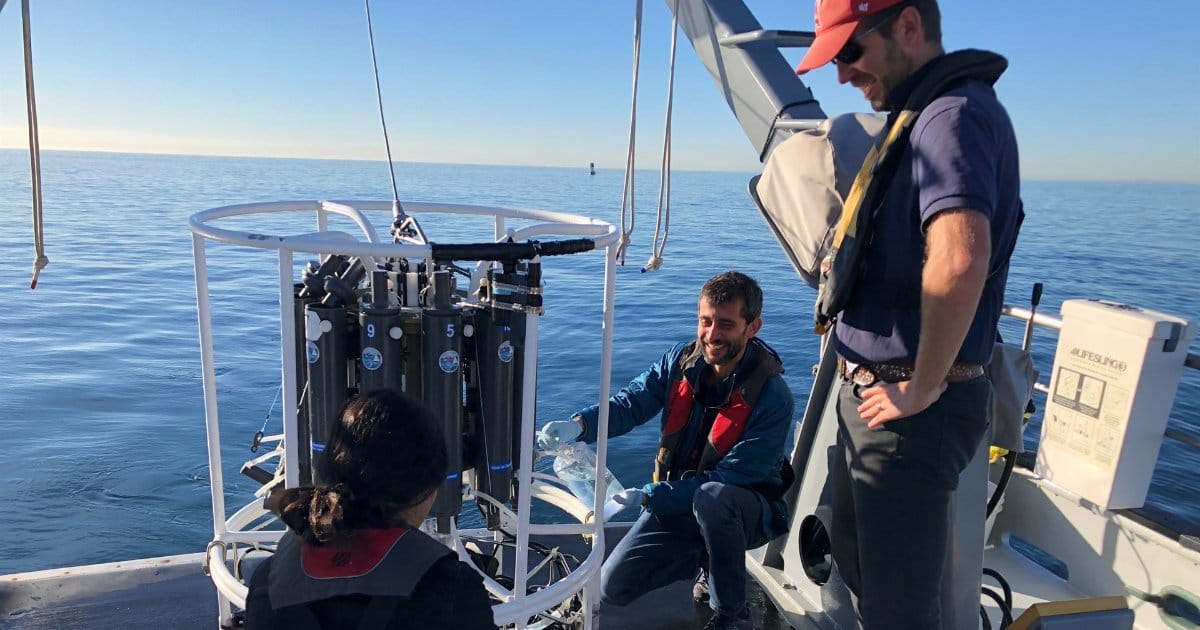
“There have been a handful of experiments where researchers have gone out in a boat, poured iron into the water and observed over the course of a month what happens: how much CO2 is absorbed and sinks, and what happens to biodiversity. Our model shows the same results as those experiments,” says Adam Martiny.
CO2 Is Removed—but Not Permanently
Even in the most extensive scenarios, the climate impact is limited.
The researchers estimate that 60 years of iron addition could remove between 0.14 and 0.70 billion tonnes of CO₂ per year from the atmosphere, depending on where in the ocean the method is applied. By way of comparison, the world currently emits around 40 billion tonnes of CO2 per year. The method will therefore only be able to serve as a supplement to emissions reductions—not as a replacement for them.
“No one believes that iron fertilization alone can solve the climate crisis. But if, at some point, we need to remove large quantities of CO2 from the atmosphere as a supplement to emissions reductions, it could be one of the tools worth looking into,” says Adam Martiny.
The study also shows that a large proportion of the effect is not permanent. More than half of the CO2 removed during iron fertilization returns to the atmosphere within the following decades if the initiative is halted.
Difficult to Quantify the Effect
According to the researchers, one of the biggest challenges is that it is difficult to quantify precisely how much CO2 is actually removed from the atmosphere.
The study shows that the most significant effects occur across vast ocean areas and often far from the location where the iron is added. This makes both monitoring and any potential CO2 credits difficult to manage.
At the same time, the method raises questions about international regulation, as one country’s activities could potentially affect marine biodiversity far from the area where the iron is added.
While European climate policy has primarily focused on reducing greenhouse gas emissions, the US is increasingly investing in technologies designed to actively remove CO2 from the atmosphere. Ocean-based solutions such as iron fertilization are increasingly part of discussions about future climate technologies in the United States.
According to Adam Martiny, it is important that Europe follows developments closely and participates actively in both research and regulation in this field.
“Having traveled around Europe, my impression is that there is relatively little discussion about iron addition in the ocean. My aim is to call on politicians to recognize that this is something we should take far more seriously. There are other countries, including the US, that are already moving in this direction, and once they get major projects off the ground, this could have consequences that are also felt in European waters. That is why it is important that we monitor developments closely and do not fall behind,” says Adam Martiny.