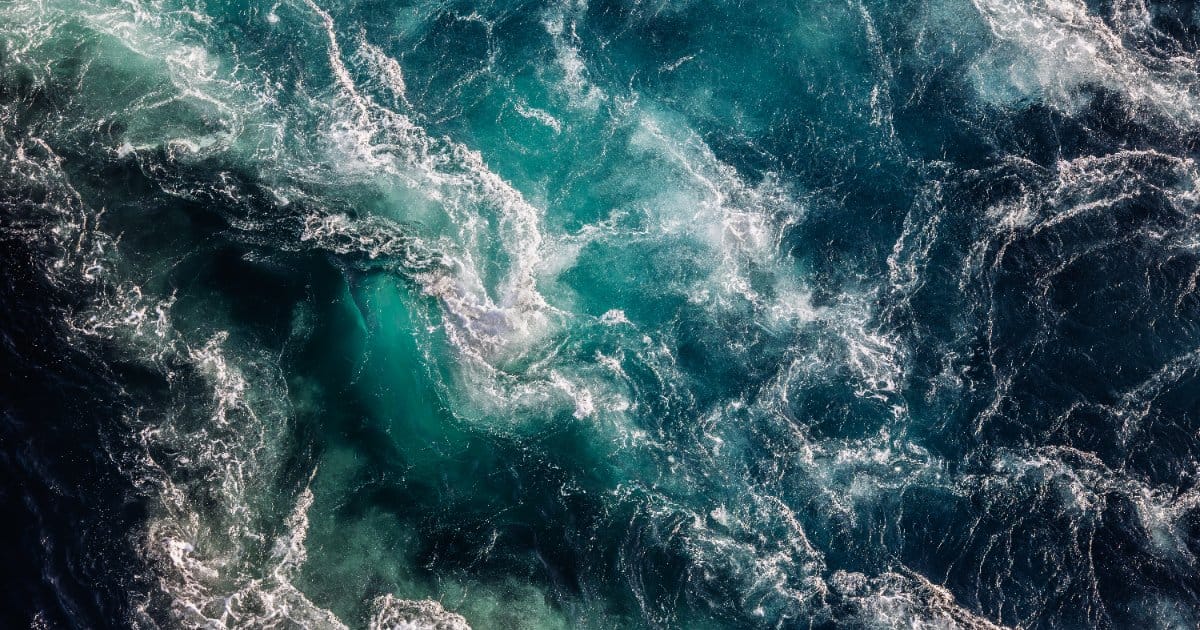
An international research team, led by the University of Cambridge, found that deep ocean turbulence—the process that distributes heat, nutrients, and carbon from the surface to the seafloor and back—affects our lives not on a scale of thousands of years as was previously thought, but within the span of a human lifetime.
However, the tools used to predict these effects and inform policy do not adequately represent this turbulence, or the speed at which it moves. The results are reported in the journal Nature Communications.
The findings come at a time when global ocean research of this kind is at risk. In May, the US National Science Foundation announced the dismantling of the Ocean Observatories Initiative, a $368 million ocean observation network that provides vital oceanographic data worldwide, although the plans were later partially canceled.
Changing turbulence patterns could affect our climate in tangible ways, which is why this type of ocean monitoring is key: if nutrients are not being pulled from the deep ocean to the surface, it could cause marine food chains to break down, which would in turn cause fisheries to collapse. The way that heat is transferred from the deep ocean to shallower waters and back affects how Arctic and Antarctic ice melts, which affects sea level rise, storm intensity, and flooding levels.
Using a combination of previously collected physical and chemical measurements, the researchers identified several fast-moving climatic processes affected by small-scale turbulence, including the distribution of heat, nutrients, and carbon. When compared with how climate models predict how turbulence in the deep ocean will affect life on land, the researchers found these models require significant improvements.
“There is a microphysics of the ocean, similar to cloud physics, that is extremely difficult and expensive to observe, but it governs our lives on human-relevant timescales—from ocean circulation changes to ecosystem dynamics, with implications for fisheries and food security, to coastal flooding and heatwaves,” said lead author Dr. Laura Cimoli from Cambridge’s Department of Applied Mathematics and Theoretical Physics (DAMTP). “We need the tools we use to predict these effects to be as accurate as possible, and we found that’s currently not the case.”
“If I think about what matters most on human timescales, it’s three things: marine nutrients and ecosystems, which impact food security; Arctic changes, which have direct geopolitical implications and almost immediately affect extreme weather and flooding in the UK; and mixing of the deep southward flows feeding warm water to Antarctic ice shelves, which drive sea level rise,” said co-author Dr. Ali Mashayek from Cambridge’s Department of Earth Sciences.
One of the tracers the researchers used to test the accuracy of climate models was CFC (chlorofluorocarbon) concentration. CFCs were released into the atmosphere in large quantities before being banned in the 1980s under the Montreal Protocol, due to the damage they caused to the ozone layer.
The researchers tracked how far and how fast CFCs have traveled over the past six decades by measuring their concentration at depth. They found some deep waters have carried CFCs all the way from Antarctica to the mid-Pacific and north Indian Ocean in just 40 years. The same waters also carry carbon, oxygen, and heat. As they travel, they mix with other waters, and so turbulence is key to how much tracers, heat, and carbon remain trapped in the deep ocean and on what time scales.
“We’re learning that the deep ocean can exchange carbon, nutrients, heat, and pollutants with the atmosphere on timescales relevant to our own lives,” said Mashayek.
Another experiment involved injecting dye into the deep ocean at known locations and depths and tracking its movement. In a deep canyon in the Rockall Trough, not far from UK waters, the dye rose as much as 100 meters per day: roughly 10,000 times faster than models predicted.
However, when comparing the CFC, dye, and other observational data with climate models, the team found that the models’ output often deviated significantly from the observational data.
“This shows that climate models are not reliably capturing key effects of deep ocean turbulence,” said co-author Professor Colm-cille Caulfield, also from DAMTP. “If we’re going to make these models more useful for decision-makers, we will need to understand the underlying fundamental physical processes much better, develop better approximations that capture all those processes in computationally efficient ways that can be embedded in climate models straightforwardly, and test and constrain the outputs of the approximations with much more observational data. All aspects of this pipeline are now at risk as science budgets are cut.”
“It used to be that turbulence in the ocean interior was thought of as deep, distant, and too slow to matter on human-relevant timescales, but there is increasing evidence that’s not always the case,” said co-author Professor Alberto Naveira Garabato from the University of Southampton. “The deep ocean can interact with the atmosphere on short timescales, and we need reliable tools to help us measure it.”
The research was supported in part by Schmidt Sciences LLC, the Advanced Research and Invention Agency (ARIA), the Natural Environment Research Council (NERC), and the Engineering and Physical Sciences Research Council (EPSRC), part of UK Research and Innovation (UKRI). Laura Cimoli is a Bye-Fellow of Murray Edwards College, Cambridge. Ali Mashayek is a Fellow of Peterhouse, Cambridge. Colm-cille Caulfield is a Fellow of Churchill College, Cambridge.