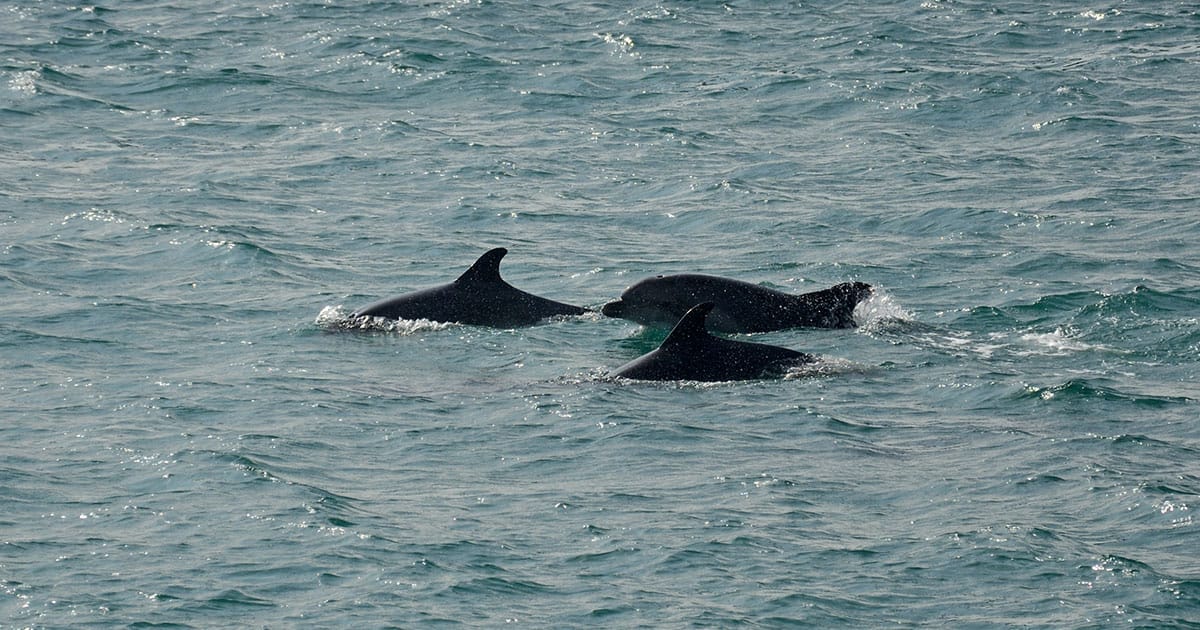
The footage, gathered between 2019 and 2023, provides one of the most detailed records of harbor porpoise mating behavior ever documented in UK waters.
Scientists from across Scotland and Shetland residents worked on the project and reported their findings in the Journal of the Marine Biological Association.
They say understanding group sizes and mating behavior could help manage and conserve harbor porpoises in the Important Marine Mammal Area of Shetland’s waters, and elsewhere.
Harbor porpoises are frequently spotted around Scotland and typically measure between 1.5 and 2 meters and weigh between 55 kg and 80kg.
Despite their abundance, their behavior remains poorly understood because they are small, fast, and spend much of their time underwater.
Research Prompted by Local Sightings
Sophie Ariadne Francine Smith from UHI Shetland undertook the research as part of her Ph.D. and became a licensed drone pilot in the process.
A sighting by Karen Hall of NatureScot, Sophie’s Ph.D. supervisor, helped kickstart investigations.
Sophie said, “Harbor porpoises are seen from land around Shetland all year round, but one sighting involved intense splashing at the surface. We realized it might be mating behavior.
“It is incredibly difficult to film porpoises from boats or from land. They don’t spend much time at the water’s surface, don’t follow a predictable line, like an orca, and they are incredibly fast.
“Drone technology means we can film them from above, which gives much more accurate accounts and a clearer interpretation of behavior.”
Porpoise Overtures Caught on Camera
The team analyzed more than 79 minutes of usable footage from four coastal locations in the east and south of Shetland.
They recorded gatherings of up to 26 animals in a single bay, far larger than the small groups of two or three typically reported for the species.
Two types of sexual behavior were observed. The first involved males rapidly approaching females in what researchers describe as copulation attempts, often ending with individual animals breaking the surface and creating the splashing seen from shore.
The second involved display behavior, where males rolled to present their underside to a female.
Sophie said, “Harbor porpoises are fast and elusive. For much of this mating behavior, they only broke the surface for a few seconds – blink and you’d miss it, which is why using drones to capture footage has been such a boon.
“We can only fly the drone when Shetland’s weather allows; in an ideal world, we’d be able to observe the harbor porpoises all year round so that we can better understand why and when they gather in these larger groups, as well as a having a better understanding of harbor porpoise social behaviors.”
The harbor porpoises were filmed in four coastal bays: Gulberwick Bay, South Nesting Bay, Mousa Sound, and Quendale Bay.
Dr. Lauren McWhinnie from Heriot-Watt University, who co-supervised the research, said: “This work helps build a clearer picture of when and how porpoises use specific coastal areas.
“Although harbor porpoise populations in the North Sea are considered relatively stable, more detailed regional data and local observations, such as those gathered in Shetland, help us to better understand their potential exposure to human activities.
“This evidence allows us to plan more effectively and take proportionate action to reduce any impacts on them.”
Dr. Rachel Shucksmith from UHI Shetland, co-supervisor, said: “Shetland was identified as an Important Marine Mammal Area (IMMA) in 2024, based on vital local and community knowledge.
“This research forms part of a wider effort to understand where, when, and why whales, dolphins, and porpoises use the Shetland coastline.
“Working closely with the local community, the project is advancing our understanding of cetacean movements and deploying innovative technology designed to operate within Shetland’s narrow weather windows.”
The research was funded under the NERC Scottish Universities Partnership for Environmental Research (SUPER) Doctoral Training Partnership (DTP). Additional funding was provided by the National Lottery Heritage Fund.
This Ph.D. was additionally supervised by Professor Ben Wilson (SAMS) and Karen Hall (NatureScot); the wider project team included Dr. Becky Giesler, Kate Allan, Dr. Emily Hague, Dr. Richard Shucksmith, and Nick McCaffrey.