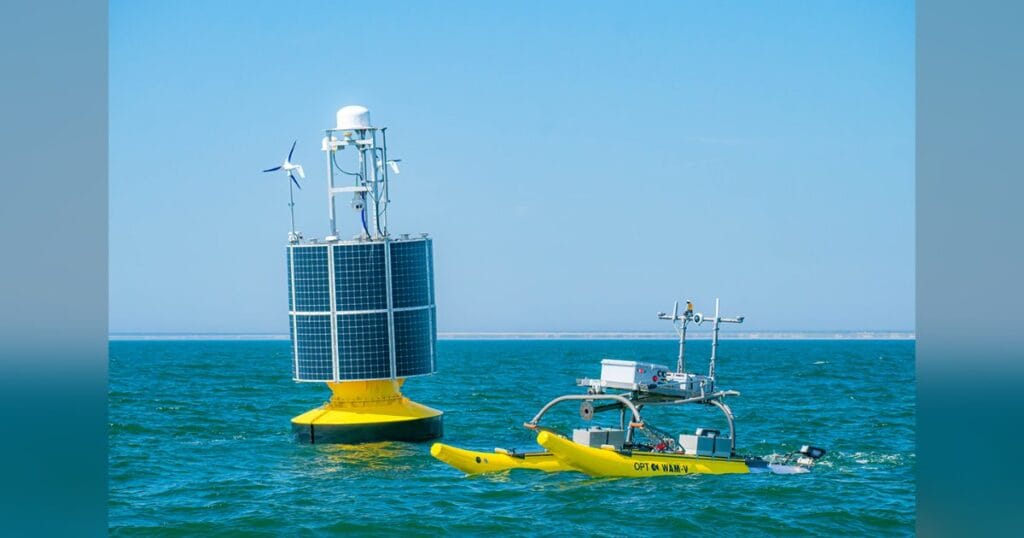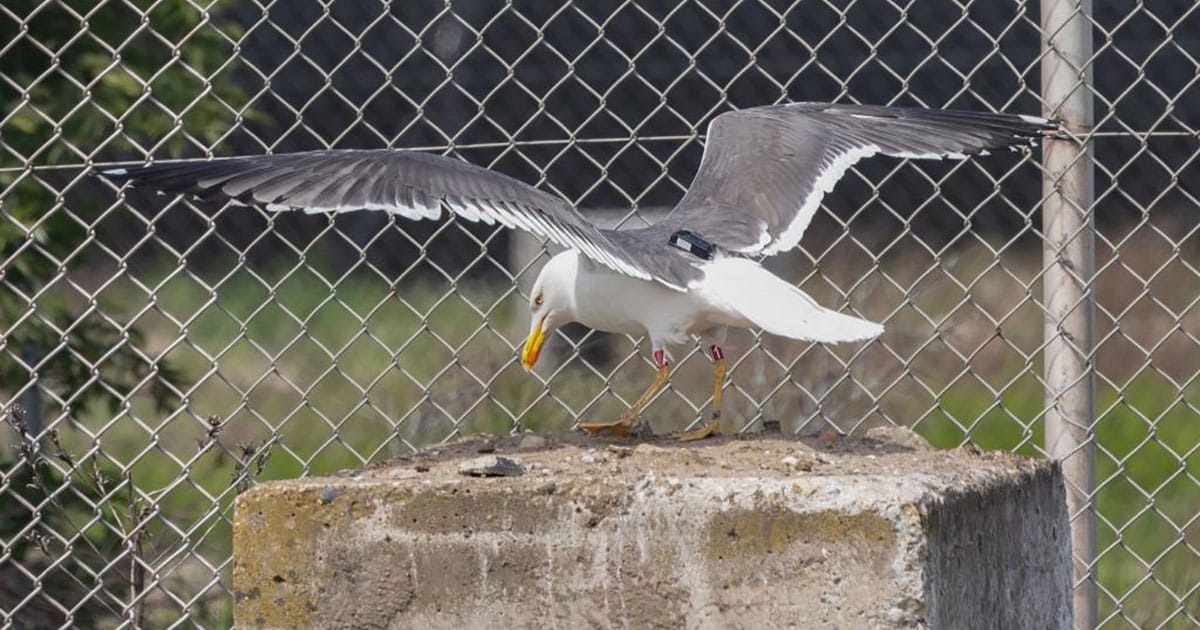
Rosemarie Kentie fitted 58 lesser black-backed gulls (Larus fuscus) with GPS transmitters to see if and when they entered the wind farm off the Zeeland coast. She wanted to know whether these birds found the wind farm attractive or, on the contrary, avoided it. Before, during, and after the breeding season, they were found to spend more time around fishing vessels than in the wind farm, where fishing is prohibited. Understandably so: near fishing vessels, they can feed on discarded by-catch.
Every Gull Has Its Own Habits
But there was quite a difference between individuals. Some males, in fact, were attracted to the wind farm frequently during and after the breeding season.
“Males are generally out at sea more often than females, who tend to forage for food on land,” said Kentie. “But each individual also has its own habits, which is fascinating. There’s a gull from Texel known to fly back and forth to Amsterdam every day, 100 kilometers away. And a gull that breeds on the Maasvlakte and goes to Utrecht every day, at a comparable distance.”
No Idea Why
Kentie, who collaborated with ecologists from Waardenburg Ecology, the Flemish INBO, IBED at the University of Amsterdam, Deltamilieu Projecten en Buijs Eco Consult, wondered whether the fact that they were attracted to the wind farm to a greater or lesser extent was linked to fishing outside the farm.
“With the Global Fishing Watch website, you can see where and when fishing takes place. We linked our data to this,” Kentie said.
She had expected that the gulls’ behavior would be easily explained by the fishing data. There is far less fishing at the weekend than on weekdays, so surely more gulls would fly into the park.
“But they didn’t. There is something that makes them prefer not to enter the wind farms at the weekend either. No idea why, it fascinates me enormously,” Kentie added.
Collision Models
Offshore wind farms pose a risk to seabirds. On the one hand, they might be attractive precisely because fishing is not permitted there and certain fish are abundant. On the other hand, the rotating blades pose a risk. Some species avoid the wind farms—meaning that such a vast wind farm effectively takes a chunk out of their foraging area.
Funders of the research were Eneco, the wind farm owner, and Rijkswaterstaat, responsible for researching the effects of wind at sea. They want to make the Collision Risk Models more realistic: models that estimate how many birds of different species fly into the blades of wind turbines.
Relatively High Risk
Based on counts of collision victims on land and knowledge of their behavior, gulls are at relatively high risk. This is partly due to the height at which they fly, namely at the height of the rotors. On the one hand, they are very agile; on the ferry to Texel, you sometimes see them skillfully catching bread out of the air. But when they look down to search for fish, they cannot see what is happening in front of them.
Scientific Publication
Kentie and colleagues published their research on June 9 in the Journal of Animal Ecology. They used an interesting method to analyze the gulls’ locations: Step Selection Analysis.
The statistical model compares locations where the gull could go with locations where it actually went.
Even More Detailed
This GPS research does not show what a gull is doing—you only see where it is every twenty minutes.
“We don’t know whether they were, for example, resting at the base of a wind turbine or looking for food,” Kentie said. Along with terns and cormorants, gulls are the only seabirds that breed in the Netherlands. The researchers plan on conducting even more detailed research into these fascinating birds that live both in the city and at sea.