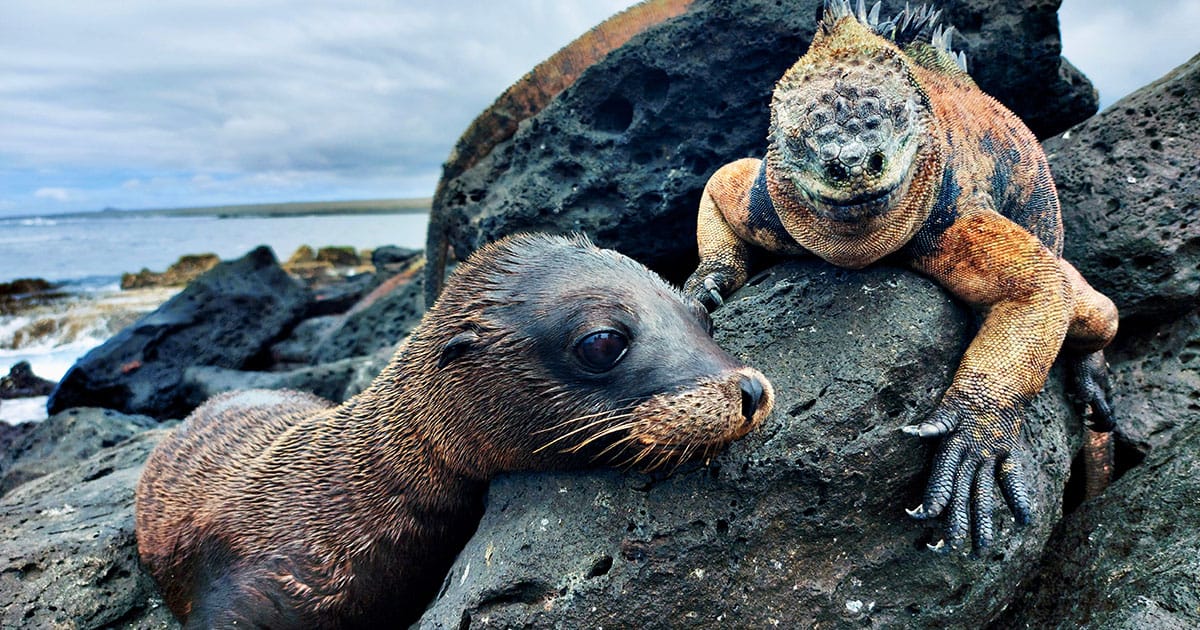
The study, led by Professor Marnie Campbell, Executive Dean of ECU’s School of Science, draws on her long-standing research in the Galápagos Islands, where introduced marine pests pose a growing threat to one of the world’s most iconic natural environments.
The Galápagos, a UNESCO World Heritage site and global tourism hotspot, relies heavily on small tourist vessels that move people between islands. While essential for the local economy, this high level of vessel movement also increases the risk of transporting invasive species that can damage native flora and fauna.
Professor Campbell said the new research offers a practical way to reduce that risk without undermining tourism or local livelihoods.
“The Galápagos is a natural history mecca,” Professor Campbell said. “It’s a marine park filled with extraordinary species that need protection. The governing bodies have already made strong progress—including adopting earlier recommendations of ours to better manage international shipping—but tourist vessels traveling between islands remain a key pathway for invasive species.”
The study shows that the high connectivity between islands means a single pest incursion could spread rapidly across the archipelago.
To address this, the researchers combined social network modeling with sea-surface temperature data to identify the vessel routes most likely to spread invasive species. They then developed a biosecurity system that focuses on reducing risk at these critical points.
“We propose zoning island routes into ‘neighborhoods’ based on geography and sea-surface temperature similarity,” Professor Campbell said. “Tourist vessels would operate within designated neighborhoods, reducing the chance that a pest introduced in one area could spread to more pristine islands.”
Co-author Dr. Chi Le said that if an invasive species is detected, cross‑neighborhood travel could be temporarily paused—allowing rapid containment—while tourism within the neighborhood continues.
“This approach balances environmental protection with economic considerations,” Dr. Le explained. “We used complex datasets to work out how to quarantine a region if a pest outbreak occurred, without shutting down tourism across the whole archipelago.
“Tourism can still thrive, and we can prevent the spread of introduced species. You can have both.”
Professor Campbell said the method is simple, scalable, and globally applicable.
“Island regions everywhere—from the Hawaiian Islands to the sub‑Antarctic and even Antarctica—face similar challenges,” she said. “People often assume marine biosecurity is too difficult, as the ocean is connected. What we’re showing is that with a straightforward, data‑driven approach, you can isolate a problem, clean it up, and protect the ecosystem.
“It’s essentially a quarantine and shipping action plan. You may never need it, but if something happens, having this plan in place means you can respond quickly and effectively.”
The research highlights how mathematical modeling and environmental data can be used to design smarter biosecurity systems—helping safeguard some of the world’s most vulnerable marine environments.
Protecting Galápagos’ marine ecosystems: Biosecurity and network design against invasive species from tourist vessels was published in iScience.