The global expansion of carbon capture and storage (CCS) is regarded as essential for achieving international climate targets and permanently removing unavoidable residual emissions from the atmosphere. In addition to depleted oil and gas reservoirs, basalt rock formations are increasingly coming into focus. In such formations, injected carbon dioxide can be converted into solid minerals within a short time through natural geochemical reactions and thus permanently and safely sequestered underground. Basalt deposits beneath the seabed, in particular, offer great potential for this purpose.
“Before CO2 is injected into the subsurface, we need to know exactly how the subsurface is structured. This baseline measurement is crucial to ensure that any subsequent changes can be detected at all,” says expedition leader Dr. Sebastian Hölz, a geophysicist at GEOMAR.
Using controlled source electromagnetics (CSEM), the researchers aim to create a high-resolution dataset of the subsurface. This will later serve as a baseline dataset for measurements following CO2 injection, thereby forming the basis for a long-term geophysical monitoring system.
In this method, an artificial source generates electromagnetic signals in the subsurface. Rock layers conduct these signals to varying degrees. From the differences measured, the researchers can infer the properties of the subsurface. The CAGEM transmitter, developed at GEOMAR, is used for this purpose, along with 12 measuring stations on the seabed—known as Ocean Bottom Electromagnetic (OBEM) stations—which record the signals.
The measurements aim to show how the electrical resistance in the subsurface is distributed up to several hundred meters below the seabed. This information provides insights into the structure of the potential storage reservoir and can help identify possible pathways for CO2 in the subsurface.
A distinctive feature of the expedition is that the first measurement profile is surveyed in both directions immediately one after the other. The transmitter therefore first travels along the profile in one direction and then back again.
“We don’t just want to measure what lies underground. We also need to know how reliable our measurements are. If we survey the same profile twice under conditions that are as similar as possible, we can estimate which changes even after a repeated measurement. This will enable us ultimately to understand which changes could be triggered by an injection,” said Hölz.
This repeat measurement is important for a future monitoring system. This is because, following a CO2 injection, changes in the electromagnetic signal would only be unambiguously interpretable if the magnitude of the measurement uncertainty—without any changes to the subsurface—were known.
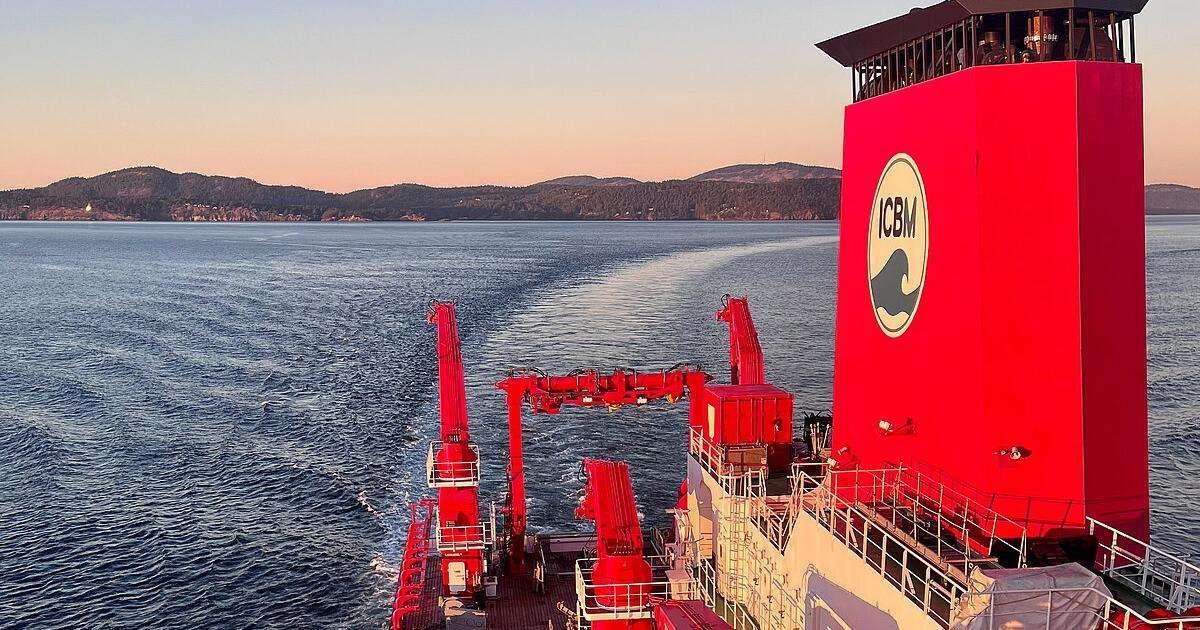
The SO321-3 expedition has only a very narrow time window for this: a total of around 72 hours is available for the geophysical work. After setting sail from Vancouver, the SONNE will first head to the work area off the Canadian Pacific coast. There, the 12 OBEM stations will be deployed on the seabed. This will be followed by the electromagnetic measurements. After the measurements, the stations will be retrieved and, where possible, redeployed directly on a second profile.
The results are to be incorporated into the planning of a permanently installed electromagnetic monitoring system. Such a system could, in future, reveal changes in the subsurface and thus help to assess how a CO2 storage site develops following an injection.