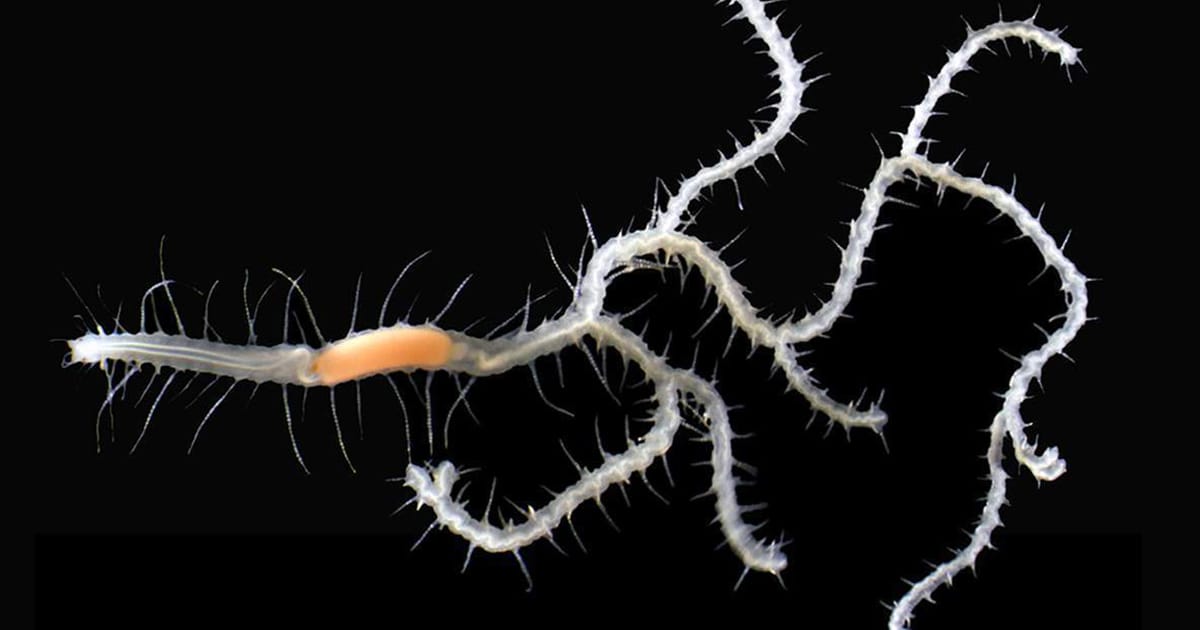
Living hidden in tropical waters, this worm grows multiple body branches within a host sponge, each tail capable of producing separate living reproductive units called “stolons”. But how does a single animal coordinate sexual reproduction across so many branches? To find out, researchers led by the University of Göttingen analyzed gene expression across different body regions and between male, female, and juvenile specimens. This provides the first complete “genetic activity map”—or transcriptome—of any branching worm, revealing how this creature manages to control reproduction across its branching body. Their findings were published in BMC Genomics.
The researchers found clear patterns in their analyses: differences in gene activity were more pronounced between different body regions in the same worm than between the sexes. The stolons—short-lived reproductive units that break off from the branches and swim away to mate—had the most distinctive genetic signatures when comparing males and females, probably reflecting their specialized role in gamete production and metamorphosis.
“We were surprised to find that the head of the worm, which was previously thought to house a sex-specific control system, didn’t show the dramatic differences we expected between males and females,” said Dr. Guillermo Ponz-Segrelles, a former researcher at the Autonomous University of Madrid. “Instead, the stolons emerged as the true hotspots of gene activity during sexual development.”
An overlooked but key feature of the reproductive stolons is that they sprout eyes before detaching from the main worm body in search of a mate. This study revealed the upregulation of genes related to eye development, providing the first clues about how the tip of a branch of the worm body metamorphoses into an independent stolon. Interestingly, the data also hint at the possibility of partial genome duplication in Ramisyllis, which may help explain the complexity of its biology and reproductive system. Despite some challenges in identifying conserved signaling pathways, the results point to a unique genetic toolkit in Ramisyllis and highlight how little we still know about reproduction in marine invertebrates.
“This worm and its surreal, tree-like body made headlines around the world in 2021 and 2022, yet it continues to amaze us,” said Thilo Schulze, a Ph.D. researcher at Göttingen University.” It challenges our understanding of how animal bodies can be organized and how such strange forms of reproduction are orchestrated at the molecular level.”
With many aspects of branching worms’ reproductive biology still a mystery, the team hopes this new genetic resource will open the door to deeper investigations into how life evolves in unexpected directions—even in the hidden corners of our oceans.