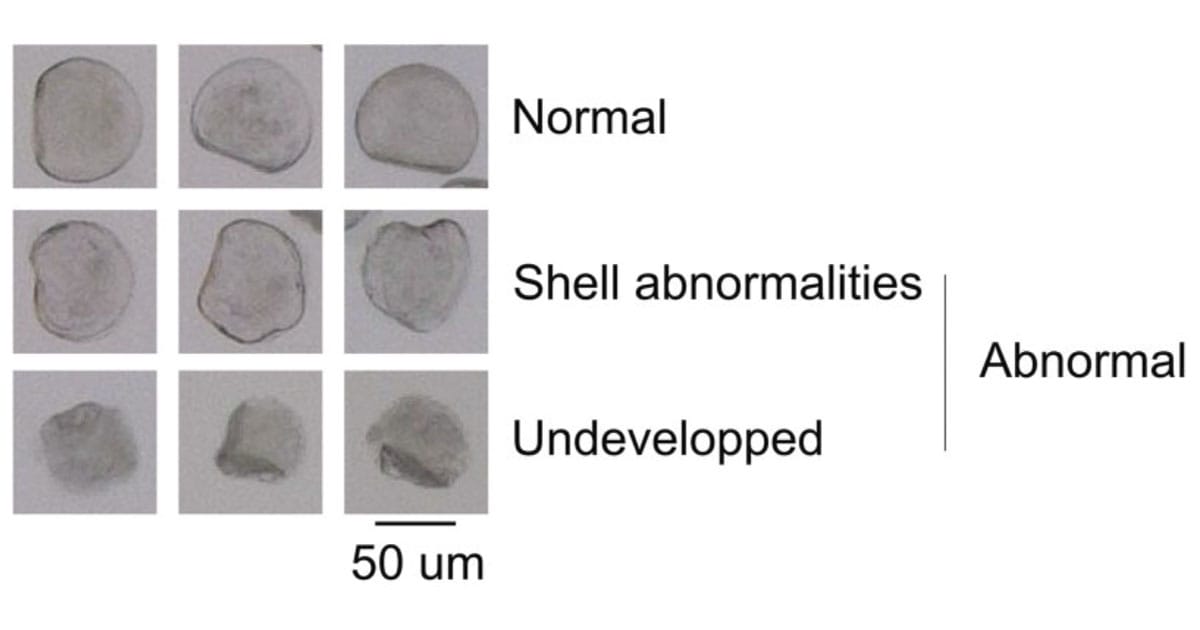
“In our research, we exposed developing oysters to these dissolved alkaline solutions. Oysters play an important ecological role: they filter water and provide habitat for other marine species. We saw that high concentrations of this alkaline enriched water using a specific mineral called olivine can hinder development of these embryos,” said Cale Miller, co-author of the study and marine ecologist at Utrecht University.
Although reducing CO2 emissions is crucial, it is also essential to remove existing CO2 from the atmosphere in order to meet the Paris Agreement targets. To achieve this goal, carbon removal methods such as OAE will need to be scaled up. This climate mitigation measure is not yet widely used, but several pilot projects are already underway in the United States and Canada. “However, we still know too little about the effects of the residual products to apply this method in a responsible manner,” said Miller.
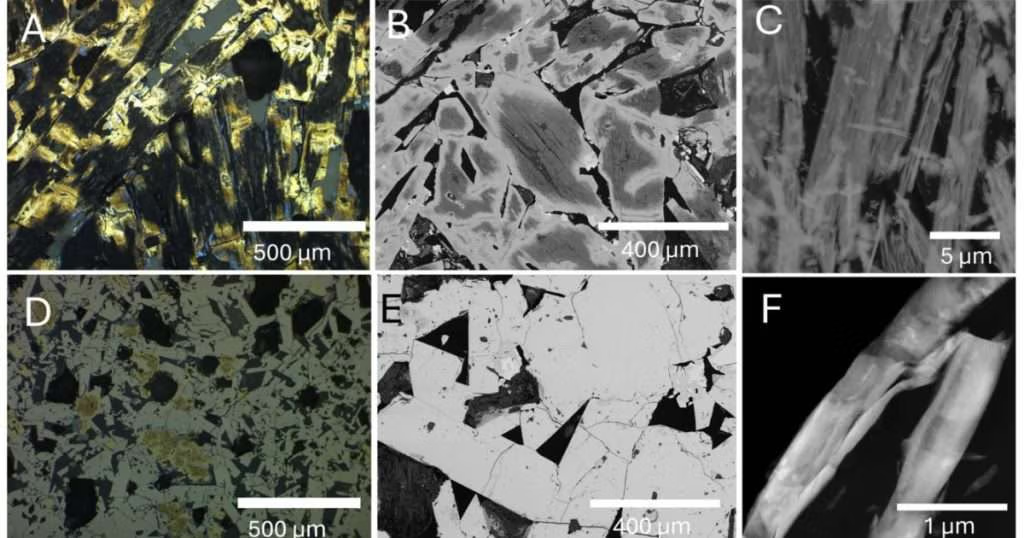
Researchers from Utrecht University and Ifremer in France carried out experiments at the Argenton Experimental Site. They exposed oysters developing in the laboratory to four minerals: olivine, limestone, ground oyster shells, and sodium carbonate. When dissolved, olivine leaves traces of metals such as nickel in the seawater. These metals can be toxic to marine ecosystems, accumulating in the tissue of organisms and potentially impairing their growth, reproduction, and survival. Fabrice Pernet, marine ecologist at Ifremer: “In our experiments, we saw those solutions of olivine and, to a much lower extent, ground oyster shell, have the potential to hinder the development of oyster embryos. We were unable to demonstrate any negative effects for limestone and sodium carbonate.” This research was funded by the Foundation Prince Albert II de Monaco, the OACIS program, and published in the ICES Journal of Marine Science.
Potential Harm to Marine Ecosystems
It is unclear whether the toxic concentrations achieved in the laboratory will also occur in the sea. “That depends on all kinds of factors, such as where the mineral is introduced, whether it ends up in the sediment, and how well it mixes with the seawater. What these results highlight is that caution is needed when introducing these substances into the environment due to potential harm to marine ecosystems,” explained Miller.
OAE: How It Works
One proposed method of OAE is a technique whereby alkaline minerals are added to seawater to increase the absorption of carbon dioxide (CO2) from the atmosphere. When the minerals dissolve, they increase the alkalinity of the water: the ability of seawater to neutralize acids. This allows the ocean to absorb more CO2 from the atmosphere. This process is similar to the natural weathering of rocks on land, but is accelerated by adding minerals directly to the ocean. Because the ocean is already a large natural carbon sink, OAE is being investigated as a possible method to help mitigate climate change.
Publication
Fabrice Pernet, Luna Ducoulombier, Hugo Koechlin, Frédéric Gazeau, Cale A Miller, Alkaline mineral dissolution can impair embryonic development in the Pacific oyster (Magallana gigas), raising caution for ocean alkalinity enhancement, ICES Journal of Marine Science, Volume 83, Issue 2, February 2026, fsag011, https://doi.org/10.1093/icesjms/fsag011