Four months of fieldwork
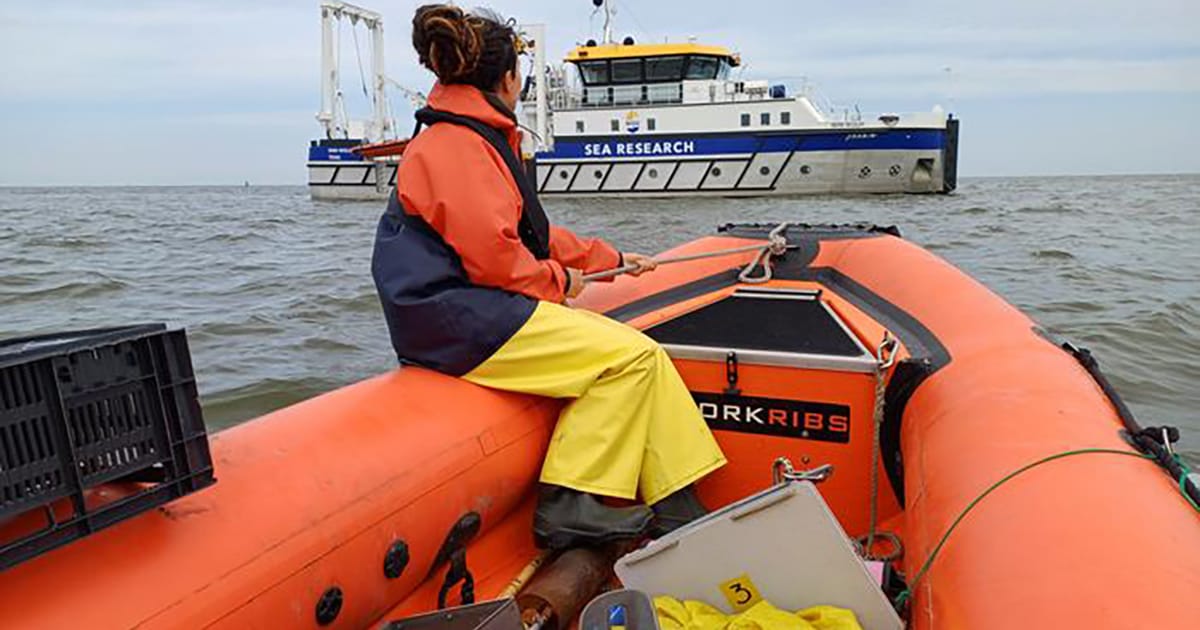
The Synoptic Intertidal Benthic Survey (SIBES) is a long-running research project coordinated by the Royal Netherlands Institute for Sea Research (NIOZ), where each year, thousands of samples from the tidal flats from the Dutch Wadden Sea are taken. In 2008, the first integral sampling of the tidal flats was carried out. Over a period of four months, a group of field workers walked (and waded) across (and over) all the tidal flats of the Dutch Wadden Sea. They did this on a network with junctions every 500 meters of tidal flats, plus at a number of randomly selected intermediate points.
Bottom Animals and Particles
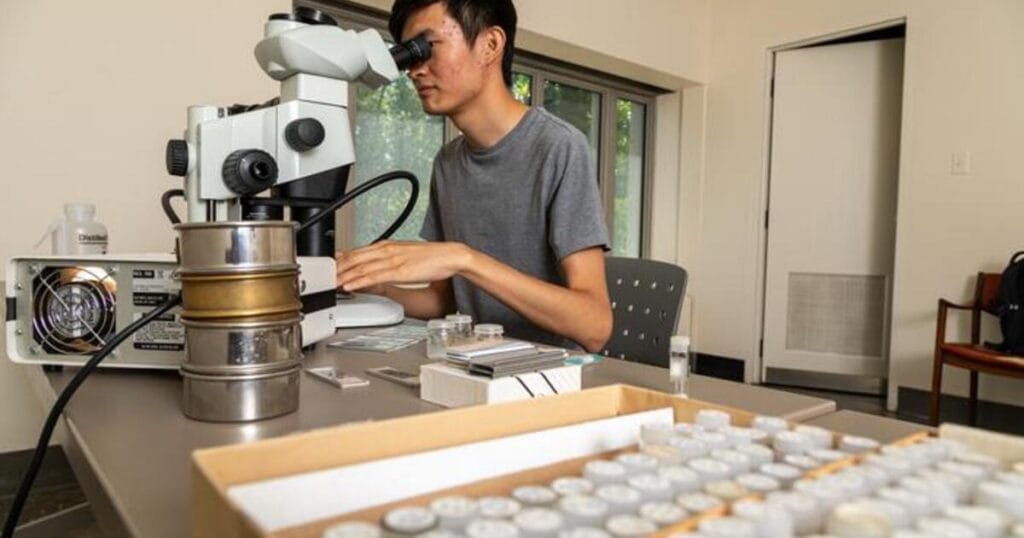
They collected standardized samples of all animal organisms larger than 1 mm, the so-called macrozoobenthos. These were identified, measured, and weighed in the laboratory. They also determined the grain size of the different sediment fractions. This sampling campaign has been repeated every year since, at more than four thousand drying points spread over 1,200 square kilometers of the Dutch mud flats. In the first fourteen years of the project, more than 50 thousand points were sampled in this way. More than 3 million individuals of 177 different animal species were collected.
Influence of Climate Change
Many conclusions can already be drawn from the collected data and more than thirty scientific articles, emphasized SIBES coordinator and NIOZ researcher Allert Bijleveld.
“Firstly, it is crystal clear that the drying Wadden Sea is not the monotonous grey mass that you might think you see when taking a quick glance over the dike. The differences in the grain size of the sediment alone show a very diverse picture, from firm and sandy to soft and silty.” The influence of the changing climate is also becoming visible in the SIBES statistics.
In their new publication, Bijleveld and colleagues show that the top four most important benthic animals are shifting. First, the cockle was the most important species in terms of meat weight, but this has been declining in recent years. “SIBES suggests that in some years the Wadden Sea becomes too warm for the cockle,” Bijleveld concluded.
Sharing the Full Data Set
Now, the researchers share the first full overview of the project, including all the available data from 2008 until 2021, in a publication in Scientific Data. They invite the scientific community to use the data for their own research, either on its own or by combining it with other data sets. Bijleveld commented: “Bottom-dwelling animals are, somewhat disrespectfully, referred to by some as bird food. And indeed, the presence of shellfish such as Baltic clams and mudsnails shows a strong correlation with the numbers and distribution of waders such as the red knot. Mud shrimp and bar-tailed godwits also seem to be linked, as do shrimps and sanderlings, or sea millipedes and dunlins.”
For Scientists and Policymakers
The SIBES researchers are inviting the scientific community to make use of this incredible collection of data and collaborate on scientific publications. “The government can also benefit from it,” emphasized Bijleveld. “Just look at the patchwork of areas with different soil compositions and animals. If you extract gas from there or perhaps lay cables through it in the future, the original composition may be disrupted, and you will also affect the natural value of the area. With SIBES, we can clarify this. If the measurements are maintained, we can also see if the mud flats are recovering from human intervention and how long that will take.”