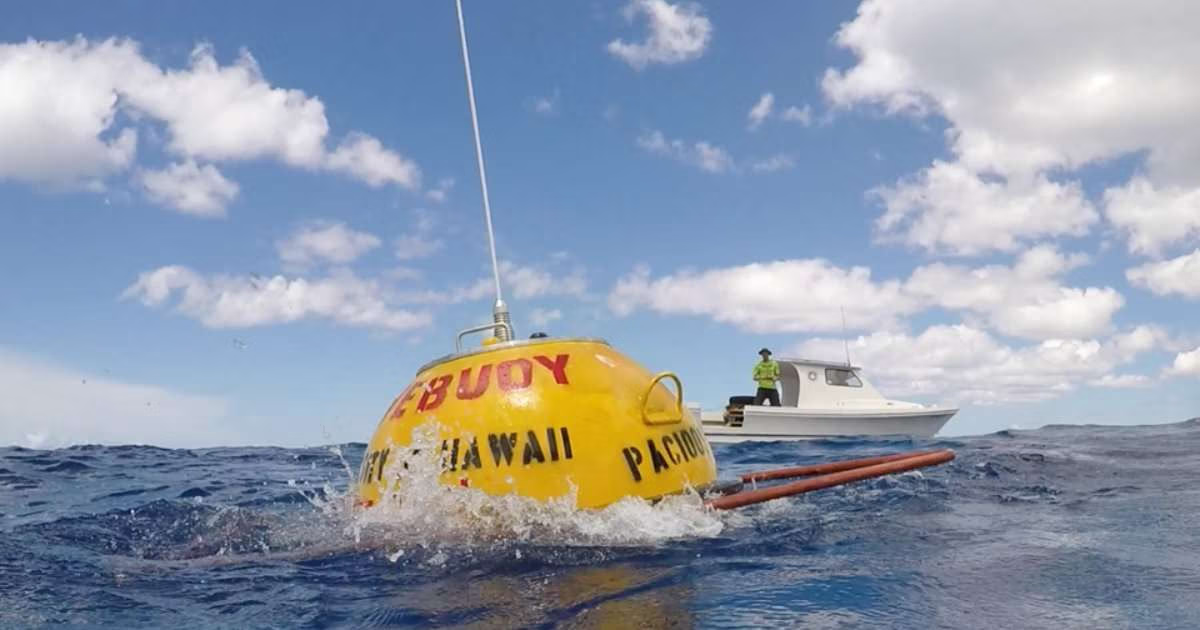
Data collected from ocean observations:
- Supports anglers, aquaculturists, shipping and logistics managers, and coastal communities in making sound economic and safety decisions;
- Supports management and mitigation of coastal hazards, such as flooding and harmful algal blooms; and
- Provides essential information for weather forecasting and national defense.
The regional associations are a fundamental part of the national observing system and help ensure that the system is both effective and efficient. They are federally certified to collect and manage high-quality observing data, forming robust partnerships with local stakeholders and coastal communities. As the regional component of the nationwide US IOOS network, regional associations meet local needs by using stakeholder feedback to guide the development of RCOSs while also integrating national priorities and requirements.
These cooperative agreements are awarded every five years through a competitive process and support the continued operation and modernization of our nation’s coastal, ocean, and Great Lakes observing capabilities. Total awards include additional funding from other NOAA offices in the National Ocean Service, National Weather Service, NOAA Fisheries, NOAA Satellites, and NOAA Research.
The 11 New Cooperative Agreements for Ocean Observing Are:
- Alaska Ocean Observing System will operate and maintain an RCOS for the state of Alaska. FY27 award: $4,569,040.
- Caribbean Coastal Ocean Observing System will operate and maintain an RCOS in the Caribbean, encompassing Puerto Rico, the US Virgin Islands, and the island of Navassa. FY27 award: $3,202,501.
- Central and Northern California Ocean Observing System will operate and maintain an RCOS for Central and Northern California, extending from Point Conception north to the California–Oregon border. FY27 award: $3,892,052.
- Great Lakes Observing System will operate and maintain an RCOS for the Great Lakes region, which includes the Great Lakes, St. Lawrence River, and interconnecting waterways. FY27 award: $3,383,210.
- Gulf of America Coastal Ocean Observing System will operate and maintain an RCOS for the Gulf of America, defined by Executive Order 14172 to include the US Continental Shelf area bounded on the northeast, north, and northwest by the States of Texas, Louisiana, Mississippi, Alabama, and Florida, and extending to the seaward boundary with Mexico and Cuba and its estuaries. FY27 award: $3,648,766.
- Mid-Atlantic Regional Association Coastal Ocean Observing System will operate and maintain an RCOS for the Mid-Atlantic, which includes the ocean and estuaries between Cape Hatteras and Cape Cod. FY27 award: $4,936,249.
- Northeastern Regional Association of Coastal Ocean Observing Systems will operate and maintain an RCOS for the US North Atlantic, which includes coastal waters from the Canadian Maritime Provinces to the New York Bight. FY27 award: $4,399,698.
- Northwest Association of Networked Ocean Observing Systems will operate and maintain an RCOS for the Pacific Northwest, centered on Washington and Oregon. FY27 award: $5,045,000.
- Pacific Islands Ocean Observing System will operate and maintain an RCOS for the Pacific Islands to include the State of Hawaii; the territories of Guam, American Samoa, and the Commonwealth of the Northern Mariana Islands; the Freely Associated States, the Republic of Palau, the Federated States of Micronesia, and the Republic of the Marshall Islands; and the US Minor Outlying Islands (Baker, Howland, Jarvis, Johnston, Kingman, Midway, Palmyra, and Wake). FY27 award: $4,033,322.
- Southeast Coastal Ocean Observing Regional Association will operate and maintain an RCOS for the US South Atlantic, which includes the ocean and estuaries from North Carolina through the west coast of Florida. FY27 award: $4,766,800.
- Southern California Coastal Ocean Observing System will operate and maintain an RCOS for Southern California, encompassing the Southern California Bight. FY27 award: $3,868,131.
This article was originally published here: https://oceanservice.noaa.gov/news/oct26/ioos-ra-awards.html